 Bug FAQ
African Black Beetle
Heteronychus arator · Order: Coleoptera · Family: Scarabaeidae
Also called: Black Lawn Beetle, Black Maize Beetle
Source: Wikipedia

The African Black Beetle is a shiny black oval beetle about 12-15 mm long; its head lacks a carina or tubercles. Adults feed on plant stems at ground level and larvae eat roots and organic matter, causing damage to lawns, turf and a wide range of crops and garden plants, especially in summer.
Source: Wikipedia
How to recognize it
The head does not have a carina or tubercles, unlike some other scarab beetles.
Source: Wikipedia
Where it lives
Larvae grow best when feeding on ryegrass compared with white clover or lotus.
Source: Wikipedia
Life cycle
The beetle can be infected by a small RNA virus that develops in gut and fat-body cells.
Source: Wikipedia
When you see it
Damage to lawns and turf is most noticeable during the summer months.
Source: Wikipedia
Where it comes from
Native to Africa; introduced to Australia, Norfolk Island and New Zealand’s North Island.
Source: Wikipedia
Lookalikes
The head lacks a carina or tubercles, a feature that helps separate it from similar scarabs.
Source: Wikipedia
Questions people ask
What plants does the African Black Beetle damage?
It can harm lawns, turf, a wide range of garden plants, trees, shrubs and many crop species.
Source: Wikipedia
When are they most likely to cause damage?
They are most active and cause the most damage during the summer.
Source: Wikipedia
How can I tell this beetle apart from other scarabs?
Its head lacks a carina or tubercles, which many other scarab beetles have.
Source: Wikipedia
Same family (Scarabaeidae)
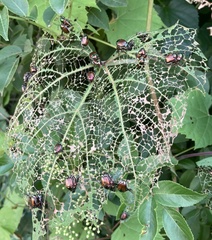 Japanese BeetlePopillia japonicaDamages trees, gardens or crops
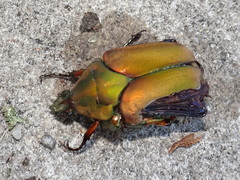 Common Green June BeetleCotinis nitidaDamages trees, gardens or crops
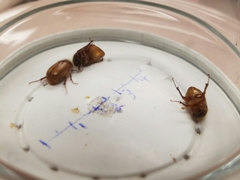 Phyllophaga crinitaPhyllophaga crinitaDamages trees, gardens or crops
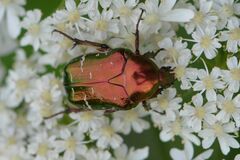 European Rose ChaferCetonia aurata
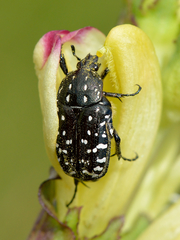 Mediterranean Spotted ChaferOxythyrea funestaDamages trees, gardens or crops
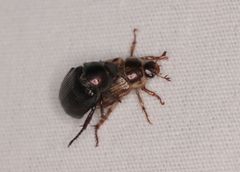 Oriental BeetleExomala orientalisDamages trees, gardens or crops
Sources
- Wikipedia: https://en.wikipedia.org/wiki/Heteronychus_arator
Look it up elsewhere: GBIF · iNaturalist · BugGuide · Wikipedia
Text written 2026-10-23 from the sources above and checked sentence by sentence against them. Data fetched 2026-10-22.