 Bug FAQ
Acorn weevil
Curculio glandium · Order: Coleoptera · Family: Curculionidae
Source: Wikipedia


Adults are 4 to 8 mm long and have a long snout (rostrum) and ovipositor; females have the longer rostrum. Females lay eggs in fallen acorns; larvae live in the soil for 1 to 2 years, survive winter without freezing, then emerge as adults. The weevil pierces acorns with its rostrum to feed, and one or two larvae can consume the whole fruit.
Source: Wikipedia
How to recognize it
All members have a long rostrum and ovipositor; females’ rostrum is longer than males’.
Source: Wikipedia
Size
Adults measure between 4 and 8 mm in length.
Source: Wikipedia
Is it a pest in the house?
They pose a large risk to populations of acorn-bearing trees. Heavy infection can make many acorns unable to germinate.
Source: Wikipedia
What it eats
It uses its elongated snout to pierce and eat the interior of acorns. One or two larvae can consume an entire acorn.
Source: Wikipedia
Life cycle
After acorns fall, larvae emerge, burrow into soil, remain there for 1 to 2 years, then pupate and emerge as adults. Larvae avoid freezing in winter by preventing their body fluids from freezing.
Source: Wikipedia
Where it comes from
It is a European species of carpophagus weevil.
Source: Wikipedia
Lookalikes
It belongs to the genus Curculio, which includes other acorn and nut weevils.
Source: Wikipedia
More photos


Questions people ask
How can I tell a male from a female acorn weevil?
Females have a longer rostrum than males.
Source: Wikipedia
What part of the tree does the acorn weevil damage?
It infects acorns, often preventing the seeds from germinating.
Source: Wikipedia
How long do the larvae stay in the soil?
They remain underground for one to two years before becoming adults.
Source: Wikipedia
Same family (Curculionidae)
 Green Immigrant Leaf WeevilPolydrusus formosusDamages trees, gardens or crops
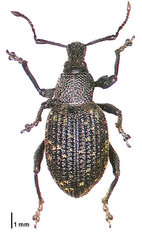 Black Vine WeevilOtiorhynchus sulcatusDamages trees, gardens or crops
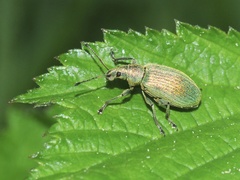 Nettle weevilPhyllobius pomaceusDamages trees, gardens or crops
 Asian Oak WeevilCyrtepistomus castaneusDamages trees, gardens or crops
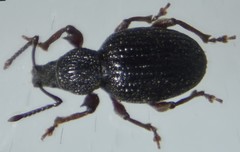 Strawberry Root WeevilOtiorhynchus ovatusDamages trees, gardens or crops
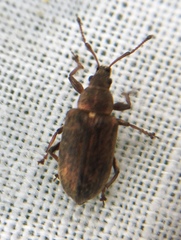 Common Leaf WeevilPhyllobius pyriDamages trees, gardens or crops
Sources
- Wikipedia: https://en.wikipedia.org/wiki/Curculio_glandium
Look it up elsewhere: GBIF · iNaturalist · BugGuide · Wikipedia
Text written 2026-10-23 from the sources above and checked sentence by sentence against them. Data fetched 2026-10-22.