 Bug FAQ
House centipede vs silverfish: how to tell them apart
Side by side. Every line is quoted from each bug's page and its sources.
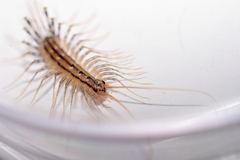 House CentipedeScutigera coleoptrataCan bite
 Common SilverfishLepisma saccharinumCan damage your home
Is it dangerous?
House Centipede
House centipedes may bite when handled, but the bite is usually mild and causes only localized pain and swelling.
Source: Wikipedia, arthropod.uark.edu
Common Silverfish
Silverfish can damage household items such as wallpaper and tapestries.
Source: Wikipedia
How to recognize it
House Centipede
The body is yellowish-gray with three dark stripes along the back, and the legs also have dark stripes. Its hind legs look like antennae, a form of automimicry.
Source: Wikipedia, arthropod.uark.edu
Common Silverfish
The abdomen narrows to a point, giving the bug a shape that resembles a tiny fish. Young ones start out white and turn a greyish, metallic shade as they mature.
Source: Wikipedia
Size
House Centipede
An adult is typically 25 to 35 mm (about 1 to 1.4 in) long, though larger ones occur.
Source: Wikipedia, arthropod.uark.edu
Common Silverfish
Adults are typically 7 to 10 mm (about 0.3 to 0.4 in) long and are active at night.
Source: Wikipedia
Does it bite or sting?
House Centipede
Bites are rare and happen mainly when the centipede is cornered or handled aggressively. Their small forcipules often cannot pierce human skin, and when they do the sting feels like a mild bee sting with localized pain and swelling. They may bite in self-defense, but the bite is not severe. Severe swelling and pain are possible, though most bites are no worse than a bee sting.
Source: Wikipedia, arthropod.uark.edu
Common Silverfish
Silverfish do not spread disease to people.
Source: Wikipedia
Is it a pest in the house?
Where it lives
House Centipede
Outdoors they prefer cool, damp sites such as under rocks, woodpiles, bark, leaf litter or compost.
Source: Wikipedia
Common Silverfish
They need high humidity, usually between 75 % and 95 %, and are found in damp places such as basements, attics, bathrooms, kitchens and even libraries.
Source: Wikipedia
Full pages: House Centipede · Common Silverfish · More comparisons · Questions