 Bug FAQ
House Centipede
Scutigera coleoptrata · Order: Scutigeromorpha · Family: Scutigeridae
Source: Wikipedia, arthropod.uark.edu
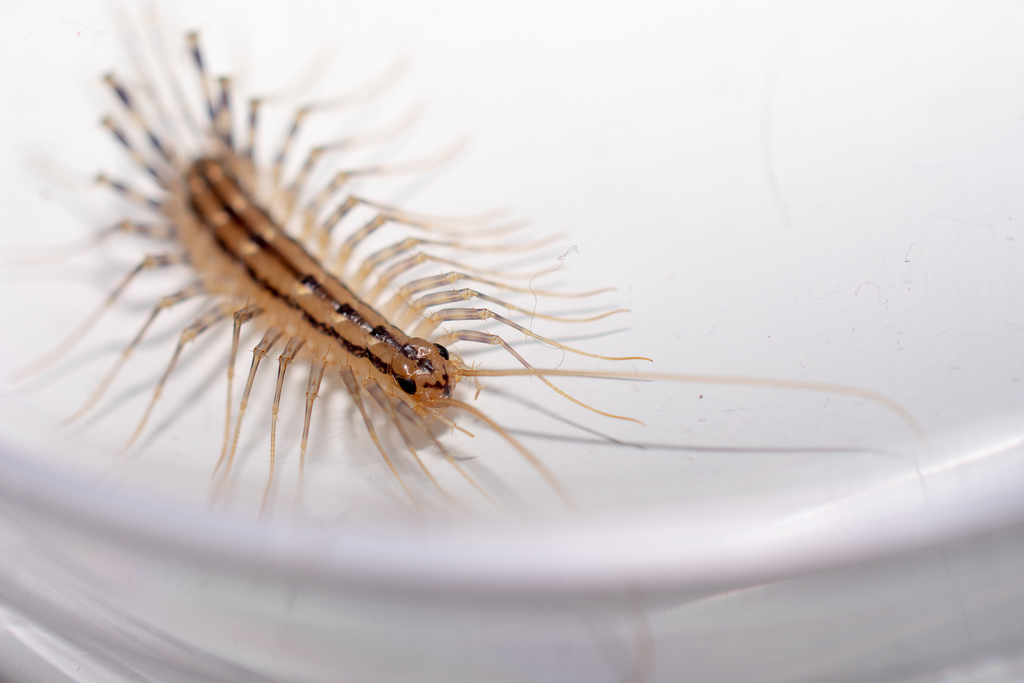
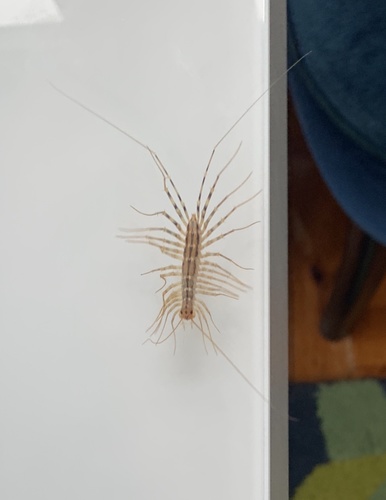
Adults are 25-35 mm long, yellowish-gray with three dark dorsal stripes and hind legs that look like antennae. They live in cool, damp places outdoors under rocks, woodpiles, leaf litter and indoors in bathrooms, closets, cellars and fire-wood piles, feeding on spiders, cockroaches and other household arthropods.
Source: Wikipedia, arthropod.uark.edu
How to recognize it
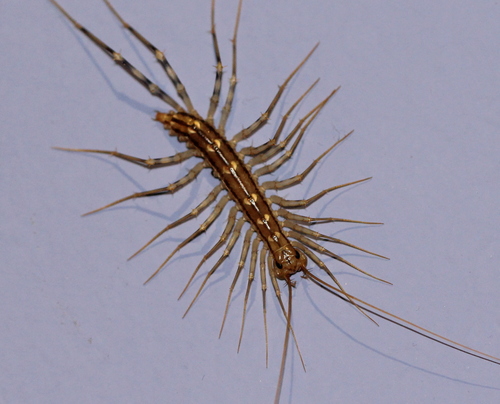
The body is yellowish-gray with three dark stripes along the back, and the legs also have dark stripes. Its hind legs look like antennae, a form of automimicry.
Source: Wikipedia, arthropod.uark.edu
Size
An adult is typically 25 to 35 mm (about 1 to 1.4 in) long, though larger ones occur.
Source: Wikipedia, arthropod.uark.edu
Is it a pest in the house?
They are not aggressive and usually flee when disturbed.
Source: Wikipedia
Does it bite or sting?
Bites are rare and happen mainly when the centipede is cornered or handled aggressively. Their small forcipules often cannot pierce human skin, and when they do the sting feels like a mild bee sting with localized pain and swelling. They may bite in self-defense, but the bite is not severe. Severe swelling and pain are possible, though most bites are no worse than a bee sting.
Source: Wikipedia, arthropod.uark.edu
How to get rid of it
Drying and cleaning damp areas helps control infestations.
Source: arthropod.uark.edu
Where it lives
Outdoors they prefer cool, damp sites such as under rocks, woodpiles, bark, leaf litter or compost.
Source: Wikipedia
Life cycle
Eggs are laid in spring; hatchlings have four leg pairs and add more with each molt, ending with ten pairs.
Source: Wikipedia
When you see it
Egg laying occurs in spring.
Source: Wikipedia
Where it comes from
It originated in the Mediterranean region and has spread worldwide.
Source: Wikipedia
Where it is found in the US
Recorded in 48 of 51 states and DC. Most records: California, Pennsylvania, New York, Ohio, Massachusetts, Virginia, North Carolina, Illinois.
Darker = more records. Counts are museum and citizen-science records, not population size.
Source: GBIF
Status: introduced in North America; introduced in Canada; introduced in United States. Source: iNaturalist
Months it is reported in the US
Source: GBIF
More photos
Questions people ask
Do house centipedes bite people?
They may bite if cornered or handled, but the bite is usually mild with only localized pain and swelling.
Source: Wikipedia, arthropod.uark.edu
How can I get rid of house centipedes indoors?
Reduce moisture by drying and cleaning bathrooms, closets, cellars and fire-wood piles.
Source: arthropod.uark.edu
Where are house centipedes originally from?
They originated in the Mediterranean region and have spread to other parts of the world.
Source: Wikipedia
Same family (Scutigeridae)

Sources
- Wikipedia: https://en.wikipedia.org/wiki/Scutigera_coleoptrata
- arthropod.uark.edu: https://arthropod.uark.edu/?p=27355
Look it up elsewhere: GBIF · iNaturalist · BugGuide · ITIS · Wikipedia
Text written 2026-10-23 from the sources above and checked sentence by sentence against them. Data fetched 2026-10-23.