 Bug FAQ
Zygoballus sexpunctatus
Zygoballus sexpunctatus · Order: Araneae · Family: Salticidae
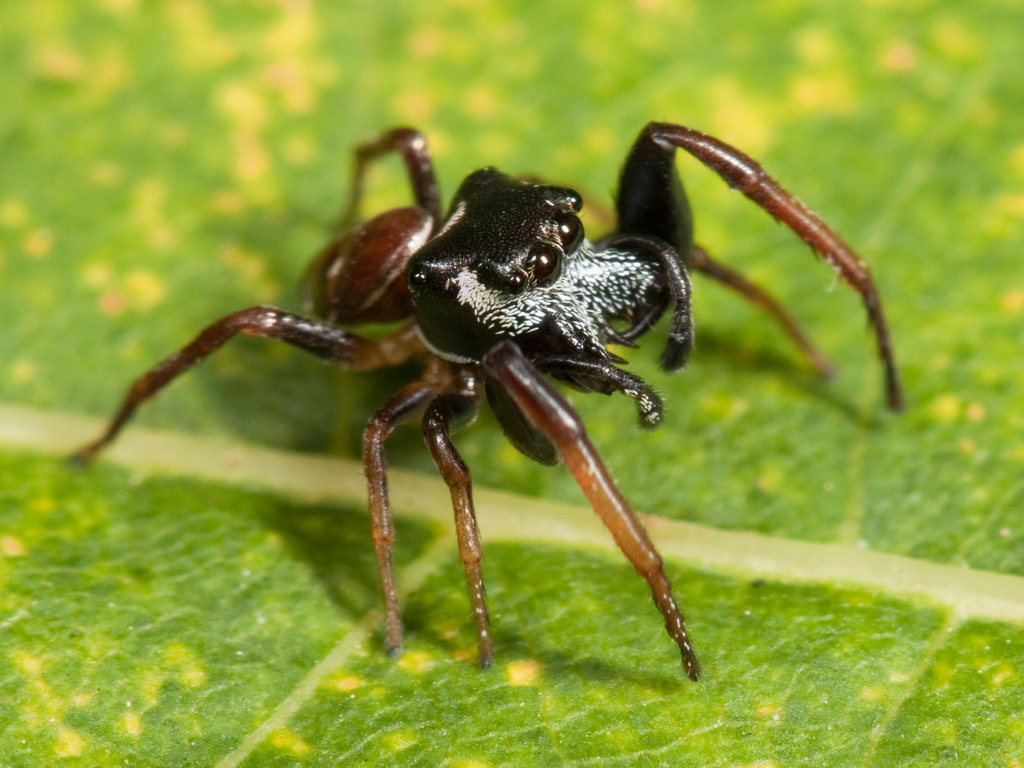
Adult Zygoballus sexpunctatus are tiny jumping spiders, only 3 to 4.5 mm long, with bronze-to-black bodies and distinctive white bands on the abdomen. These spiders hunt small invertebrates like aphids and young caterpillars, and they become sexually mature in late April after overwintering as immature individuals.
Source: Wikipedia
Size
Females are 3.5 to 4.5 mm long while males are 3 to 3.5 mm.
Source: Wikipedia
What it eats
It is an opportunistic feeder that eats a wide range of invertebrate prey.
Source: Wikipedia
Life cycle
Spiders hibernate through winter as immature individuals and reach sexual maturity around late April.
Source: Wikipedia
When you see it
They become sexually mature in late April after overwintering as immatures. Males display ritualized courtship and agonistic behavior.
Source: Wikipedia
Where it comes from
The original specimen was collected in North Carolina.
Source: Wikipedia
Lookalikes
It resembles Zygoballus rufipes, whose range overlaps with it. Males can be told apart by a large spot of white scales at the start of the thoracic slope, which Z. rufipes lacks.
Source: Wikipedia
Where it is found in the US
Recorded in 22 of 51 states and DC. Most records: Texas, Georgia, Florida, Oklahoma, North Carolina, Pennsylvania, New Jersey, South Carolina.
Darker = more records. Counts are museum and citizen-science records, not population size.
Source: GBIF
Months it is reported in the US
Source: GBIF
More photos

Questions people ask
When are these spiders active?
They become sexually mature in late April after overwintering as immatures.
Source: Wikipedia
What do they eat?
They hunt small invertebrates, especially aphids and young caterpillars.
Source: Wikipedia
Same family (Salticidae)



Sources
- Wikipedia: https://en.wikipedia.org/wiki/Zygoballus_sexpunctatus
Look it up elsewhere: GBIF · iNaturalist · BugGuide · ITIS · Wikipedia
Text written 2026-10-26 from the sources above and checked sentence by sentence against them. Data fetched 2026-10-26.