 Bug FAQ
Yellow-headed Aspen Leaftier
Epinotia nisella · Order: Lepidoptera · Family: Tortricidae
Also called: Brindled Poplar Tortrix, Grey Poplar Bell
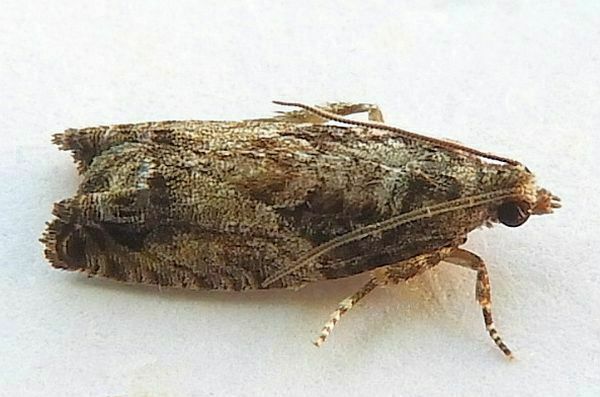
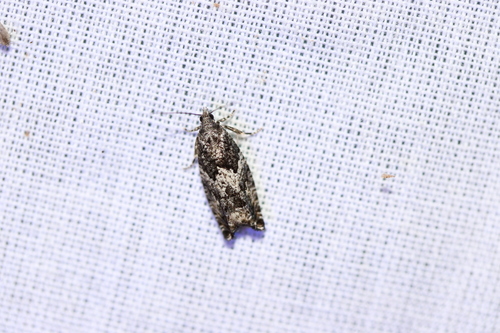
The yellow-headed aspen leaftier has a wingspan of about 12 to 17 mm and grey forewings with white mixing and blackish-grey streaks. It lives across most of Europe, the Near East, the eastern Palearctic, and parts of North America including the United States and Canada. Adults fly in July and August, while larvae feed on poplar and willow catkins or between leaf sandwiches from April to June.
Source: Wikipedia
How to recognize it
Forewings are grey with white mixing, a slight ferruginous tint and irregular blackish-grey streaks. Hindwings are light brownish-grey, becoming darker toward the edge.
Source: Wikipedia
Size
The wingspan ranges from about 12 to 17 mm.
Source: Wikipedia
Where it lives
Adults are seen in July and August resting on foliage or among lichen on tree trunks of their food plants.
Source: Wikipedia
What it eats
Eggs are laid on poplars and willows, especially rough-leaved species.
Source: Wikipedia
Life cycle
Adults are on the wing in July and August. Pupae are light brown and are found in the larval habitat or in a flimsy brownish silken cocoon among leaf litter in June and July.
Source: Wikipedia
When you see it
Adults are active in July and August.
Source: Wikipedia
Where it is found in the US
Recorded in 16 of 51 states and DC. Most records: Alaska, New York, Minnesota, Michigan, Vermont, Montana, Pennsylvania, Nevada.
Darker = more records. Counts are museum and citizen-science records, not population size.
Source: GBIF
Status: native in North America; native in Canada. Source: iNaturalist
Months it is reported in the US
Source: GBIF
More photos
Questions people ask
What plants do the larvae feed on?
Larvae feed on poplar and willow catkins or between two leaves from April to June.
Source: Wikipedia
Where can I find this moth?
It is found across most of Europe and in parts of North America, including many US states and Canadian provinces.
Source: Wikipedia
Same family (Tortricidae)
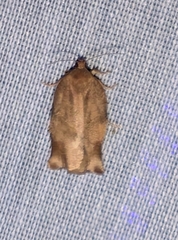 Oblique-banded Leafroller MothChoristoneura rosaceanaDamages trees, gardens or crops
 Garden TortrixClepsis peritanaDamages trees, gardens or crops
 Common MarbleSyricoris lacunanaDamages trees, gardens or crops
 Red-banded Leafroller MothArgyrotaenia velutinanaDamages trees, gardens or crops
 Light Brown Apple MothEpiphyas postvittanaDamages trees, gardens or crops
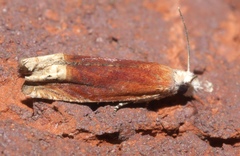 Aster and Reddish Eucosma Moths and AlliesEucosma parmatana
Sources
- Wikipedia: https://en.wikipedia.org/wiki/Epinotia_nisella
Look it up elsewhere: GBIF · iNaturalist · BugGuide · Wikipedia
Text written 2026-10-27 from the sources above and checked sentence by sentence against them. Data fetched 2026-10-27.