 Bug FAQ
Winter tick
Dermacentor albipictus · Order: Ixodida · Family: Ixodidae
Also called: Elk tick, Moose Tick, White fern winter tick
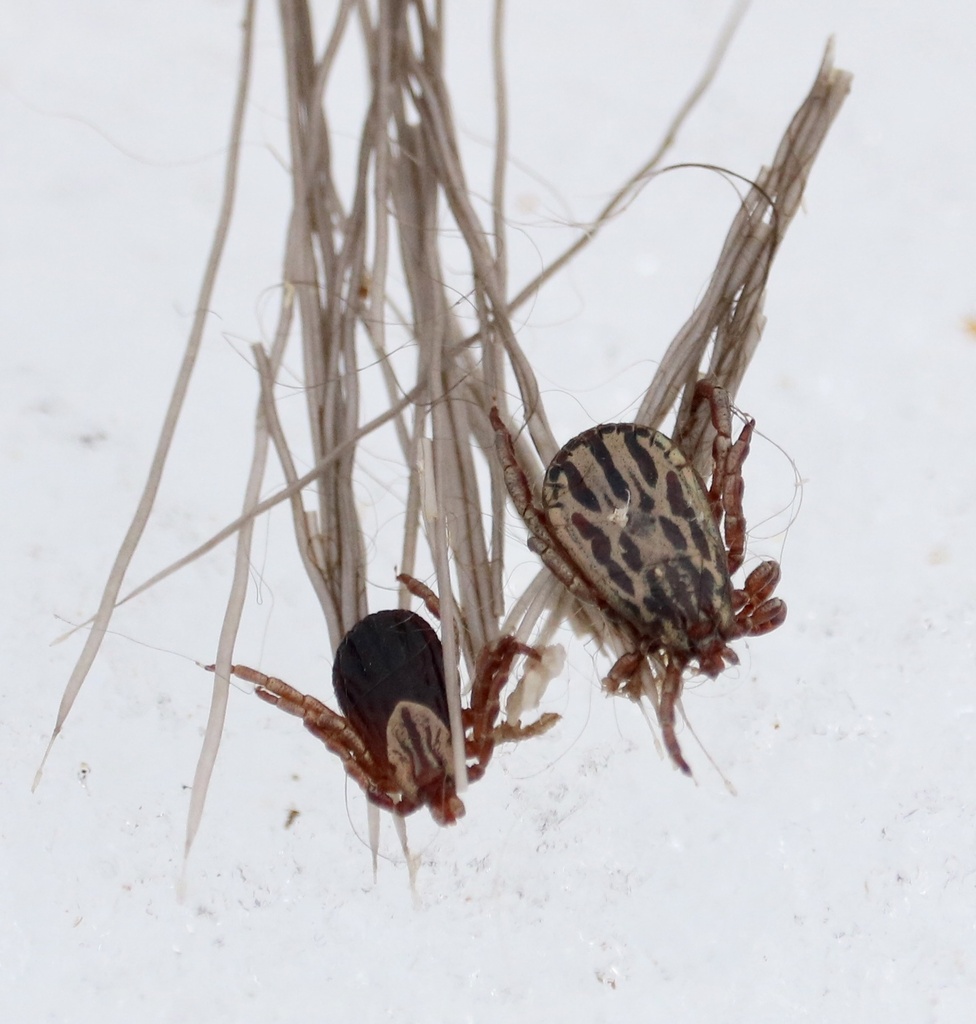
Adult female winter ticks can grow up to 15 mm and are reddish-brown with a white dorsal shield, while males are smaller and dark brown with white markings. They are found throughout North America, live on low vegetation, and parasitize many mammals, especially moose, where they can form large clusters. The tick has a one-year, single-host life cycle: larvae attach, become nymphs in about 10 days, develop into adults, mate in late winter, and the engorged females drop off to lay eggs and die.
Source: Wikipedia
How to recognize it
Females are reddish-brown with a white shield behind the head, and males are smaller, dark brown with some white markings. The species shows sexual dimorphism, with females larger than males.
Source: Wikipedia
Size
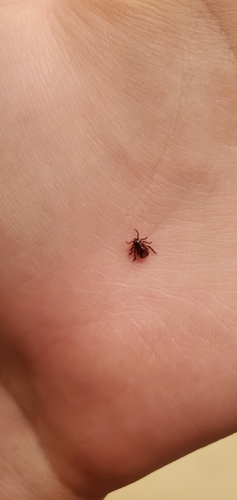
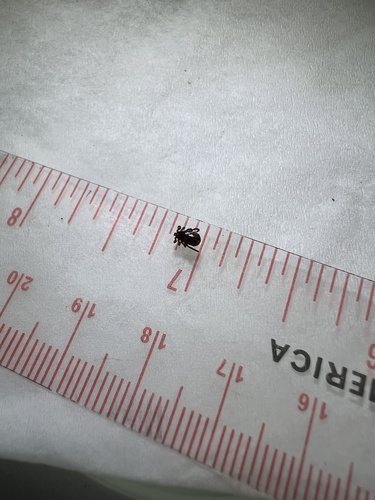
Females can reach up to 15 mm (0.6 in) in late winter, making them unusually large for ticks.
Source: Wikipedia
Where it lives
Winter ticks are distributed across North America. They prefer vegetation up to about 1.25 m tall, where they can easily find a host.
Source: Wikipedia
What it eats
The tick feeds on the blood of many mammals, affecting moose most aggressively because the animals have difficulty removing them. In the larval stage they will attach to any passing mammal, showing no specific host preference. Their development proceeds from larvae to nymphs and then to adults.
Source: Wikipedia
Life cycle
The species has a single-host, roughly one-year life cycle. Larvae become nymphs about ten days after attaching to a host such as a moose.
Source: Wikipedia
When you see it
Mating occurs in late winter, after which blood-filled females drop off their hosts to lay eggs and then die. Observed detachment of ticks from captive moose in Ontario happened from late March to early April.
Source: Wikipedia
Where it comes from
Dermacentor albipictus is a hard tick native to North America that parasitizes many mammal species.
Source: Wikipedia
Where it is found in the US
Recorded in 30 of 51 states and DC. Most records: Illinois, Iowa, Texas, Utah, California, Wisconsin, Maine, New Mexico.
Darker = more records. Counts are museum and citizen-science records, not population size.
Source: GBIF
Status: native in North America; native in United States; native in Canada. Source: iNaturalist
Months it is reported in the US
Source: GBIF
More photos
Questions people ask
Do winter ticks bite people?
No, they are not known to bite people and they do not transmit diseases.
Source: Wikipedia
When do winter ticks leave their hosts?
After mating in late winter, engorged females drop off to lay eggs and die, typically from late March to early April.
Source: Wikipedia
Which animal suffers the most from winter ticks?
Moose are most heavily affected because they have difficulty removing the ticks, allowing large clusters to form.
Source: Wikipedia
Do winter ticks prefer any particular host?
In the larval stage they will attach to any passing mammal and have no specific host preference.
Source: Wikipedia
Same family (Ixodidae)
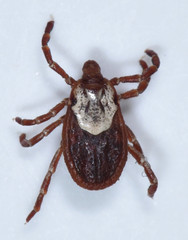 American Dog TickDermacentor variabilisCan spread germs or disease
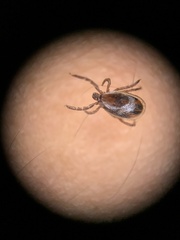 Eastern Black-legged TickIxodes scapularisCan spread germs or disease
 Lone Star TickAmblyomma americanumCan spread germs or disease
 Gulf Coast TickAmblyomma maculatumCan spread germs or disease
 Western Black-legged TickIxodes pacificusCan spread germs or disease
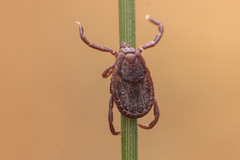 Brown Dog TickRhipicephalus sanguineusCan spread germs or disease
Sources
- Wikipedia: https://en.wikipedia.org/wiki/Dermacentor_albipictus
Look it up elsewhere: GBIF · iNaturalist · BugGuide · ITIS · Wikipedia
Text written 2026-10-25 from the sources above and checked sentence by sentence against them. Data fetched 2026-10-25.