 Bug FAQ
Willow Leaf Beetle
Plagiodera versicolora · Order: Coleoptera · Family: Chrysomelidae
Also called: Imported Willow Leaf Beetle
Source: Wikipedia

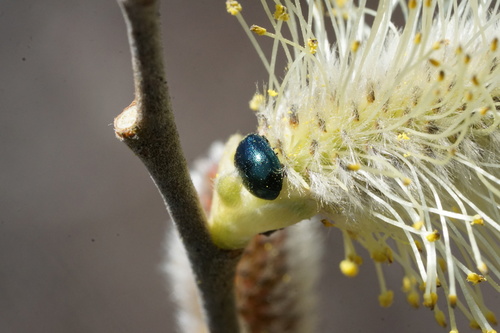
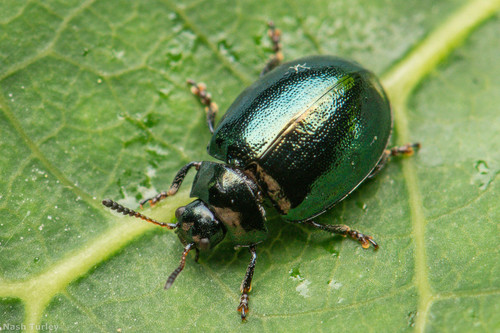
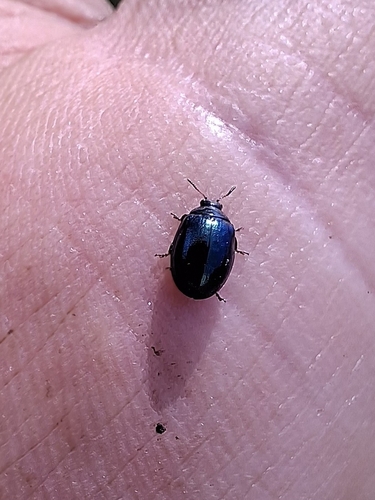
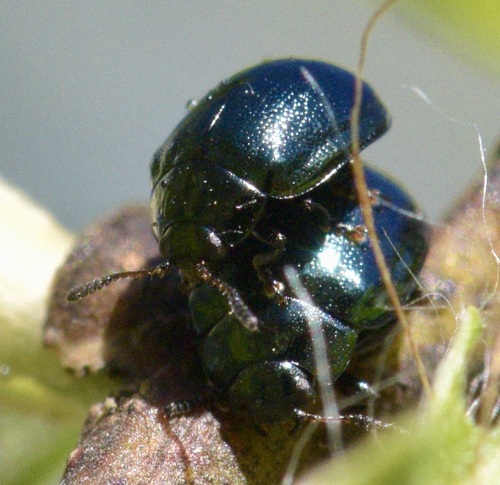
The willow leaf beetle is a tiny beetle about 2.5 to 4.8 mm long and shines metallic blue, green, sometimes purplish or black. It lives near water, especially where willow and poplar grow, and adults appear from mid-July, flying on warm days.
Source: Wikipedia
How to recognize it
The beetle has a metallic blue or green colour, occasionally appearing purplish to black.
Source: Wikipedia
Size
Adults measure between 2.5 and 4.8 mm in length.
Source: Wikipedia
Where it lives
It is usually found in habitats close to water.
Source: Wikipedia
What it eats
Adults eat the leaves and pollen of willow and poplar, especially crack willow (Salix fragilis).
Source: Wikipedia
Life cycle
Adults overwinter under logs, loose bark, or vegetable litter near their host plants and become active in April. Larvae are fully developed from June onward, and pupation takes place under the host-plant leaves.
Source: Wikipedia
Where it is found in the US
Recorded in 29 of 51 states and DC. Most records: Massachusetts, Vermont, New York, Pennsylvania, Michigan, Connecticut, New Jersey, North Carolina.
Darker = more records. Counts are museum and citizen-science records, not population size.
Source: GBIF
Status: introduced in North America; introduced in United States; introduced in Canada. Source: iNaturalist
Months it is reported in the US
Source: GBIF
More photos
Questions people ask
Can they damage my garden trees?
Yes, they feed on the leaves of willow and poplar and can cause damage to those trees.
Source: Wikipedia
Same family (Chrysomelidae)
 Spotted Cucumber BeetleDiabrotica undecimpunctataDamages trees, gardens or crops
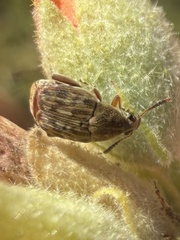 Bean WeevilAcanthoscelides obtectusDamages trees, gardens or crops
 Cowpea WeevilCallosobruchus maculatusDamages trees, gardens or crops
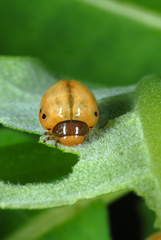 Swamp Milkweed Leaf BeetleLabidomera clivicollisDamages trees, gardens or crops
 Alder Leaf BeetleAgelastica alniDamages trees, gardens or crops
 Dogbane Leaf BeetleChrysochus auratus
Sources
- Wikipedia: https://en.wikipedia.org/wiki/Plagiodera_versicolora
Look it up elsewhere: GBIF · iNaturalist · BugGuide · ITIS · Wikipedia
Text written 2026-10-22 from the sources above and checked sentence by sentence against them. Data fetched 2026-10-22.