 Bug FAQ
Dogbane Leaf Beetle
Chrysochus auratus · Order: Coleoptera · Family: Chrysomelidae
Also called: Dogbane Beetle

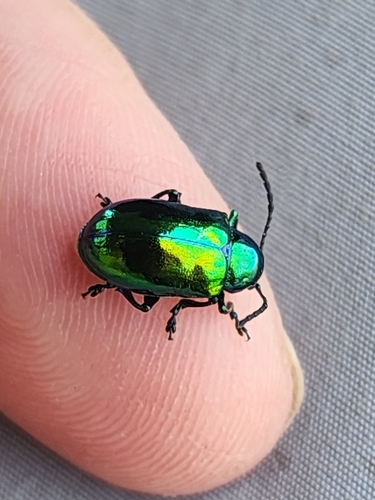
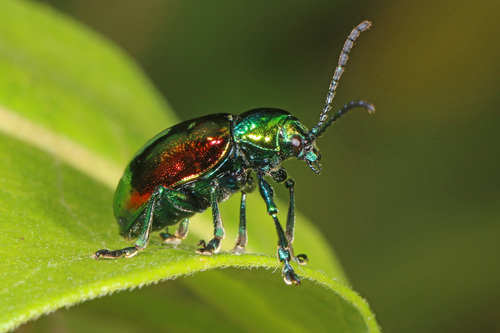
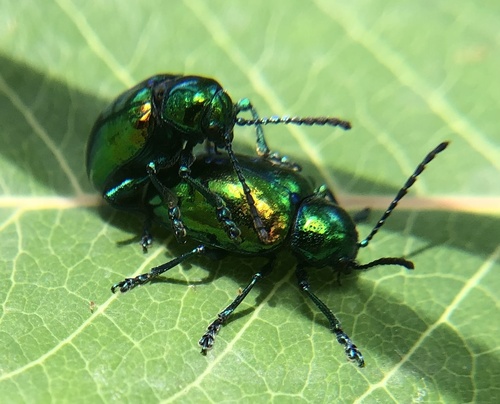
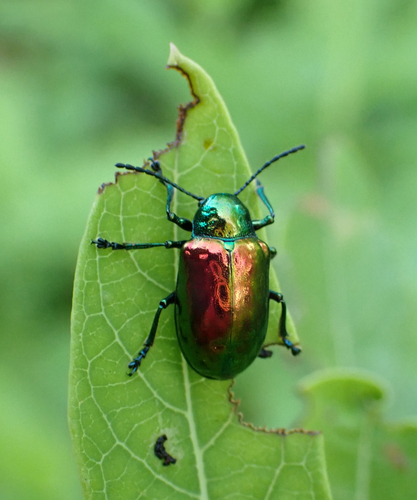
The Dogbane Leaf Beetle is a small, blue-green beetle about 8 to 11 mm long with copper-colored wing covers. It lives in eastern North America, from the eastern United States into southern Canada, and can extend west of the Rockies into Arizona and Utah. Adults feed on dogbane plants and can process the plant’s toxins; they produce one generation per year, with larvae dropping to the soil after hatching in midsummer.
Source: Wikipedia
How to recognize it
It has two pairs of wings, the hardened forewings are copper-colored elytra. Its body shows a blue-green hue.
Source: Wikipedia
Size
The beetle measures roughly 8 to 11 mm in length.
Source: Wikipedia
How to get rid of it
Because it feeds on dogbane, the beetle is considered for biological control of that plant. Integrated management programs aim to conserve and boost its populations for agricultural use.
Source: Wikipedia
What it eats
Adults eat dogbane species such as Apocynum cannabinum and Apocynum androsaemifolium. They can neutralize the toxins in dogbane leaves.
Source: Wikipedia
Life cycle
The species produces one generation each year.
Source: Wikipedia
When you see it
Adults emerge when their bodies harden, usually in early summer, and remain on the host plant for six to eight weeks.
Source: Wikipedia
Where it comes from
Its range includes eastern North America and extends west of the Rockies into Arizona and Utah.
Source: Wikipedia
Lookalikes
It can interbreed with the western species Chrysochus cobaltinus, producing hybrid offspring. Chrysochus cobaltinus itself is found only in western North America.
Source: Wikipedia
Where it is found in the US
Recorded in 47 of 51 states and DC. Most records: Ohio, Virginia, Pennsylvania, Maryland, New York, Illinois, North Carolina, New Jersey.
Darker = more records. Counts are museum and citizen-science records, not population size.
Source: GBIF
Status: native in North America; native in Canada; native in United States. Source: iNaturalist
Months it is reported in the US
Source: GBIF
More photos
Questions people ask
Are they a problem for gardens or crops?
They feed on dogbane plants, not on common garden crops, and are even studied for controlling dogbane spread.
Source: Wikipedia
Where might I find this beetle?
Look for it in eastern North America, from the eastern U.S. into southern Canada, and occasionally farther west into Arizona and Utah.
Source: Wikipedia
Same family (Chrysomelidae)
 Spotted Cucumber BeetleDiabrotica undecimpunctataDamages trees, gardens or crops
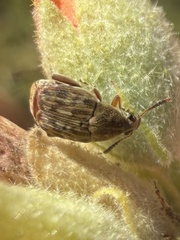 Bean WeevilAcanthoscelides obtectusDamages trees, gardens or crops
 Cowpea WeevilCallosobruchus maculatusDamages trees, gardens or crops
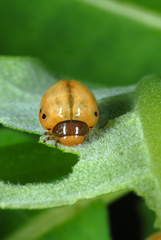 Swamp Milkweed Leaf BeetleLabidomera clivicollisDamages trees, gardens or crops
 Alder Leaf BeetleAgelastica alniDamages trees, gardens or crops
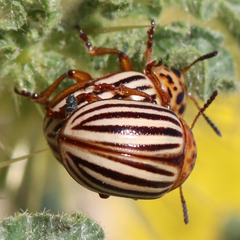 Colorado Potato BeetleLeptinotarsa decemlineata
Sources
- Wikipedia: https://en.wikipedia.org/wiki/Chrysochus_auratus
Look it up elsewhere: GBIF · iNaturalist · BugGuide · ITIS · Wikipedia
Text written 2026-10-22 from the sources above and checked sentence by sentence against them. Data fetched 2026-10-22.