 Bug FAQ
Cowpea Weevil
Callosobruchus maculatus · Order: Coleoptera · Family: Chrysomelidae
Also called: Southern cowpea weevil, four-spotted bean weevil
Source: Wikipedia

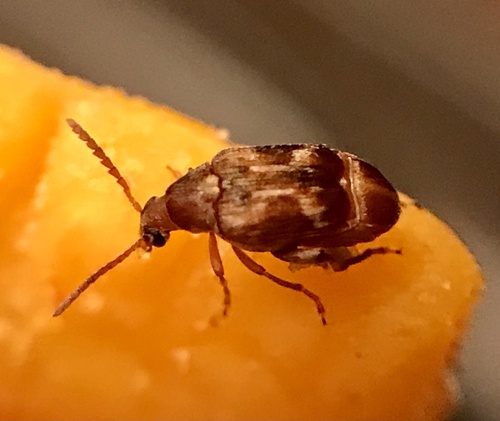
The cowpea weevil is a small, reddish-brown beetle with two black spots on its wing covers. Its larvae eat the interior of beans, destroying the seed tissue, and adults can lay over a hundred eggs.
Source: Wikipedia
How to recognize it
It is elongated, reddish-brown overall, with gray-black wing covers marked by two central black spots.
Source: Wikipedia
Is it a pest in the house?
It is a common pest of stored legumes found on every continent except Antarctica.
Source: Wikipedia
Does it bite or sting?
It is medically harmless to humans.
Source: Wikipedia
How to get rid of it
Hermetic storage bags, such as Purdue Improved Cowpea Storage bags, effectively control it. Freezing stored food at to 18 °C for 6 to 24 hours kills all life stages.
Source: Wikipedia
Where it lives
It is found worldwide wherever stored legumes are kept, except Antarctica.
Source: Wikipedia
What it eats
Larvae feed inside beans, eating the tissue just under the surface and leaving a thin layer for exit. Adults do not need food or water, but will drink sugared water if offered.
Source: Wikipedia
Life cycle
A female can lay more than a hundred eggs, most of which hatch. Development from egg to adult takes 3 to 7 weeks, depending on conditions.
Source: Wikipedia
Where it comes from
The species likely originated in West Africa and spread globally with legume trade.
Source: Wikipedia
Lookalikes
It is often confused with Callosobruchus chinensis, another bean beetle.
Source: Wikipedia
Where it is found in the US
Recorded in 15 of 51 states and DC. Most records: Kentucky, Alabama, Connecticut, Michigan, Texas, New Mexico, South Carolina, Georgia.
Darker = more records. Counts are museum and citizen-science records, not population size.
Source: GBIF
Months it is reported in the US
Source: GBIF
More photos
Questions people ask
How can I get rid of cowpea weevils in my pantry?
Use airtight, hermetic storage containers or freeze infested food at to 18 °C for at least six hours.
Source: Wikipedia
Do cowpea weevils bite or sting people?
No, they are considered medically harmless to humans.
Source: Wikipedia
What does the cowpea weevil look like?
It is an elongated, reddish-brown beetle with gray-black wing covers that have two central black spots.
Source: Wikipedia
Where did the cowpea weevil originate?
It most likely originated in West Africa and spread worldwide with legume trade.
Source: Wikipedia
Same family (Chrysomelidae)
 Spotted Cucumber BeetleDiabrotica undecimpunctataDamages trees, gardens or crops
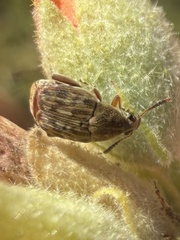 Bean WeevilAcanthoscelides obtectusDamages trees, gardens or crops
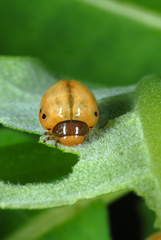 Swamp Milkweed Leaf BeetleLabidomera clivicollisDamages trees, gardens or crops
 Alder Leaf BeetleAgelastica alniDamages trees, gardens or crops
 Dogbane Leaf BeetleChrysochus auratus
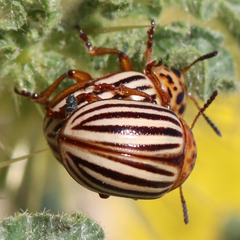 Colorado Potato BeetleLeptinotarsa decemlineata
Sources
- Wikipedia: https://en.wikipedia.org/wiki/Callosobruchus_maculatus
Look it up elsewhere: GBIF · iNaturalist · BugGuide · ITIS · Wikipedia
Text written 2026-10-23 from the sources above and checked sentence by sentence against them. Data fetched 2026-10-22.