 Bug FAQ
Willow Clytra
Clytra laeviuscula · Order: Coleoptera · Family: Chrysomelidae
Source: Wikipedia
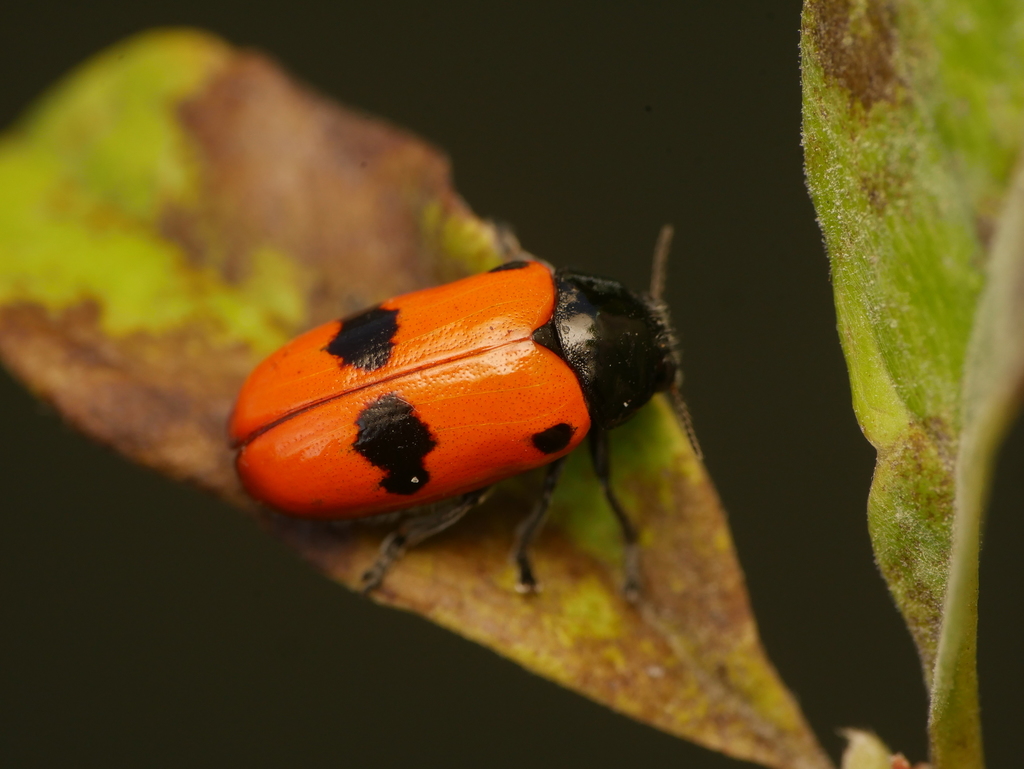
Willow Clytra are small beetles about 8 to 11 mm long with a shiny red-orange back marked by four black spots. Adults are most often seen from May through August in wet forests, sunny edges, dry slopes, grasslands, floodplains and parks across most of Europe and the Near East.
Source: Wikipedia
How to recognize it
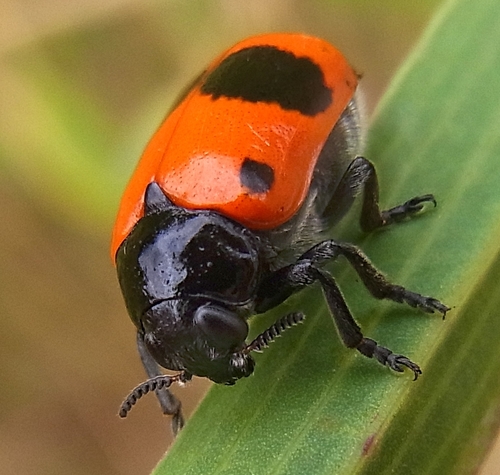
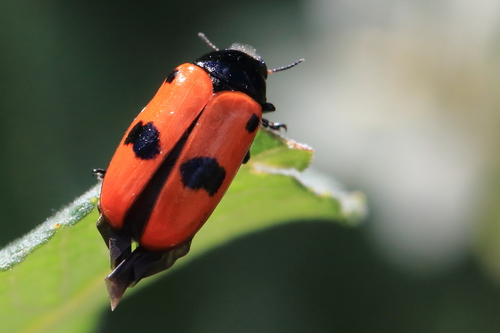
The beetle’s elytra are bright red-orange with two larger black spots near the centre and two smaller spots near the shoulders; the head, legs, antennae and prothorax are black and shiny.
Source: Wikipedia
Size
It measures roughly 7.5 to 11.5 mm in length and about 4 mm wide.
Source: Wikipedia
Where it lives
It lives in a range of habitats including wet forests, sunny forest edges, dry slopes, dry grasslands, floodplains and city parks.
Source: Wikipedia
What it eats
Both adults and larvae feed on leaves, flowers and pollen of many deciduous trees such as oak, willow, poplar, birch, ash, beech, hazel and others, as well as on pollen from rose, knotweed and daisy species.
Source: Wikipedia
Life cycle
The larval stage lasts about two years, while adult beetles emerge after roughly two weeks.
Source: Wikipedia
When you see it
Adults are commonly observed from May through August.
Source: Wikipedia
Where it comes from
Its native range covers most of Europe, the eastern Palearctic region, and the Near East.
Source: Wikipedia
Lookalikes
It looks similar to the related species Clytra quadripunctata.
Source: Wikipedia
More photos
Questions people ask
Can they damage my garden plants?
They feed on the foliage of many trees and shrubs, so they can cause noticeable leaf damage in gardens and parks.
Source: Wikipedia
Same family (Chrysomelidae)
 Spotted Cucumber BeetleDiabrotica undecimpunctataDamages trees, gardens or crops
 Bean WeevilAcanthoscelides obtectusDamages trees, gardens or crops
 Cowpea WeevilCallosobruchus maculatusDamages trees, gardens or crops
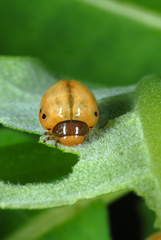 Swamp Milkweed Leaf BeetleLabidomera clivicollisDamages trees, gardens or crops
 Alder Leaf BeetleAgelastica alniDamages trees, gardens or crops
 Dogbane Leaf BeetleChrysochus auratus
Sources
- Wikipedia: https://en.wikipedia.org/wiki/Clytra_laeviuscula
Look it up elsewhere: GBIF · iNaturalist · BugGuide · Wikipedia
Text written 2026-10-22 from the sources above and checked sentence by sentence against them. Data fetched 2026-10-22.