 Bug FAQ
Whitman's Jumping Spider
Phidippus whitmani · Order: Araneae · Family: Salticidae
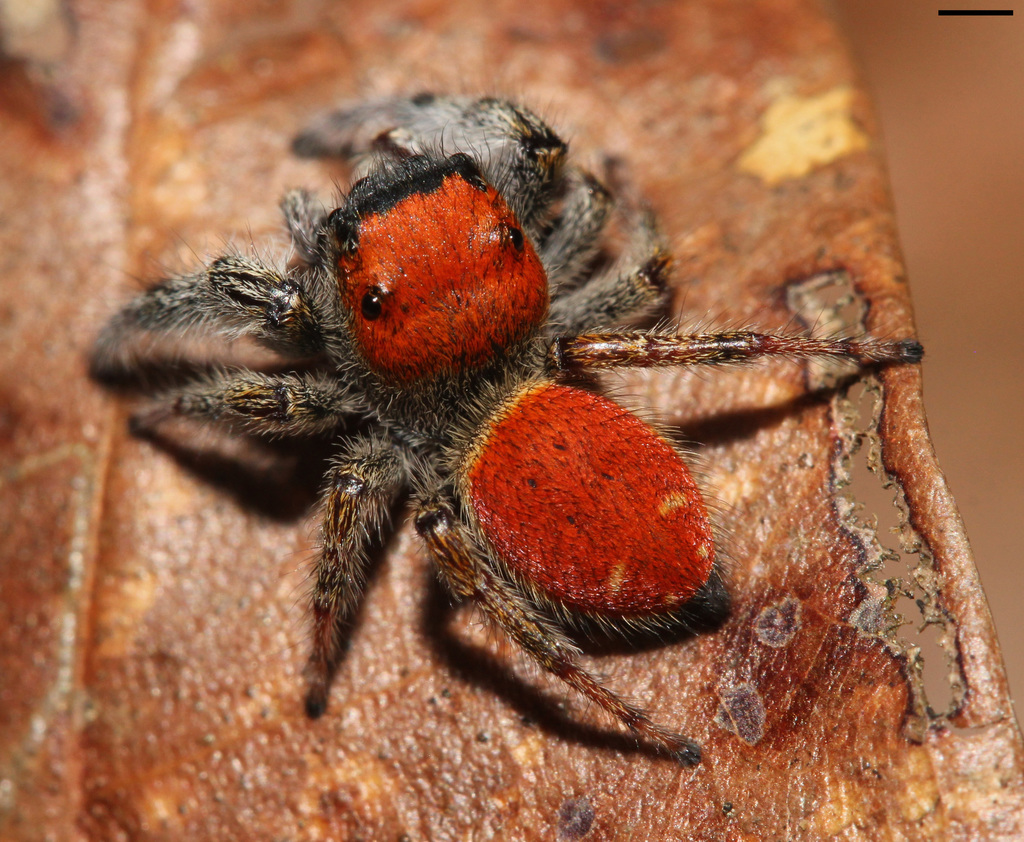
Male Whitman's Jumping Spiders have a bright red top of the abdomen and cephalothorax, a white band on the abdomen, and a side band with small black or white spots. Their chelicerae are black with a fringe of white, and females in the southern part of the range may also show red coloration. They are found across the United States and Canada, from Florida up to New York and New Hampshire and as far west as Colorado. Adults appear in May or June, and females lay eggs during July and August.
Source: Wikipedia
How to recognize it
The chelicerae are black and have a white fringe.
Source: Wikipedia
When you see it
Maturation occurs in May-June, with egg-laying in July-August.
Source: Wikipedia
Where it comes from
Phidippus whitmani occurs throughout the United States and Canada.
Source: Wikipedia
Where it is found in the US
Recorded in 39 of 51 states and DC. Most records: North Carolina, Virginia, Georgia, South Carolina, Tennessee, New York, Maryland, Texas.
Darker = more records. Counts are museum and citizen-science records, not population size.
Source: GBIF
Status: native in North America; native in Canada. Source: iNaturalist
Months it is reported in the US
Source: GBIF
More photos

Questions people ask
When do Whitman's Jumping Spiders mature and lay eggs?
They become adults in May or June, and females lay eggs during July and August.
Source: Wikipedia
Same family (Salticidae)



Sources
- Wikipedia: https://en.wikipedia.org/wiki/Phidippus_whitmani
Look it up elsewhere: GBIF · iNaturalist · BugGuide · ITIS · Wikipedia
Text written 2026-10-23 from the sources above and checked sentence by sentence against them. Data fetched 2026-10-23.