 Bug FAQ
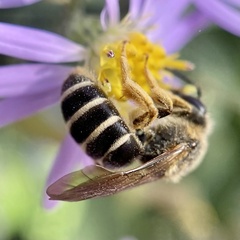
White-lipped Blood Bee
Sphecodes albilabris · Order: Hymenoptera · Family: Halictidae

The white-lipped blood bee is 11 to 14 mm long. It lives on inland dunes, sand fields, grasslands and similar sandy or loess habitats from lowlands up to mountains. Females are active March-August and males July-October, flying from March to October. The larvae parasitise the nests of other solitary bees such as Colletes cunicularius and several Halictus species.
Source: Wikipedia
Size
Adults measure 11 to 14 mm in length.
Source: Wikipedia
Where it lives
Found on inland dunes, drifting sand, sand pits, grasslands, flood dams and other sandy or loess areas, from lowlands to montane zones.
Source: Wikipedia
Life cycle
Adults fly from March to October; females are on wing March-August and males July-October.
Source: Wikipedia
When you see it
Active period spans March through October, with females earlier in the season than males.
Source: Wikipedia
Where it comes from
Endemic to central and western Europe, also present in North Africa. Accidentally introduced to the United States and Australia.
Source: Wikipedia
Where it is found in the US
Recorded in 1 of 51 states and DC. Most records: Illinois.
Darker = more records. Counts are museum and citizen-science records, not population size.
Source: GBIF
More photos


Same family (Halictidae)


Sources
- Wikipedia: https://en.wikipedia.org/wiki/Sphecodes_albilabris
Look it up elsewhere: GBIF · iNaturalist · BugGuide · ITIS · Wikipedia
Text written 2026-10-23 from the sources above and checked sentence by sentence against them. Data fetched 2026-10-22.