 Bug FAQ
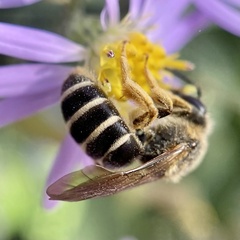
Great Banded Furrow Bee
Halictus scabiosae · Order: Hymenoptera · Family: Halictidae
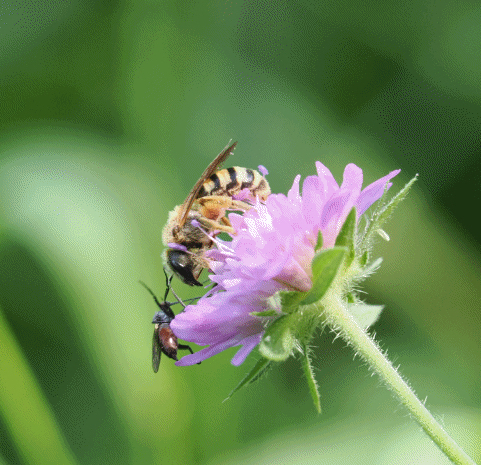
It nests in hardened ground paths, often forming many colonies at the same site, and is found across most of Europe and North Africa. Adults feed on nectar and pollen, especially from Asteraceae flowers, may have several generations per year, with females emerging in April and new males and females appearing in July.
Source: Wikipedia
How to recognize it
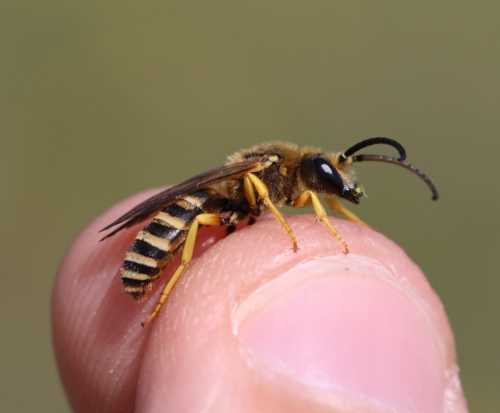
Its legs are yellow and the antennae are entirely black and curve at the tip.
Source: Wikipedia
Where it lives
It nests in the ground, preferring hardened paths. Many colonies often share the same nesting site.
Source: Wikipedia
What it eats
Adults collect nectar and pollen from a variety of flowers, especially those in the Asteraceae family.
Source: Wikipedia
Life cycle
The species can produce several generations each year.
Source: Wikipedia
Where it comes from
It occurs throughout most of Europe and in North Africa.
Source: Wikipedia
Lookalikes
It looks very similar to the related Halictus sexcinctus and can be confused with it.
Source: Wikipedia
Where it is found in the US
Recorded in 1 of 51 states and DC. Most records: Illinois.
Darker = more records. Counts are museum and citizen-science records, not population size.
Source: GBIF
More photos
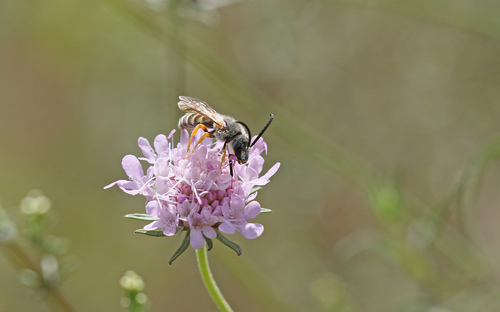
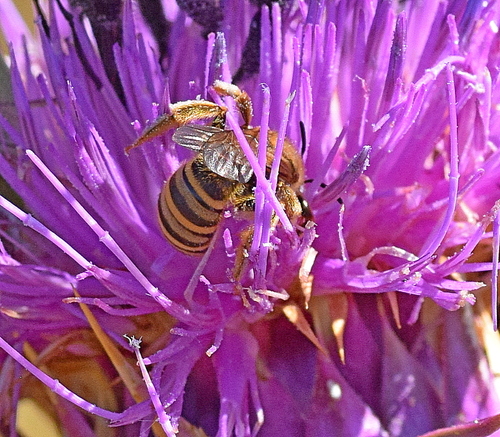
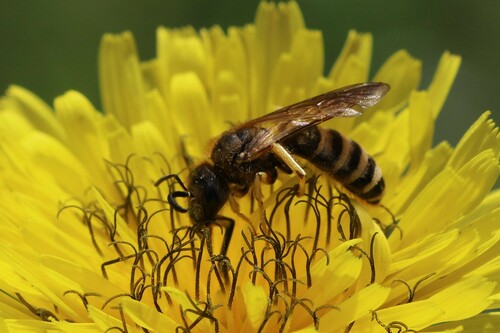
Same family (Halictidae)


Sources
- Wikipedia: https://en.wikipedia.org/wiki/Halictus_scabiosae
Look it up elsewhere: GBIF · iNaturalist · BugGuide · ITIS · Wikipedia
Text written 2026-10-22 from the sources above and checked sentence by sentence against them. Data fetched 2026-10-22.