 Bug FAQ
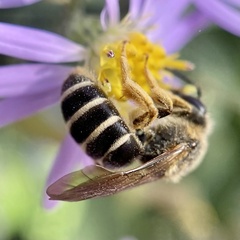
White-banded Sweat Bee
Lasioglossum leucozonium · Order: Hymenoptera · Family: Halictidae
Also called: Sweat Bee, White-zoned Furrow Bee

The white-banded sweat bee (Lasioglossum leucozonium) lives in open, sandy or chalky areas and sometimes nests in groups, though it is solitary. Females are most active in early June and males later in July and August, with both sexes flying from early May to mid-August. It feeds on pollen from many flowers and has been seen on apple trees and lowbush blueberries.
Source: Wikipedia
How to recognize it
Females have a rough, short propodeal dorsal area and a dull, grainy first metasomal tergum with distinct punctures; the vertex behind the ocelli shows stripes. Compared with L. zonulum, its pronotal angle is less projecting but still obtuse.
Source: Wikipedia
Where it lives
It prefers open habitats on sandy or chalky soils, though it can also occur on heavy clay. Nests are sometimes found in aggregations despite the species being solitary.
Source: Wikipedia
What it eats
Adults and larvae eat pollen from a variety of flowers. They have been observed visiting apple trees and lowbush blueberries.
Source: Wikipedia
Life cycle
The species produces only one generation each year. After maturing, offspring mate and then enter hibernation.
Source: Wikipedia
When you see it
Females and males are active from early May to mid-August. Females peak in early June, while males are most common in late July and August.
Source: Wikipedia
Where it comes from
Although now common in North America, genetic studies show it was introduced to the region.
Source: Wikipedia
Lookalikes
It is sometimes compared to its close relative L. zonulum, but has distinct features separating it from other Lasioglossum species. Its pronotal angle projects out less than that of L. zonulum, though it remains obtuse.
Source: Wikipedia
Where it is found in the US
Recorded in 26 of 51 states and DC. Most records: Massachusetts, Michigan, New York, New Hampshire, Maine, Vermont, North Carolina, West Virginia.
Darker = more records. Counts are museum and citizen-science records, not population size.
Source: GBIF
Months it is reported in the US
Source: GBIF
More photos
Questions people ask
When are white-banded sweat bees active?
Both sexes are on the wing from early May through mid-August, with females peaking in early June and males later in July and August.
Source: Wikipedia
What habitats do they prefer?
They are found in open areas on sandy or chalky soils and occasionally on heavy clay, nesting sometimes in aggregations.
Source: Wikipedia
Is this bee native to North America?
Genetic evidence shows it was introduced to North America, even though it is now common there.
Source: Wikipedia
Same family (Halictidae)

Sources
- Wikipedia: https://en.wikipedia.org/wiki/Lasioglossum_leucozonium
Look it up elsewhere: GBIF · iNaturalist · BugGuide · ITIS · Wikipedia
Text written 2026-10-23 from the sources above and checked sentence by sentence against them. Data fetched 2026-10-23.