 Bug FAQ
White Banded House Jumper
Maratus griseus · Order: Araneae · Family: Salticidae
Also called: Red-headed House Hopper, Shaggy House Hopper, White-banded House Jumping Spider
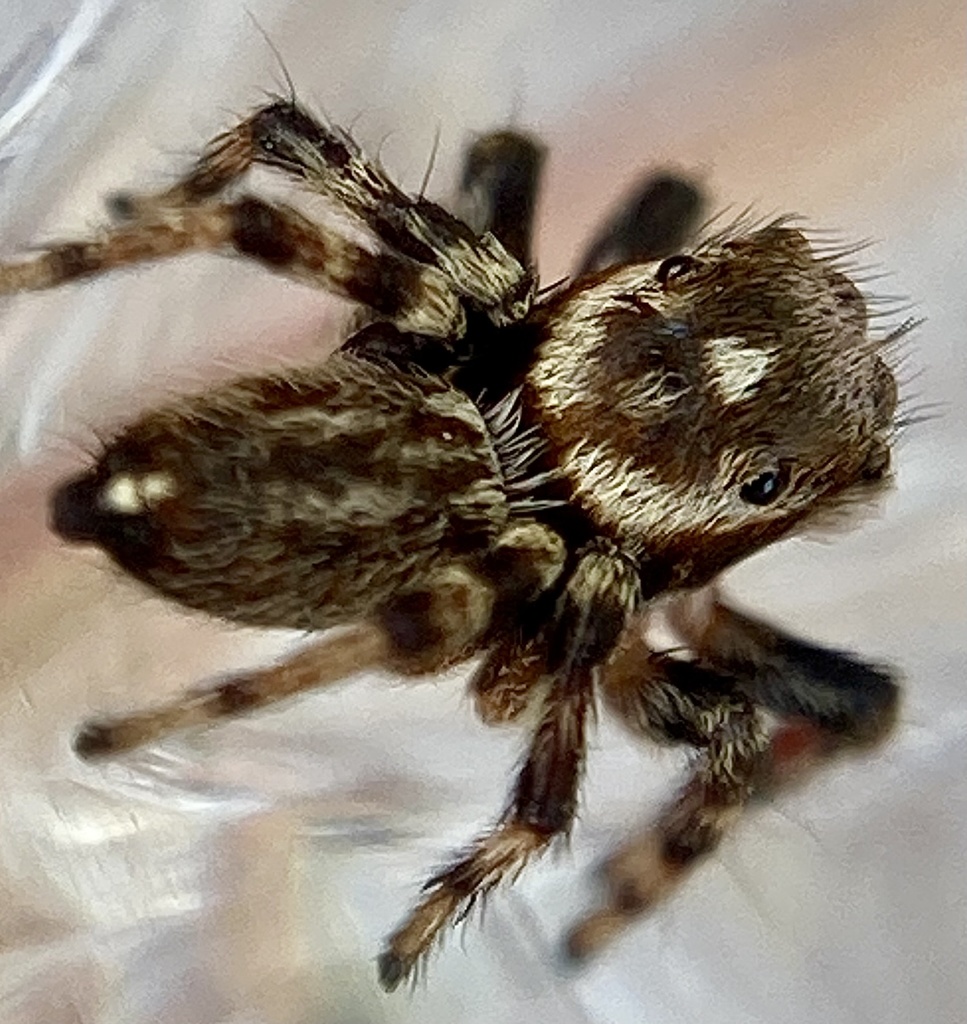
White-banded house jumpers are tiny jumping spiders about 2 to 6 mm long and are found across most of Australia and New Zealand. Males have a bright reddish-orange eye band and white hairs on their palps, while females are dull brown or black with a white head ring. They are active during the day, live alone, hunt other invertebrates (including larger prey and other spiders), and live about a year, hatching in the austral spring and mating in August.
Source: Wikipedia
Size
Adults measure between 2 and 6 mm in length.
Source: Wikipedia
Where it lives
They are diurnal and mostly solitary, living in Australia and New Zealand.
Source: Wikipedia
What it eats
They prey on other invertebrates, often larger than themselves, and will also eat other spiders and any insects they can subdue.
Source: Wikipedia
Life cycle
Their life span is about one year; they hatch in the austral spring (December/January).
Source: Wikipedia
When you see it
Mature males appear in August, followed shortly by females, and mating occurs then.
Source: Wikipedia
Where it comes from
In Australia they occur in temperate regions, including ACT, NSW, QLD, SA, TAS, VIC and WA.
Source: Wikipedia
Lookalikes
They belong to the genus Maratus, known as peacock spiders, which makes them easy to recognise.
Source: Wikipedia
Same family (Salticidae)



Sources
- Wikipedia: https://en.wikipedia.org/wiki/Maratus_griseus
Look it up elsewhere: GBIF · iNaturalist · BugGuide · ITIS · Wikipedia
Text written 2026-10-22 from the sources above and checked sentence by sentence against them. Data fetched 2026-10-22.