 Bug FAQ
White-banded Crab Spider
Misumenoides formosipes · Order: Araneae · Family: Thomisidae
Also called: Whitebanded Crab Spider
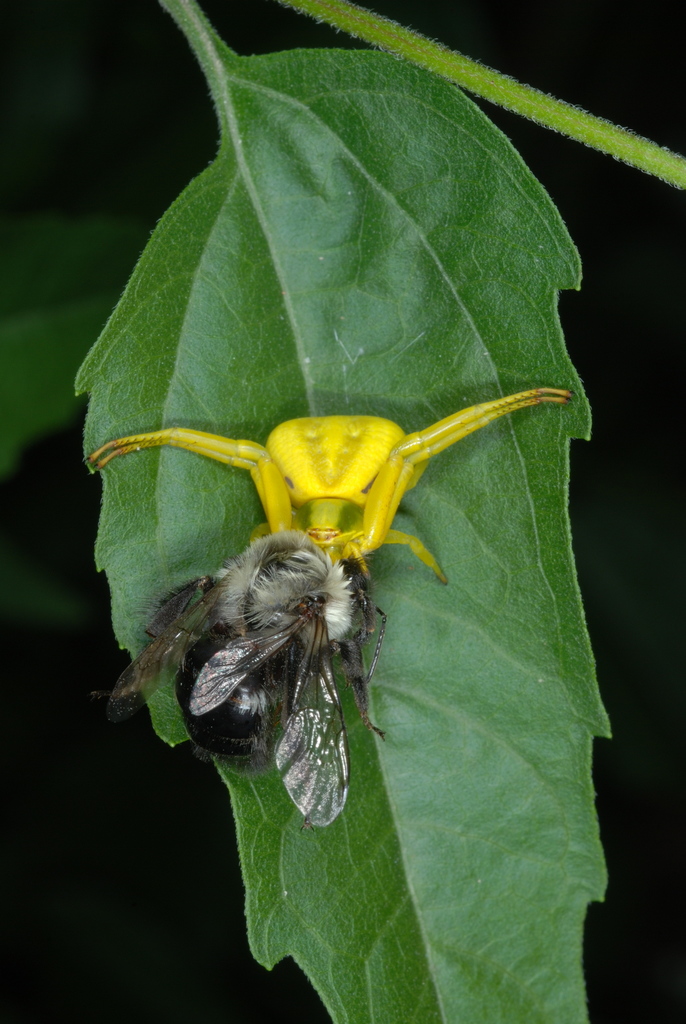
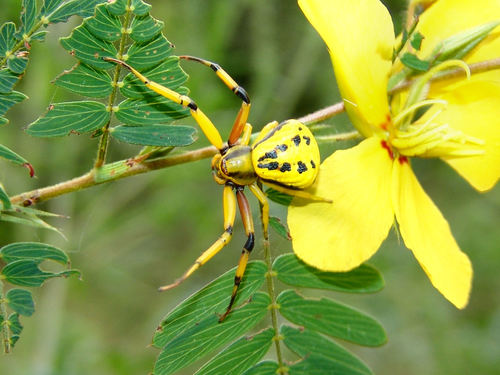
Female white-banded crab spiders are 5.0 to 11.3 mm long, while males are much smaller at 2.5 to 3.2 mm. Males have darker front legs and a gold abdomen, and both sexes show a distinctive white line across their eyes. Females wait on flowers to catch pollinators, whereas males mainly drink nectar from Queen Anne’s lace.
Source: Wikipedia
How to recognize it
Males keep darker front legs and a gold abdomen throughout life.
Source: Wikipedia
Size
Females measure 5.0 to 11.3 mm (0.20 to 0.44 in) in length.
Source: Wikipedia
Where it lives
They occur across the United States and in Colombia’s Antioquia region. Males roam heterogeneous habitats to locate and guard sedentary females until they mature.
Source: Wikipedia
What it eats
Females ambush pollinators on flower heads. Males obtain most nutrients from nectar of Queen Anne’s lace (Daucus carota).
Source: Wikipedia
Life cycle
Females lay 80 to 180 tan eggs in a 10 to 14 mm silk sack on nearby foliage. Males search for and guard females until they are ready to reproduce.
Source: Wikipedia
When you see it
They are active during daylight hours. They tolerate temperatures from about 2 °C to 48 °C.
Source: Wikipedia
Where it comes from
Their range includes the United States and Colombia (Copacabana, Antioquia).
Source: Wikipedia
Lookalikes
The white ridge below the bottom eye row distinguishes them from similar spiders. They are called crab spiders because their body shape and front legs resemble a crab.
Source: Wikipedia
Where it is found in the US
Recorded in 43 of 51 states and DC. Most records: Virginia, North Carolina, Illinois, Ohio, Texas, California, Maryland, Missouri.
Darker = more records. Counts are museum and citizen-science records, not population size.
Source: GBIF
Status: native in North America; native in Canada. Source: iNaturalist
Months it is reported in the US
Source: GBIF
More photos


Questions people ask
What do male and female white-banded crab spiders look like?
Females are larger (5.0 to 11.3 mm) and lack the darker front legs and gold abdomen that males (2.5 to 3.2 mm) have.
Source: Wikipedia
Where might I find this spider?
They are found throughout the United States and in Colombia’s Antioquia region, often on flowers where females wait for pollinators.
Source: Wikipedia
What do they eat?
Females catch pollinating insects on flowers, while males mainly drink nectar from Queen Anne’s lace.
Source: Wikipedia
Same family (Thomisidae)


Sources
- Wikipedia: https://en.wikipedia.org/wiki/Misumenoides_formosipes
Look it up elsewhere: GBIF · iNaturalist · BugGuide · ITIS · Wikipedia
Text written 2026-10-22 from the sources above and checked sentence by sentence against them. Data fetched 2026-10-22.