 Bug FAQ
Wharf Borer
Nacerdes melanura · Order: Coleoptera · Family: Oedemeridae
Also called: False Blister Beetle
Source: Wikipedia
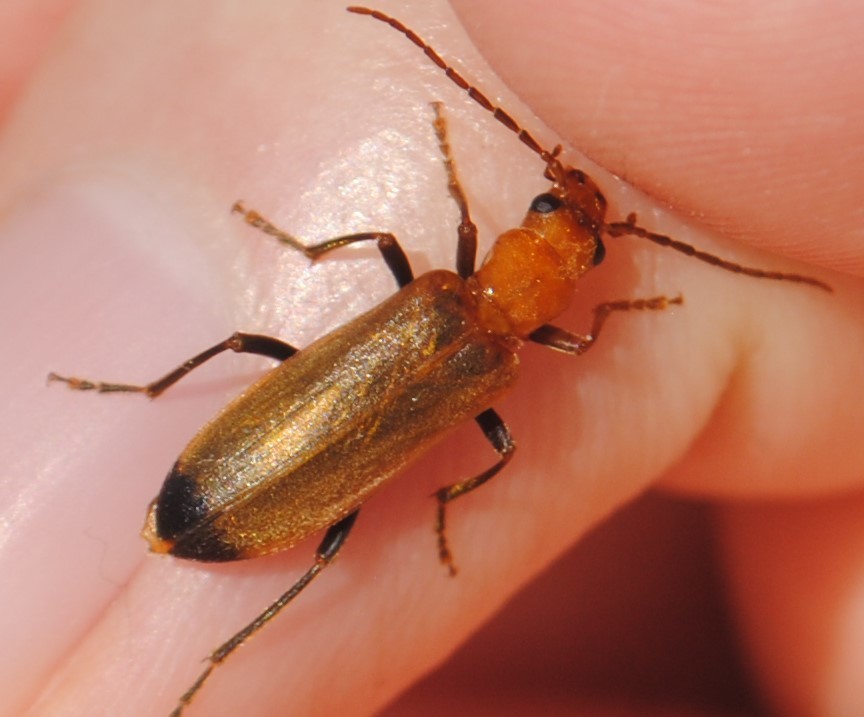
They develop from egg to adult in roughly a year, with cream-white pupae lasting 6 to 17 days depending on temperature and humidity. The beetles infest moist, decaying wood such as submerged wharf timbers and can damage both hardwood and softwood used in construction.
Source: Wikipedia
How to recognize it
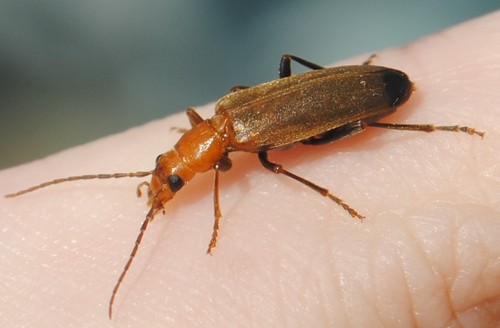
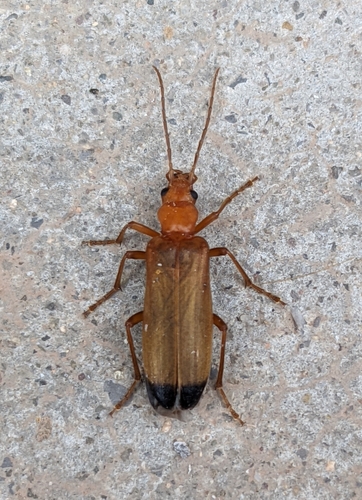
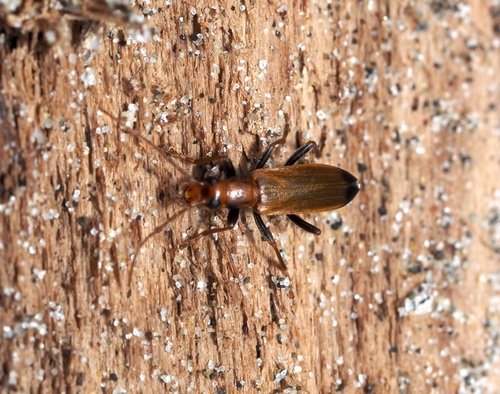
A black band across the end of each wing case and three raised longitudinal lines identify the beetle.
Source: Wikipedia
Size
Adults measure about 10 to 12 mm, are yellowish to reddish-orange, have a long slender body and antennae half the body length.
Source: Wikipedia
Is it a pest in the house?
Both hardwood and softwood can be infested.
Source: Wikipedia
How to get rid of it
Correcting wood moisture problems and removing decaying wood helps prevent infestations. Applying a residual insecticide such as permethrin can control beetles during the June-August period.
Source: Wikipedia
What it eats
Females lay eggs on rotten wood; the larvae hatch, burrow into the wood and feed on it. Adult beetles do not eat and rely on energy stored from their larval stage.
Source: Wikipedia
Life cycle
Development from egg to adult takes about one year. Pupae are cream-white and remain for 6 to 17 days, with duration affected by temperature and humidity.
Source: Wikipedia
When you see it
Adults emerge from pupae between May and September, most often seen in June. They are most noticeable as a nuisance from June to August.
Source: Wikipedia
Where it comes from
The species is thought to be native to the Great Lakes region of North America. Scientific literature still has uncertainty about its exact origin.
Source: Wikipedia
Lookalikes
They resemble soldier beetles in size and shape, but both groups are harmless to humans.
Source: Wikipedia
Where it is found in the US
Recorded in 34 of 51 states and DC. Most records: New York, Pennsylvania, Massachusetts, Illinois, Kentucky, Washington, Maryland, New Jersey.
Darker = more records. Counts are museum and citizen-science records, not population size.
Source: GBIF
Status: introduced in United States; introduced in Canada. Source: iNaturalist
Months it is reported in the US
Source: GBIF
More photos
Questions people ask
How can I get rid of wharf borers?
Fix moisture issues in the wood and remove any decaying timber; a residual insecticide like permethrin can also be applied during the summer months.
Source: Wikipedia
What do wharf borers look like?
They are 10 to 12 mm long, yellow-orange, with a black band across the end of each wing case and three raised lines on the elytra.
Source: Wikipedia
When are wharf borers most active?
Adults emerge from May to September, with the highest activity and nuisance reports from June to August.
Source: Wikipedia
Do wharf borers damage my house?
Yes, they feed on moist, decaying wood and can damage both hardwood and softwood used in building structures.
Source: Wikipedia
Same family (Oedemeridae)

Sources
- Wikipedia: https://en.wikipedia.org/wiki/Wharf_borer
Look it up elsewhere: GBIF · iNaturalist · BugGuide · ITIS · Wikipedia
Text written 2026-10-25 from the sources above and checked sentence by sentence against them. Data fetched 2026-10-25.