 Bug FAQ
Western Spruce Budworm Moth
Choristoneura freemani · Order: Lepidoptera · Family: Tortricidae
Source: Wikipedia
Adults are about 12 mm long with a wingspan of 22 to 28 mm, while mature larvae grow to 25 to 32 mm. Larvae eat all new foliage before older needles are touched, leading to severe tree damage during outbreaks that have affected over 100,000 ha of forest.
Source: Wikipedia
How to recognize it
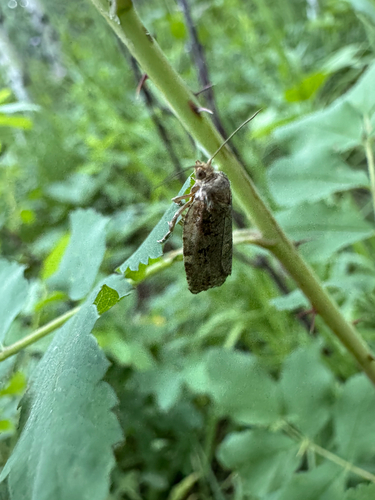
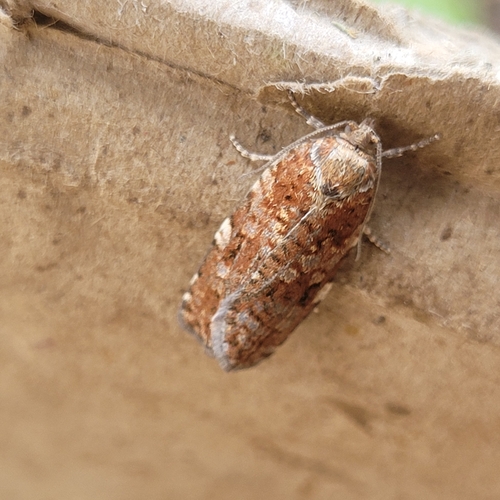
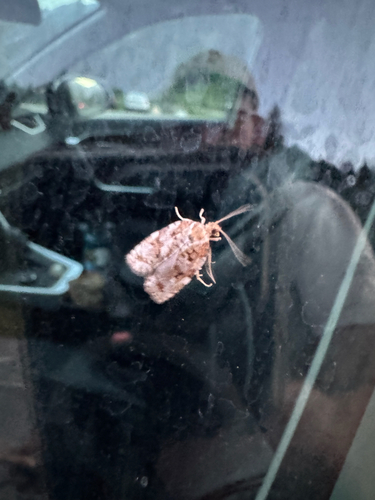
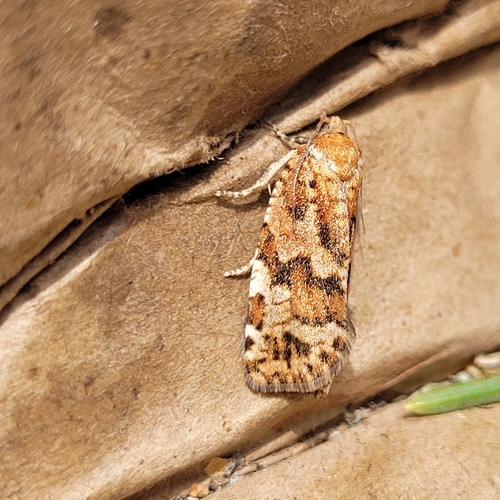
The moth’s forewings are gray- or orange-brown with banded or streaked patterns and usually a white dot on the wing margin. Larvae have black heads and collars with orange- or cinnamon-brown bodies.
Source: Wikipedia
Size
Adult moths measure about 12.7 mm in length and spread their wings 22 to 28 mm. Mature larvae are 25 to 32 mm long.
Source: Wikipedia
Is it a pest in the house?
Outbreaks do not follow a regular pattern. From 1949-1958 sustained outbreaks defoliated more than 100,000 ha in the Fraser Canyon-Lillooet-Pemberton area of British Columbia.
Source: Wikipedia
How to get rid of it
After a period of dormancy, outbreaks reappeared in 1922 near Priest Lake, Idaho.
Source: Wikipedia
Where it lives
Larvae hide under bark scales or among lichens on tree trunks and branches.
Source: Wikipedia
What it eats
Larvae consume all new foliage before moving to older needles, often destroying the fresh growth completely.
Source: Wikipedia
Life cycle
Across most of its range the bug completes one full year from egg to adult. Larvae pass through six developmental stages.
Source: Wikipedia
When you see it
Adults emerge from pupae in late July or early August, with earlier emergence in the southern Rockies in early July. Larvae leave their winter shelters between early May and late June to begin feeding.
Source: Wikipedia
Where it comes from
The first recorded outbreak occurred in 1909 on southeastern Vancouver Island, British Columbia.
Source: Wikipedia
Where it is found in the US
Recorded in 12 of 51 states and DC. Most records: Idaho, Montana, Oregon, Colorado, New Mexico, Arizona, Utah, Wyoming.
Darker = more records. Counts are museum and citizen-science records, not population size.
Source: GBIF
Status: native in North America; native in Canada; native in United States. Source: iNaturalist
Months it is reported in the US
Source: GBIF
More photos
Questions people ask
When do western spruce budworm moths appear?
Adults typically emerge in late July or early August, with earlier emergence in early July in the southern Rockies.
Source: Wikipedia
How long does the larval stage last?
Larvae develop through six stages over the spring and early summer before pupating.
Source: Wikipedia
How can I tell this moth apart from similar species?
Look for the characteristic white dot on the wing margin and the gray- or orange-brown banded forewings; the similar Choristoneura occidentalis shares the same range.
Source: Wikipedia
How are budworm outbreaks controlled?
Aerial spraying of insecticides has been used to terminate smaller outbreaks in the Rockies.
Source: Wikipedia
Same family (Tortricidae)
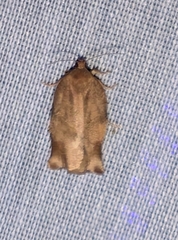 Oblique-banded Leafroller MothChoristoneura rosaceanaDamages trees, gardens or crops
 Garden TortrixClepsis peritanaDamages trees, gardens or crops
 Common MarbleSyricoris lacunanaDamages trees, gardens or crops
 Red-banded Leafroller MothArgyrotaenia velutinanaDamages trees, gardens or crops
 Light Brown Apple MothEpiphyas postvittanaDamages trees, gardens or crops
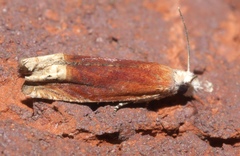 Aster and Reddish Eucosma Moths and AlliesEucosma parmatana
Sources
- Wikipedia: https://en.wikipedia.org/wiki/Choristoneura_freemani
Look it up elsewhere: GBIF · iNaturalist · BugGuide · Wikipedia
Text written 2026-10-26 from the sources above and checked sentence by sentence against them. Data fetched 2026-10-26.