 Bug FAQ
Western Red-tailed Spider Wasp
Tachypompilus unicolor · Order: Hymenoptera · Family: Pompilidae
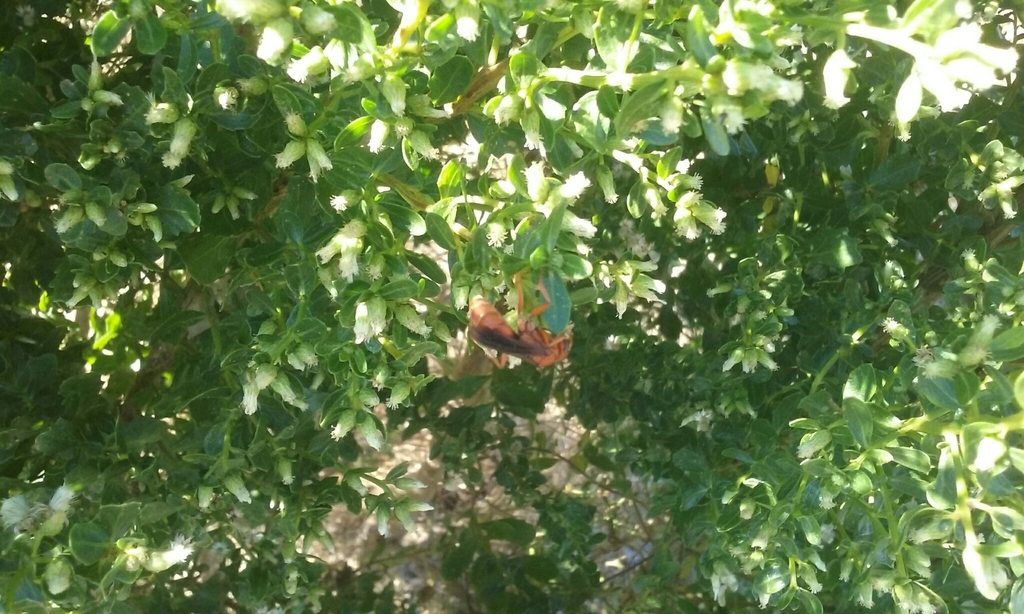
The western red-tailed spider wasp lives in western North America, from southern California up through British Columbia and east to Idaho and South Dakota. Adults feed on honeydew and visit a variety of flowers such as milkweed, baccharis, and wislizenia. In California they are on the wing from May through October, with most activity in July and August.
Source: Wikipedia
Size
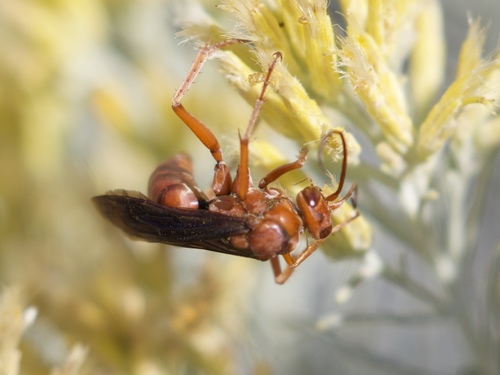
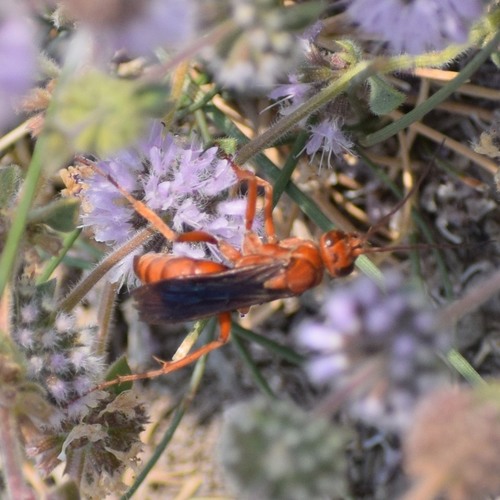
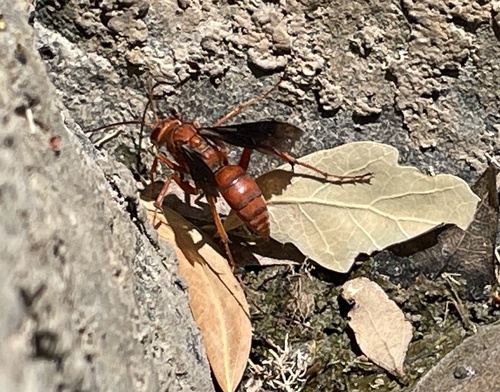
The same subspecies T. u. cerinus is noted for its entirely red body and yellow, dark-margined wings.
Source: Wikipedia
What it eats
Adult wasps feed on honeydew secretions and nectar from flowers. Females have been observed taking honeydew from oak galls and visiting flowers of milkweed, baccharis, chrysothamnus, lepidospartum, and wislizenia.
Source: Wikipedia
Life cycle
In California the flight period runs from May to October, peaking in July and August.
Source: Wikipedia
When you see it
The species is most active during the summer months, especially July and August.
Source: Wikipedia
Where it comes from
Tachypompilus unicolor is a spider-wasp species native to western North America.
Source: Wikipedia
Where it is found in the US
Recorded in 12 of 51 states and DC. Most records: California, Arizona, Utah, Texas, Idaho, Oregon, Washington, Nevada.
Darker = more records. Counts are museum and citizen-science records, not population size.
Source: GBIF
Status: native in North America; native in United States. Source: iNaturalist
Months it is reported in the US
Source: GBIF
More photos
Questions people ask
What do western red-tailed spider wasps eat?
Adults feed on honeydew and visit a range of flowers such as milkweed, baccharis, chrysothamnus, lepidospartum, and wislizenia.
Source: Wikipedia
When are they active?
They are on the wing from May through October, with the highest numbers in July and August.
Source: Wikipedia
Where are they found?
Their range includes southern California, northern Baja California, the Channel Islands, up to British Columbia, and eastward to Idaho, South Dakota, and northern Utah.
Source: Wikipedia
Same family (Pompilidae)
Sources
- Wikipedia: https://en.wikipedia.org/wiki/Tachypompilus_unicolor
Look it up elsewhere: GBIF · iNaturalist · BugGuide · Wikipedia
Text written 2026-10-26 from the sources above and checked sentence by sentence against them. Data fetched 2026-10-26.