 Bug FAQ
Tarantula hawk
Pepsis grossa · Order: Hymenoptera · Family: Pompilidae
Source: Wikipedia, extension.colostate.edu
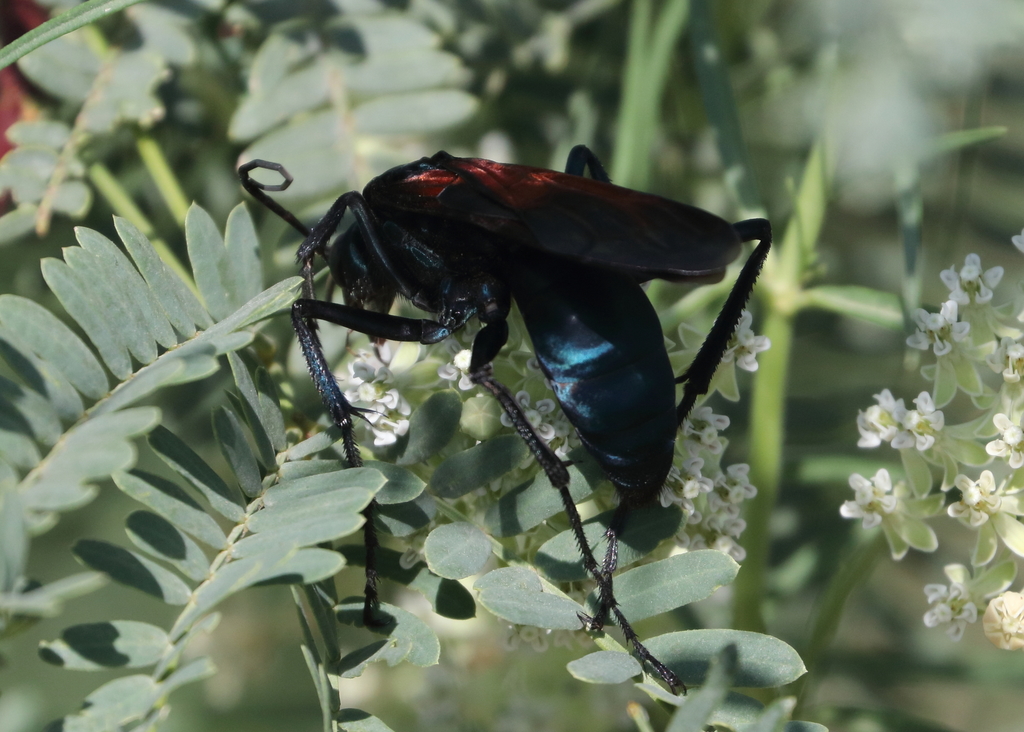
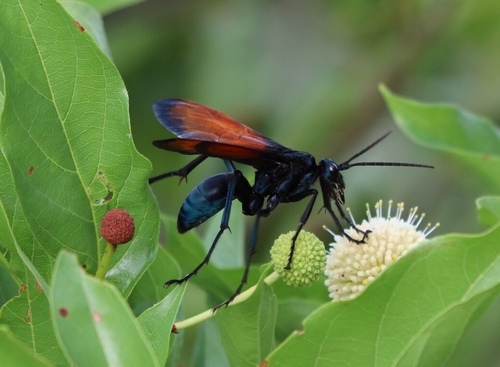
Tarantula hawks are large metallic blue or black wasps with orange to yellow wings. Females hunt tarantulas, paralyze them, and lay eggs on the spider; the larvae eat the spider inside a cocoon.
Source: extension.colostate.edu, Wikipedia
How to recognize it
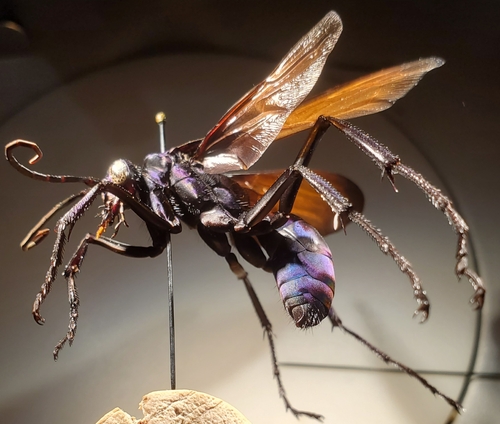
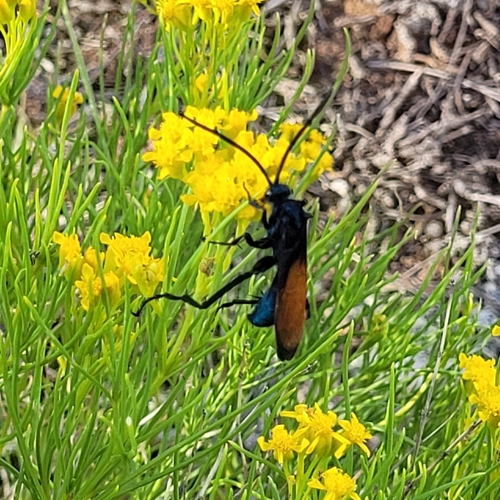
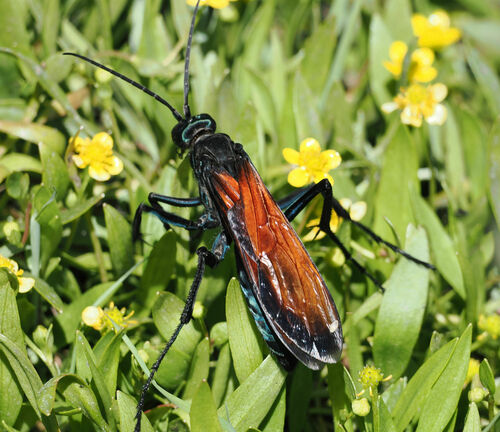
They have a metallic blue or black iridescent body with orange to yellow wings; some have black tips on the wings. Two main colour forms exist: a bright orange-winged form and a black-winged form; a third “lygamorphic” form occurs in northern South America.
Source: extension.colostate.edu, Wikipedia
Size
Adults range from about 10 to 50 mm long, roughly the length of a matchstick.
Source: extension.colostate.edu
Does it bite or sting?
Only females hunt and can sting; their sting ranks among the most painful insect stings, scoring 4.0 on the Schmidt index. Stings cause immediate, intense, short-term pain but the insects are generally docile and rarely sting unless provoked.
Source: Wikipedia, extension.colostate.edu
How to get rid of it
Tarantula hawks do not cause problems for agriculture or homeowners.
Source: extension.colostate.edu
Where it lives
Females hunt on the ground, searching for tarantulas and using rapid wing and antenna movements.
Source: Wikipedia
What it eats
Adults capture tarantulas, paralyze them, and lay eggs on the spider; the larvae feed on the immobilized spider.
Source: Wikipedia
Life cycle
The larva hatches, consumes the spider, spins a silk cocoon, pupates, and emerges as an adult wasp. Females lay fertilized eggs on large female spiders to produce female wasps; unfertilized eggs on male spiders become males.
Source: Wikipedia
Where it comes from
They are native to the southern United States and extend south through Central America to northern South America.
Source: Wikipedia
Lookalikes
Batesian mimics include the robber fly Wyliea mydas and the fly Mydas xanthopterus, which copy the wasp’s black body and orange wings.
Source: Wikipedia
Where it is found in the US
Recorded in 10 of 51 states and DC. Most records: Arizona, Texas, New Mexico, Colorado, Oklahoma, Utah, Arkansas, California.
Darker = more records. Counts are museum and citizen-science records, not population size.
Source: GBIF
Status: native in North America; native in United States. Source: iNaturalist
Months it is reported in the US
Source: GBIF
More photos
Questions people ask
Do tarantula hawks sting people?
Yes, females can sting and the sting is extremely painful, though they usually only do so when heavily provoked.
Source: Wikipedia, extension.colostate.edu
Same family (Pompilidae)

Sources
- Wikipedia: https://en.wikipedia.org/wiki/Pepsis_grossa
- extension.colostate.edu: https://extension.colostate.edu/resource/tarantula-hawks-of-colorado/
Look it up elsewhere: GBIF · iNaturalist · BugGuide · Wikipedia
Text written 2026-10-23 from the sources above and checked sentence by sentence against them. Data fetched 2026-10-23.