 Bug FAQ
Wellington Tree Wētā
Hemideina crassidens · Order: Orthoptera · Family: Anostostomatidae
Also called: Wellington tree weta
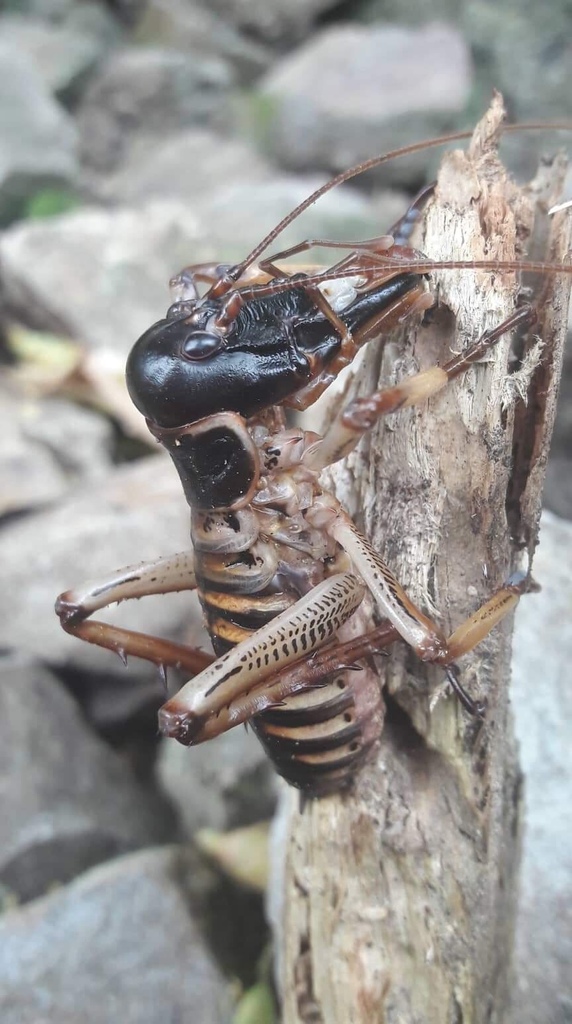
Adult Wellington tree wētā are over 6.5 cm long and have a smooth, shiny body with a banded abdomen of dark and yellow colours. They are nocturnal omnivores that eat a variety of plants such as kawakawa, kōtukutuku and rangiora. They live in tree holes or other refuges, are endemic to New Zealand, and take about 18 months to reach maturity.
Source: Wikipedia
How to recognize it
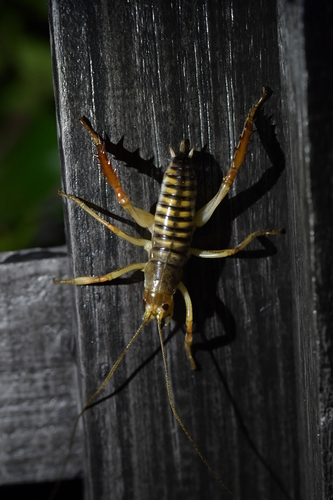
The abdomen shows alternating dark brown-black and yellow bands with a pale underside, a pattern similar to the Wellington Hurricanes rugby uniform.
Source: Wikipedia
Size
Mature individuals exceed 6.5 cm in body length.
Source: Wikipedia
Where it lives
They are active at night and spend most of their time in trees. They usually occupy tree holes but can also use scrub or rock refuges when trees are scarce.
Source: Wikipedia
What it eats
They are omnivorous, feeding mainly on plant material such as kawakawa, kōtukutuku and rangiora.
Source: Wikipedia
Life cycle
Mating and egg-laying occur in summer and autumn; females deposit eggs about 10 mm deep in soil. Eggs hatch in spring, and the insects need roughly 18 months to become adults, living about three years total.
Source: Wikipedia
When you see it
They are active at night throughout the year, with most reproduction in summer and autumn.
Source: Wikipedia
Where it comes from
The species is native and restricted to New Zealand, found from Ruapehu to Wellington in the North Island and in Westland on the South Island.
Source: Wikipedia
Lookalikes
They closely resemble the Hawke’s Bay tree wētā, differing only in chromosome number. Their colour pattern helps tell them apart from the Auckland tree wētā.
Source: Wikipedia
More photos
Questions people ask
How can I tell a Wellington tree wētā from other wētā?
Look for a smooth, shiny body with a banded abdomen of dark and yellow colours, a pattern like the Hurricanes uniform.
Source: Wikipedia
Where does the Wellington tree wētā live?
It lives in tree holes, but will also use scrub or rock shelters when trees are unavailable.
Source: Wikipedia
What does the Wellington tree wētā eat?
It feeds on a variety of plants, including kawakawa, kōtukutuku and rangiora.
Source: Wikipedia
How long does it take for a Wellington tree wētā to become an adult?
It takes about 18 months from hatching to reach sexual maturity.
Source: Wikipedia
Same family (Anostostomatidae)


Sources
- Wikipedia: https://en.wikipedia.org/wiki/Hemideina_crassidens
Look it up elsewhere: GBIF · iNaturalist · BugGuide · Wikipedia
Text written 2026-10-23 from the sources above and checked sentence by sentence against them. Data fetched 2026-10-22.