 Bug FAQ
Cook Strait Giant Weta
Deinacrida rugosa · Order: Orthoptera · Family: Anostostomatidae
Also called: Stephens Island Weta

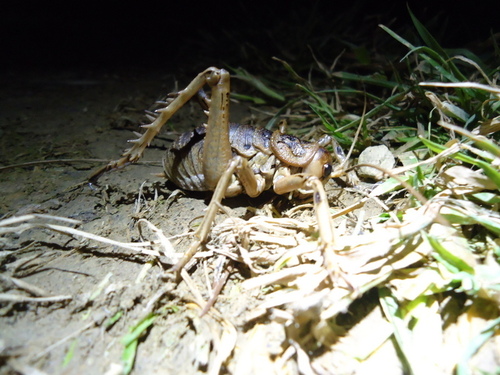
The Cook Strait giant wētā can grow up to 7 cm long and has a bulky, armored body with black-marked plates and spiny hind legs. It lives in open grassland, shrubland and forest edges across several New Zealand islands, hiding by day in grass, leaf litter or under stones. Nocturnal adults emerge at dusk to feed on plant parts, especially the flowers of tauhinu (Cassinia leptophylla).
Source: Wikipedia
How to recognize it
The body is brownish-yellow, covered with thick overlapping plates that have black markings. Its head is small compared with large jaws, and the hind legs have five or six big spines that can be raised in defense.
Source: Wikipedia
Size
It can reach up to 7 cm (2.8 in) in length, making it one of the world’s largest insects.
Source: Wikipedia
Does it bite or sting?
When threatened it raises its spiked legs over its head and makes a hissing sound by rubbing its armored plates together.
Source: Wikipedia
Where it lives
During daylight it hides in grass, soil refuges, dead leaves, bark or stones.
Source: Wikipedia
What it eats
It is nocturnal and eats the aerial parts of plants. After dusk it forages on the ground and low shrubs, favoring tauhinu flowers.
Source: Wikipedia
Life cycle
It takes about two years to reach adult size, growing through roughly nine molts over 12 to 18 months.
Source: Wikipedia
When you see it
Adults are active at night, emerging just after dusk to feed.
Source: Wikipedia
More photos
Questions people ask
How can I identify a Cook Strait giant wētā?
Look for a large (up to 7 cm) brownish-yellow insect with thick overlapping plates marked in black and spiny hind legs that can be raised in defense.
Source: Wikipedia
Where might I find this wētā?
It lives in open grassland, shrubland and forest edges across several New Zealand islands and hides during the day in grass, leaf litter or under stones.
Source: Wikipedia
What does it eat?
It feeds at night on the aerial parts of plants, especially the flowers of tauhinu (Cassinia leptophylla).
Source: Wikipedia
Same family (Anostostomatidae)

Sources
- Wikipedia: https://en.wikipedia.org/wiki/Deinacrida_rugosa
Look it up elsewhere: GBIF · iNaturalist · BugGuide · Wikipedia
Text written 2026-10-23 from the sources above and checked sentence by sentence against them. Data fetched 2026-10-22.