 Bug FAQ
Wart-biter
Decticus verrucivorus · Order: Orthoptera · Family: Tettigoniidae
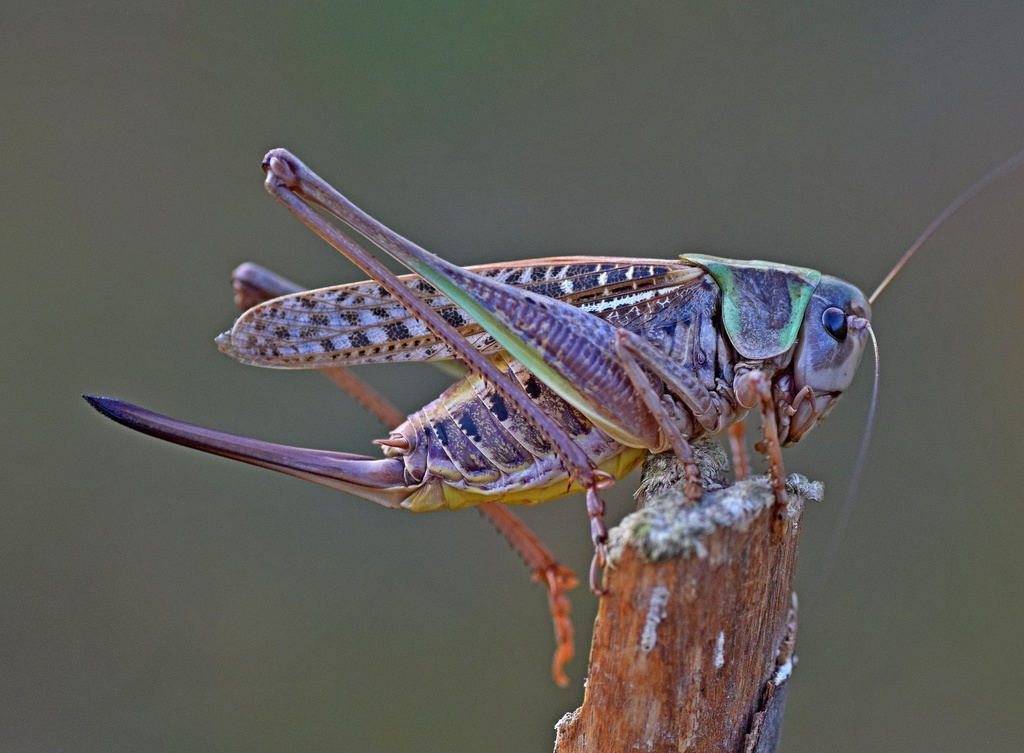
Wart-biters are medium-sized grasshoppers about 3 cm long, dark green with brown mottling, and live on calcareous grasslands and heathlands that have a mix of short turf, tussocks and flowering herbs. They are found across most of continental Europe and into temperate Asia, lay eggs in soil that hatch after two winters, and adults appear in July with numbers peaking in late July-early August.
Source: Wikipedia
How to recognize it
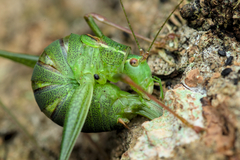
They are usually shiny dark green with brown spots on the pronotum and wings; a darker brown form also exists but still shows some green.
Source: Wikipedia
Size
Adults measure 31 to 37 mm (about 1.2 to 1.5 in), females being larger than males.
Source: Wikipedia
Where it lives
They live in calcareous grassland and heathland that provides a mosaic of bare ground, short turf, grass tussocks and herb-rich sward, preferring sites that are not heavily grazed.
Source: Wikipedia
What it eats
They eat both plants and insects, feeding on knapweed, nettles, bedstraws and also on other grasshoppers.
Source: Wikipedia
Life cycle
Eggs are laid in soil and usually hatch after two winters; the nymphs emerge in a protective sheath that helps them reach the surface, then pass through seven instars from April to June, becoming adults in early July.
Source: Wikipedia
When you see it
Adult numbers are highest in late July and early August.
Source: Wikipedia
More photos

Questions people ask
Are wart-biters a garden pest?
They feed on some garden plants but also eat insects; the evidence does not label them as a serious crop or garden pest.
Source: Wikipedia
When can I expect to see adult wart-biters?
Adults appear in early July and are most common in late July to early August.
Source: Wikipedia
What do wart-biters look like?
They are about 3 cm long, shiny dark green with brown mottling, and a darker brown form also occurs.
Source: Wikipedia
Same family (Tettigoniidae)
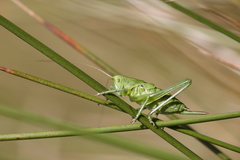 Great Green Bush-cricketTettigonia viridissimaCan bite
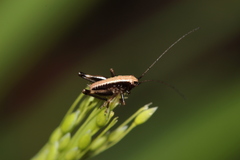 Dark Bush-cricketPholidoptera griseoaptera
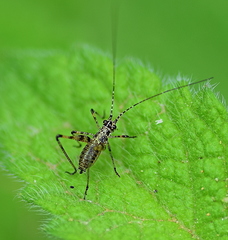 Mediterranean KatydidPhaneroptera nanaDamages trees, gardens or crops
 Fork-tailed Bush KatydidScudderia furcataDamages trees, gardens or crops
 Speckled Bush-cricketLeptophyes punctatissima
 Roesel's Bush-cricketRoeseliana roeselii
Sources
- Wikipedia: https://en.wikipedia.org/wiki/Wart-biter
Look it up elsewhere: GBIF · iNaturalist · BugGuide · Wikipedia
Text written 2026-10-22 from the sources above and checked sentence by sentence against them. Data fetched 2026-10-22.