 Bug FAQ
Tropical Swallowtail Moth
Lyssa zampa · Order: Lepidoptera · Family: Uraniidae
Also called: Black-swallowtail Moth
Source: Wikipedia
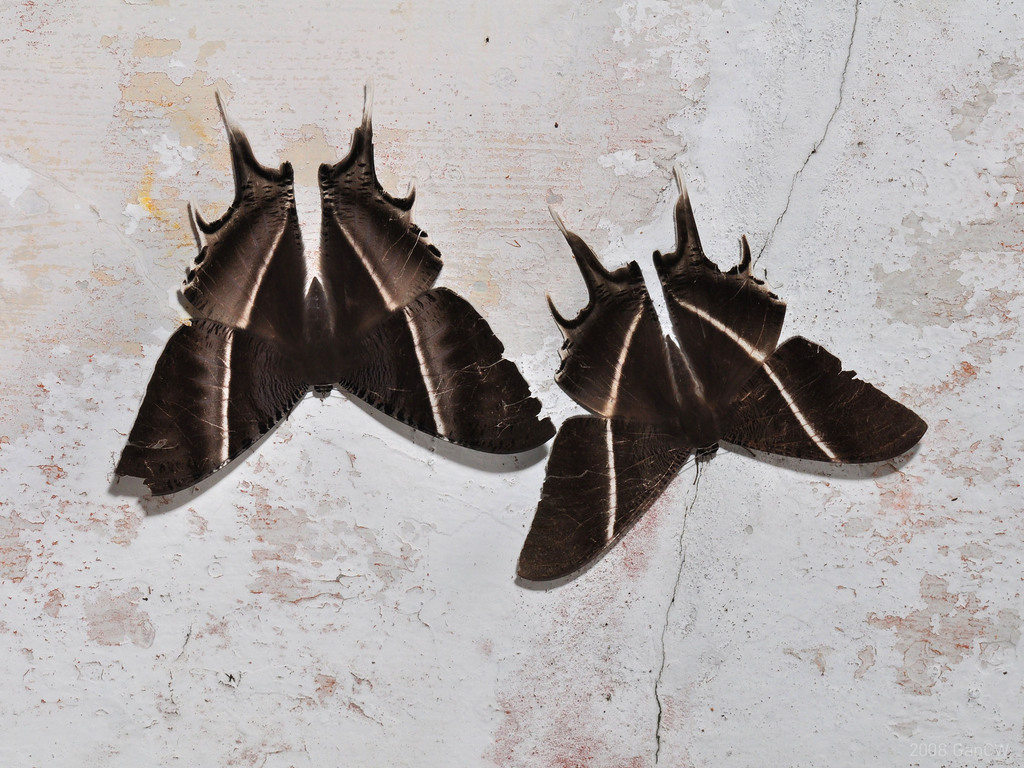
The tropical swallowtail moth is a large, day- and night-active moth found across tropical Southeast Asia and nearby regions.
Source: Wikipedia
Size
The forewing is about 70 mm long and the wingspan can reach up to 160 mm.
Source: Wikipedia
Where it lives
It lives in tropical Southeast Asian countries such as Indonesia, Singapore, Malaysia, Thailand and the Philippines. Moths may appear in cities when forest dry spells push them into urban areas.
Source: Wikipedia
What it eats
Caterpillars feed on Endospermum and other plants in the rubber-tree family (Euphorbiaceae).
Source: Wikipedia
When you see it
Adults are most common from May through November, depending on location.
Source: Wikipedia
Where it comes from
Beyond the core range, it is also found on the Andaman Islands, in southern China, the Himalayas, and occasionally in Taiwan, Japan and South Korea.
Source: Wikipedia
Where it is found in the US
Recorded in 1 of 51 states and DC. Most records: South Carolina.
Darker = more records. Counts are museum and citizen-science records, not population size.
Source: GBIF
More photos


Questions people ask
Can they damage my garden or trees?
The larvae feed on rubber-tree family plants and can damage those trees.
Source: Wikipedia
When are they most likely to be seen?
They are most abundant from May to November, and they can appear in urban areas during dry forest spells.
Source: Wikipedia
Same family (Uraniidae)
Sources
- Wikipedia: https://en.wikipedia.org/wiki/Lyssa_zampa
Look it up elsewhere: GBIF · iNaturalist · BugGuide · Wikipedia
Text written 2026-10-22 from the sources above and checked sentence by sentence against them. Data fetched 2026-10-22.