 Bug FAQ
Tree Locust
Anacridium moestum · Order: Orthoptera · Family: Acrididae
Source: Wikipedia


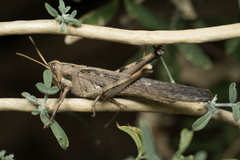
The tree locust grows to about 5 to 9 cm long and has a slender, mottled reddish-brown or grey body with green-speckled wing covers.
Source: Wikipedia
How to recognize it
Adults have a mottled reddish-brown or grey body, green-speckled forewings, pale blue hind wings with a black band, purplish hind tibiae, and vertically striped eyes and face; nymphs are yellowish-green.
Source: Wikipedia
Size
They reach a length of 50 to 90 mm (2.0 to 3.5 in).
Source: Wikipedia
Is it a pest in the house?
Tree locusts may occasionally damage crops and fruit trees, but they rarely form large swarms.
Source: Wikipedia
Where it lives
They are found on trees or shrubs in grassland areas that contain acacias.
Source: Wikipedia
What it eats
They feed on the leaves of acacia, Zizyphus, Capparis aphelia and gum trees.
Source: Wikipedia
Where it comes from
The species is native and widespread across southern and south-tropical Africa.
Source: Wikipedia
More photos


Questions people ask
Where does the tree locust live?
It lives on trees or shrubs in grasslands with acacias, mainly in southern and south-tropical Africa.
Source: Wikipedia
How big does a tree locust get?
Adults grow to about 5 to 9 cm (2.0 to 3.5 in) in length.
Source: Wikipedia
Can tree locusts damage my garden or orchard?
Yes, they can occasionally damage crops and fruit trees when they appear in swarms.
Source: Wikipedia
Same family (Acrididae)
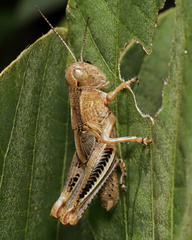 Differential GrasshopperMelanoplus differentialisDamages trees, gardens or crops
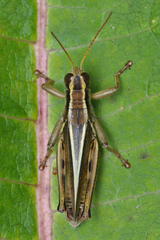 Two-striped GrasshopperMelanoplus bivittatusDamages trees, gardens or crops
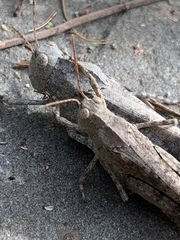 Carolina GrasshopperDissosteira carolinaDamages trees, gardens or crops
 Common Field GrasshopperChorthippus brunneus
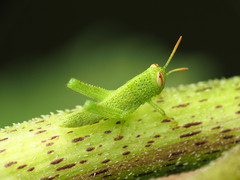 Egyptian Bird GrasshopperAnacridium aegyptium
 Gray Bird GrasshopperSchistocerca nitensDamages trees, gardens or crops
Sources
- Wikipedia: https://en.wikipedia.org/wiki/Anacridium_moestum
Look it up elsewhere: GBIF · iNaturalist · BugGuide · Wikipedia
Text written 2026-10-23 from the sources above and checked sentence by sentence against them. Data fetched 2026-10-23.