 Bug FAQ
Common Field Grasshopper
Chorthippus brunneus · Order: Orthoptera · Family: Acrididae
Also called: Field Grasshopper

The common field grasshopper is usually brown but can appear in many other colours and wing patterns. It lives in dry, short-grass habitats across Europe, North Africa and temperate Asia, and feeds on grasses. It has one generation per year, lays eggs in soil for about ten weeks, and adults can be seen through late autumn, especially in August.
Source: Wikipedia
How to recognize it
Adults are mostly brown, though individuals may be black, green, purple or white. Their wings may be plain, striped, mottled or a mix of stripes and mottling.
Source: Wikipedia
Where it lives
They prefer dry places, especially heathland, and like grass sward heights of 10 to 20 cm with fine-leaved species.
Source: Wikipedia
What it eats
They are herbivores that eat a variety of grasses.
Source: Wikipedia
Life cycle
They have one generation per year; females lay eggs over ten weeks in the soil, which hatch from April onward, and the young pass through four nymph stages before adulthood.
Source: Wikipedia
When you see it
Adults can survive into late autumn and are most common in August.
Source: Wikipedia
Where it comes from
They are common throughout the Western Palearctic, found in Europe, North Africa and temperate parts of Asia.
Source: Wikipedia
Lookalikes
In northern Spain they hybridise with C. jacobsi, and females of both species prefer the songs of pure males over hybrid males.
Source: Wikipedia
Status: introduced in Canada. Source: iNaturalist
More photos


Same family (Acrididae)
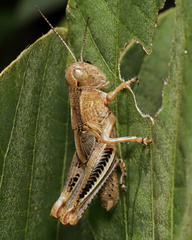 Differential GrasshopperMelanoplus differentialisDamages trees, gardens or crops
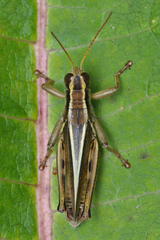 Two-striped GrasshopperMelanoplus bivittatusDamages trees, gardens or crops
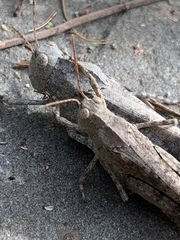 Carolina GrasshopperDissosteira carolinaDamages trees, gardens or crops
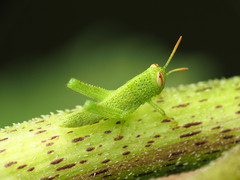 Egyptian Bird GrasshopperAnacridium aegyptium
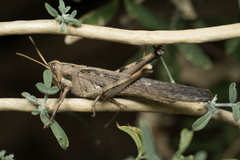 Gray Bird GrasshopperSchistocerca nitensDamages trees, gardens or crops
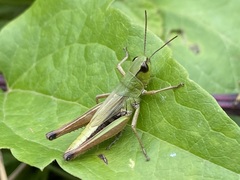 Meadow GrasshopperPseudochorthippus parallelus
Sources
- Wikipedia: https://en.wikipedia.org/wiki/Chorthippus_brunneus
Look it up elsewhere: GBIF · iNaturalist · BugGuide · Wikipedia
Text written 2026-10-22 from the sources above and checked sentence by sentence against them. Data fetched 2026-10-22.