 Bug FAQ
Tipu psyllid
Platycorypha nigrivirga · Order: Hemiptera · Family: Psyllidae
Source: Wikipedia

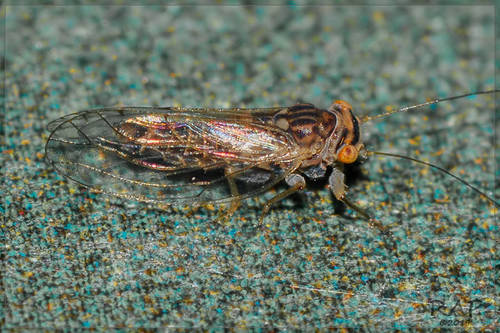
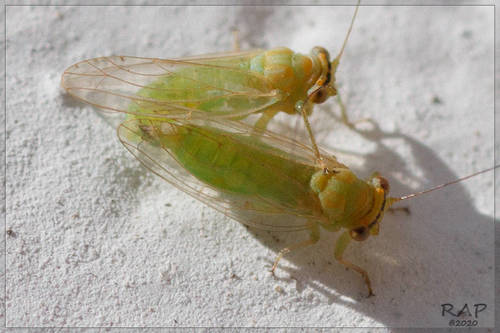
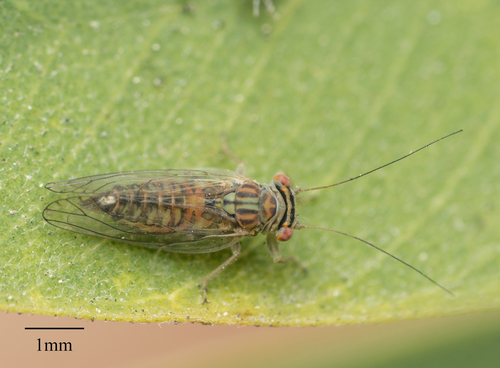
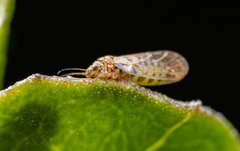
Tipu psyllid adults are yellowish-green with a dark stripe across the head and additional dark marks on the thorax. They feed on the phloem of Tipu trees, and their feeding makes young leaves and branches curl and fall off, harming ornamental plantings. The bug is native to parts of South America and has been recorded in the United States, Europe and Africa.
Source: Wikipedia
How to recognize it
Adults are yellowish or green with a dark transverse head stripe and dark thorax markings.
Source: Wikipedia
Is it a pest in the house?
Because its feeding damages ornamental Tipu trees, local authorities list it as a pest and invasive species.
Source: Wikipedia
Where it lives
This species is the only Platycorypha that uses Tipu trees (Tipuana tipu) as its host.
Source: Wikipedia
What it eats
Both nymphs and adults feed on the phloem of Tipu trees.
Source: Wikipedia
Where it comes from
Specimens have been collected in the United States as well as Argentina, Bolivia, Brazil, Uruguay and Spain. It is also known from other parts of Europe and Africa.
Source: Wikipedia
Where it is found in the US
Recorded in 1 of 51 states and DC. Most records: California.
Darker = more records. Counts are museum and citizen-science records, not population size.
Source: GBIF
Months it is reported in the US
Source: GBIF
More photos
Questions people ask
How does the Tipu psyllid harm trees?
Its nymphs and adults feed on phloem, causing young leaves and branches to curl and drop prematurely.
Source: Wikipedia
Where is the Tipu psyllid found?
It has been recorded in the United States, Argentina, Bolivia, Brazil, Uruguay, Spain, as well as other parts of Europe and Africa.
Source: Wikipedia
What does the Tipu psyllid look like?
Adults are yellowish-green with a dark stripe across the head, dark markings on the thorax, and a flat wing cell that is over 1.7 times wider than high.
Source: Wikipedia
Is the Tipu psyllid considered a pest?
Yes, local authorities classify it as a pest and invasive species because it damages ornamental Tipu trees.
Source: Wikipedia
Same family (Psyllidae)
Sources
- Wikipedia: https://en.wikipedia.org/wiki/Platycorypha_nigrivirga
Look it up elsewhere: GBIF · iNaturalist · BugGuide · Wikipedia
Text written 2026-10-28 from the sources above and checked sentence by sentence against them. Data fetched 2026-10-28.