 Bug FAQ
Tawny-edged Skipper
Polites themistocles · Order: Lepidoptera · Family: Hesperiidae
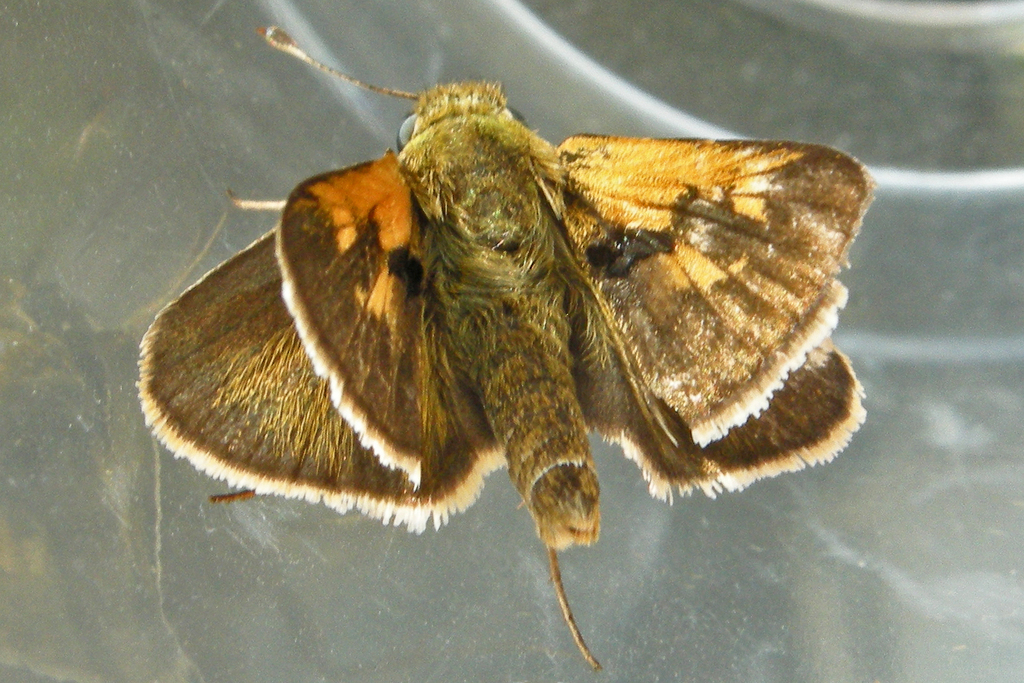
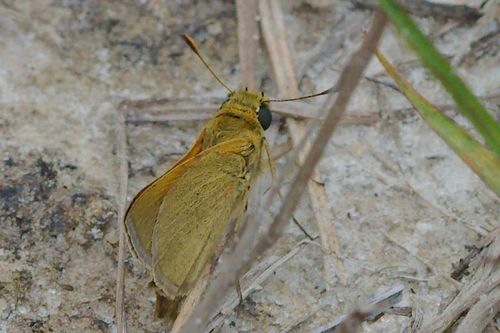
The tawny-edged skipper is a small North American butterfly with a wingspan of about three-quarters to one inch (19 to 25 mm). Males have brown or olive-brown upper wings with a bright orange stripe along the forewing costa that stops at the stigma, while the underside ranges from light brown to brownish-orange. It lives in many habitats such as alpine bogs, forest glades, moist meadows, savannas and stream sides, and its larvae feed on grasses like slender crabgrass, Panicum microcarpum and smooth meadow-grass.
Source: Wikipedia
How to recognize it
Male upper wings are brown or olive brown with a bright orange stripe along the forewing costa that ends at the stigma. Underside of the wings can be light brown, brown, or brownish-orange.
Source: Wikipedia
What it eats
Larvae feed on grasses such as slender crabgrass (Digitaria filiformis), Panicum microcarpum and smooth meadow-grass (Poa pratensis).
Source: Wikipedia
Life cycle
The larva builds a shelter by tying leaves together with silk.
Source: Wikipedia
Lookalikes
Crossline skippers are generally larger than tawny-edged skippers.
Source: Wikipedia
Where it is found in the US
Recorded in 48 of 51 states and DC. Most records: Illinois, Vermont, Ohio, Florida, Connecticut, New York, Massachusetts, Michigan.
Darker = more records. Counts are museum and citizen-science records, not population size.
Source: GBIF
Status: native in North America; native in United States; native in Canada. Source: iNaturalist
Months it is reported in the US
Source: GBIF
More photos
Questions people ask
What plants do the larvae eat?
The larvae feed on grasses such as slender crabgrass, Panicum microcarpum and smooth meadow-grass.
Source: Wikipedia
When can I see these butterflies?
In the north and west they fly from June to early August; in the east from May to August; and in the deep south from May to early November.
Source: Wikipedia
Same family (Hesperiidae)




Sources
- Wikipedia: https://en.wikipedia.org/wiki/Polites_themistocles
Look it up elsewhere: GBIF · iNaturalist · BugGuide · ITIS · Wikipedia
Text written 2026-10-22 from the sources above and checked sentence by sentence against them. Data fetched 2026-10-22.