 Bug FAQ
Sweetpotato Leaf Beetle
Aspidomorpha miliaris · Order: Coleoptera · Family: Chrysomelidae
Source: Wikipedia
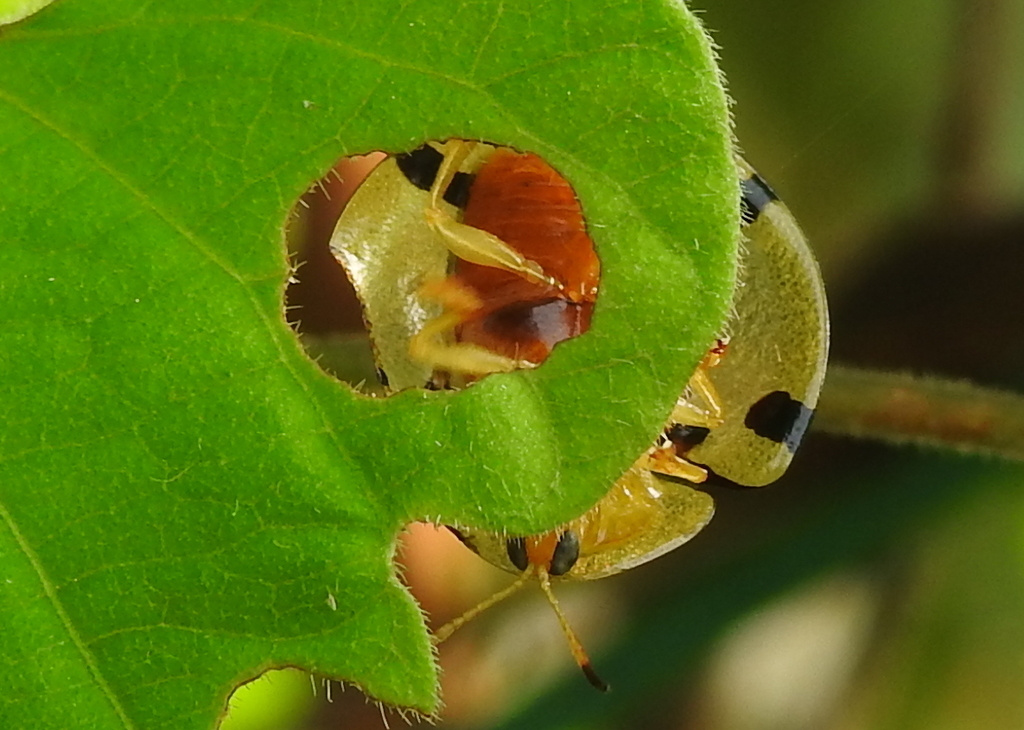
The beetle is about 15 mm long. Its back is yellow-brown with a variable pattern of black spots. Larvae feed together on Ipomoea species and can harm crops.
Source: Wikipedia
How to recognize it
The beetle’s back is yellowish-brown and covered with scattered black spots, which can range from few to many.
Source: Wikipedia
Size
Adults grow to about 15 mm (0.59 in) in length.
Source: Wikipedia
Where it lives
It occurs throughout Southeast Asia and India.
Source: Wikipedia
What it eats
Larvae live gregariously and feed on plants of the genus Ipomoea, which can include cultivated crops.
Source: Wikipedia
Life cycle
The larvae are gregarious feeders on Ipomoea species.
Source: Wikipedia
Where it comes from
Its native range includes Southeast Asia and India.
Source: Wikipedia
Lookalikes
It is often considered the same as populations of Aspidimorpha sanctaecrucis found on Ipomoea carnea.
Source: Wikipedia
Questions people ask
What plants does the Sweetpotato Leaf Beetle damage?
Its larvae feed on Ipomoea species, which can include cultivated sweet-potato vines.
Source: Wikipedia
How can I recognize this beetle?
Look for a yellow-brown back with scattered black spots; the number of spots varies widely.
Source: Wikipedia
Same family (Chrysomelidae)
 Spotted Cucumber BeetleDiabrotica undecimpunctataDamages trees, gardens or crops
 Bean WeevilAcanthoscelides obtectusDamages trees, gardens or crops
 Cowpea WeevilCallosobruchus maculatusDamages trees, gardens or crops
 Swamp Milkweed Leaf BeetleLabidomera clivicollisDamages trees, gardens or crops
 Alder Leaf BeetleAgelastica alniDamages trees, gardens or crops
 Dogbane Leaf BeetleChrysochus auratus
Sources
- Wikipedia: https://en.wikipedia.org/wiki/Aspidimorpha_miliaris
Look it up elsewhere: GBIF · iNaturalist · BugGuide · Wikipedia
Text written 2026-10-22 from the sources above and checked sentence by sentence against them. Data fetched 2026-10-22.