 Bug FAQ
Sumac Flea Beetle
Blepharida rhois · Order: Coleoptera · Family: Chrysomelidae
Source: Wikipedia
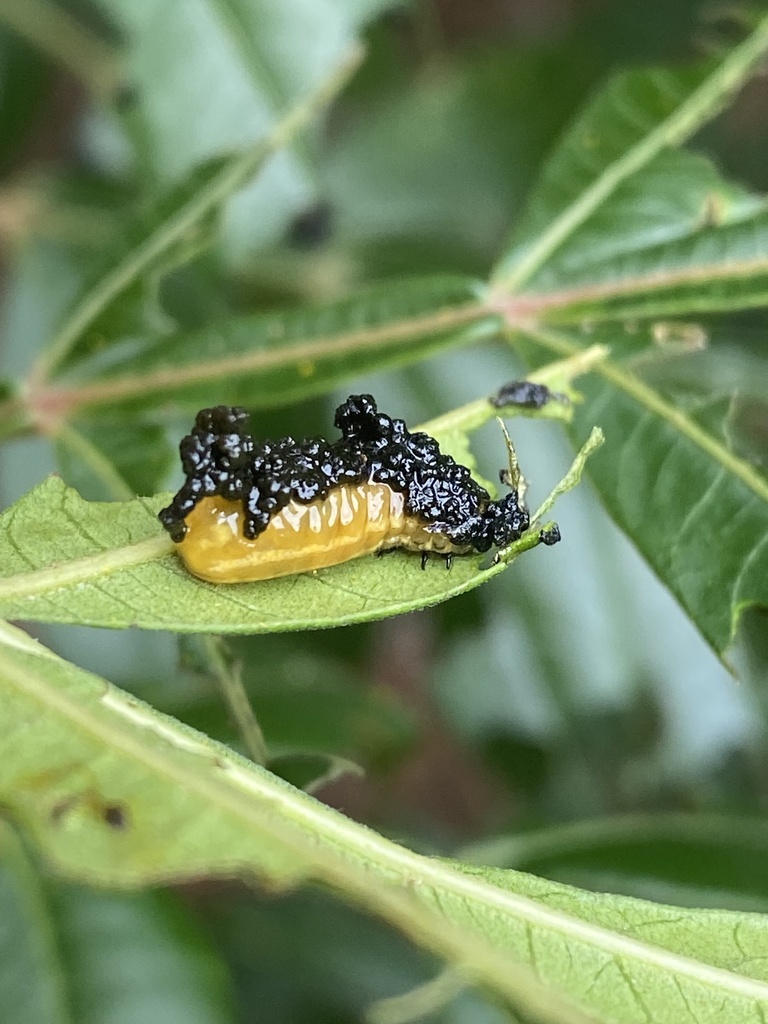
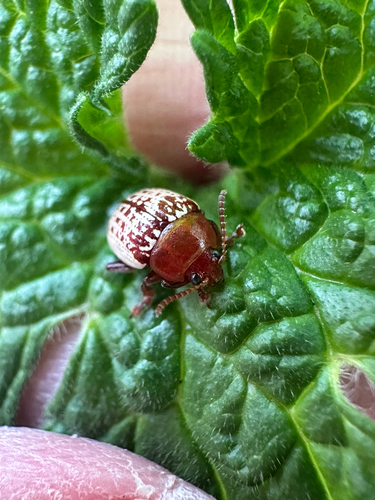
Adults are about a quarter of an inch long, cream-colored with irregular reddish markings, while larvae are the same size, gray with yellow stripes. Both stages feed exclusively on the leaves of sumac (Rhus), and heavy feeding can kill the plant if not watched. They are found across much of North America, from Virginia to Alberta and west to Montana.
Source: Wikipedia
Size
Both larvae and adults measure about a quarter of an inch long.
Source: Wikipedia
Is it a pest in the house?
The beetle is considered a pest of sumac trees. Larval feeding can kill the plant if not monitored.
Source: Wikipedia
How to get rid of it
Integrated pest management recommends checking leaves for larvae in mid to late May. Insecticides can be applied to branches and leaves soon after eggs hatch to control larvae.
Source: Wikipedia
Where it lives
They feed on the surface of sumac leaves. In winter they hide under leaves, in soil, or among weeds near fields or ditches.
Source: Wikipedia
What it eats
Both adults and larvae are specialists that eat only sumac (Rhus) leaves.
Source: Wikipedia
Life cycle
Females lay eggs in fecal casings on leaves and branches. Larvae hatch about two weeks after the eggs are laid. Full-grown larvae drop to the soil to pupate. Adults emerge from the pupae roughly two weeks later.
Source: Wikipedia
When you see it
Adult activity follows the availability of sumac leaves. When food is abundant, adults stay on a plant; otherwise they hop between plants. Overwintering adults emerge in early spring and immediately lay eggs on sumac stems.
Source: Wikipedia
Where it comes from
The species is native to North America. Its range extends from Virginia to Alberta in the east and to Montana in the west.
Source: Wikipedia
Lookalikes
It belongs to the Alticinae subfamily, which contains over 1,000 species in 550 genera. Most New World Alticinae feed on Bursera, making this beetle unusual for feeding on Rhus.
Source: Wikipedia
Where it is found in the US
Recorded in 42 of 51 states and DC. Most records: Florida, Minnesota, Colorado, Maryland, Utah, Massachusetts, Texas, Michigan.
Darker = more records. Counts are museum and citizen-science records, not population size.
Source: GBIF
Status: native in North America; native in Canada. Source: iNaturalist
Months it is reported in the US
Source: GBIF
More photos
Questions people ask
How can I control sumac flea beetles?
Monitor leaves for larvae in mid-late May and apply insecticide to branches and leaves shortly after eggs hatch.
Source: Wikipedia
When do the beetles lay eggs?
Overwintering adults emerge in early spring and lay eggs on sumac stems right away.
Source: Wikipedia
What damage do they cause?
Larvae feed on sumac leaves and can kill the plant if the feeding is heavy.
Source: Wikipedia
Same family (Chrysomelidae)
 Spotted Cucumber BeetleDiabrotica undecimpunctataDamages trees, gardens or crops
 Bean WeevilAcanthoscelides obtectusDamages trees, gardens or crops
 Cowpea WeevilCallosobruchus maculatusDamages trees, gardens or crops
 Swamp Milkweed Leaf BeetleLabidomera clivicollisDamages trees, gardens or crops
 Alder Leaf BeetleAgelastica alniDamages trees, gardens or crops
 Dogbane Leaf BeetleChrysochus auratus
Sources
- Wikipedia: https://en.wikipedia.org/wiki/Blepharida_rhois
Look it up elsewhere: GBIF · iNaturalist · BugGuide · ITIS · Wikipedia
Text written 2026-10-23 from the sources above and checked sentence by sentence against them. Data fetched 2026-10-23.