 Bug FAQ
Styrian praying lacewing
Mantispa styriaca · Order: Neuroptera · Family: Mantispidae
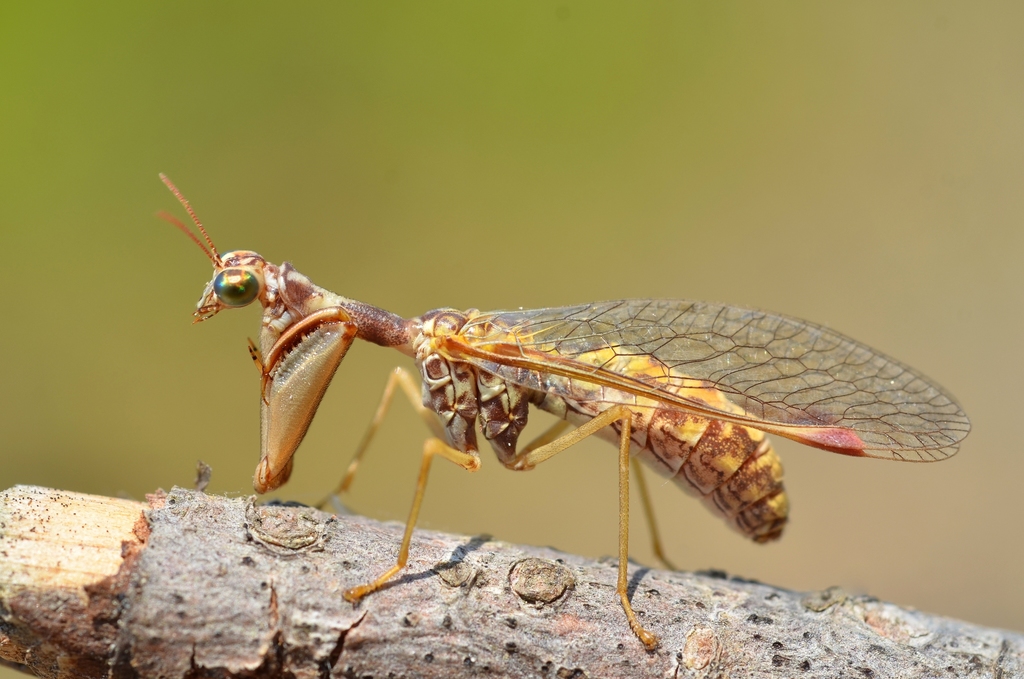
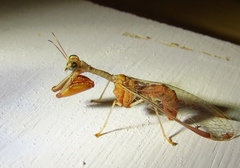
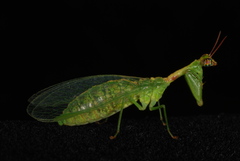
The Styrian praying lacewing is a yellow-brown insect about 35 mm across with clear wings and mantis-like forelegs used to catch prey. It lives in southern and central Europe, where the larvae hatch from reddish eggs after about three weeks, overwinter, and pupate in mid-June before becoming adults. Adults hunt quickly, striking prey in less than 60 ms, while early larvae are carnivorous and have been found with dead spiders nearby.
Source: Wikipedia
How to recognize it
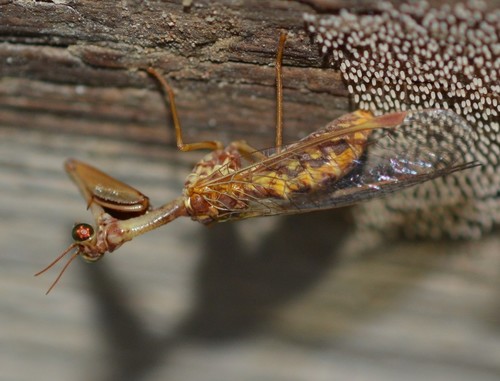
Adults are yellow-brown with transparent wings; the species goes through several larval stages.
Source: Wikipedia
Size
Wingspan is about 35 mm (1.4 in).
Source: Wikipedia
Where it lives
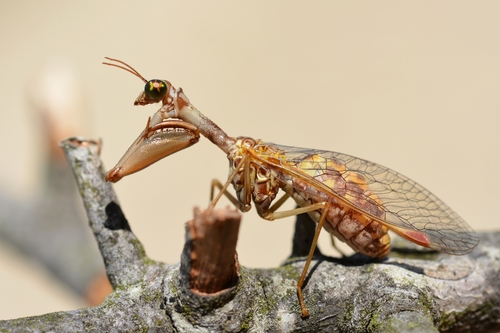
Forelegs resemble those of a praying mantis and are used to seize living prey.
Source: Wikipedia
What it eats
First-stage larvae are carnivorous, often found with dead spiders. Adult lacewings capture prey with rapid foreleg strikes lasting under 60 ms.
Source: Wikipedia
Life cycle
Eggs are reddish; larvae emerge after about 21 days and then hibernate through winter. Pupation occurs in mid-June, after which the insect emerges as a nymph before reaching adult form.
Source: Wikipedia
When you see it
Pupation takes place in the middle of June.
Source: Wikipedia
Where it comes from
It is native to southern and central Europe.
Source: Wikipedia
Lookalikes
Before molting, the larva resembles a dipluran of the genus Campodea.
Source: Wikipedia
More photos

Questions people ask
When do Styrian praying lacewings appear?
They pupate in mid-June and the adults emerge shortly after.
Source: Wikipedia
What do the larvae look like?
The early larva looks like a Campodea dipluran before it molts.
Source: Wikipedia
How can I tell this insect apart from similar bugs?
Adults are yellow-brown with clear wings and mantis-like forelegs; larvae initially resemble Campodea diplurans.
Source: Wikipedia
Same family (Mantispidae)

Sources
- Wikipedia: https://en.wikipedia.org/wiki/Mantispa_styriaca
Look it up elsewhere: GBIF · iNaturalist · BugGuide · ITIS · Wikipedia
Text written 2026-10-23 from the sources above and checked sentence by sentence against them. Data fetched 2026-10-22.