 Bug FAQ
Say's Mantidfly
Dicromantispa sayi · Order: Neuroptera · Family: Mantispidae
Also called: Say's Mantisfly
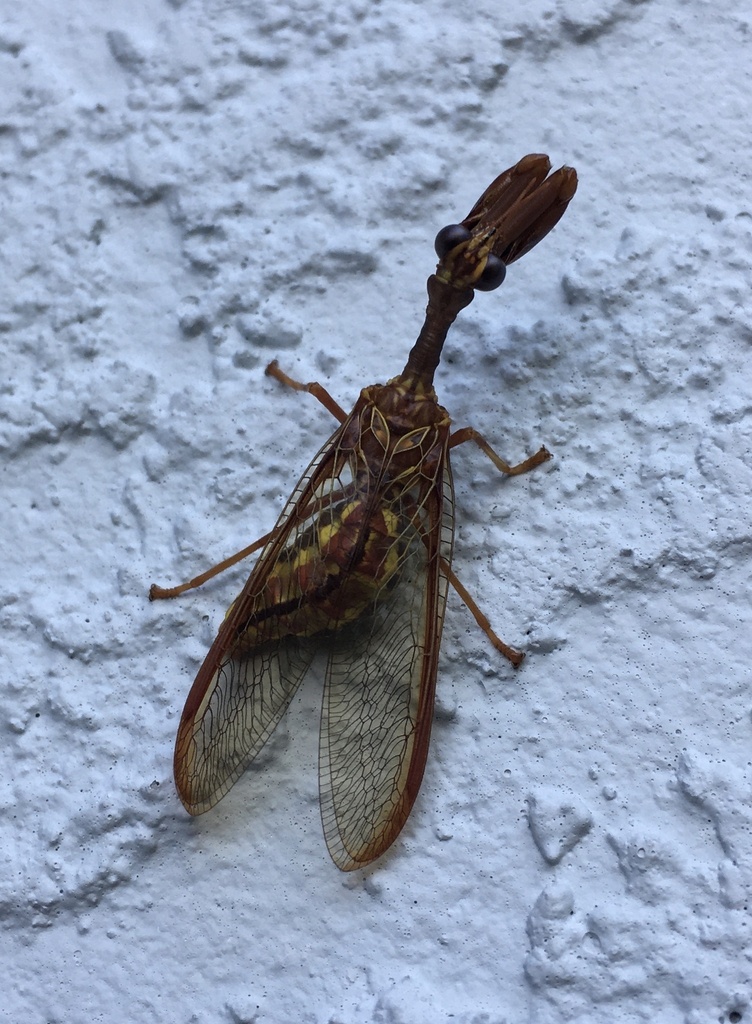
Say's mantidfly is a 14-15 mm long insect with a brown to black head marked with pale yellow and clear wings that have brown veins but no spots at the tips. It lives on forest edges and prairies where spiders occur, is found from the Caribbean through Central America into North America, and adults fly from mid-July to early September. Adults eat small flying insects, while larvae hunt spider eggs, especially those of wolf spiders and the running crab spider Philodromus vulgaris; females lay eggs on any surface and there is one generation each year.
Source: Wikipedia
How to recognize it
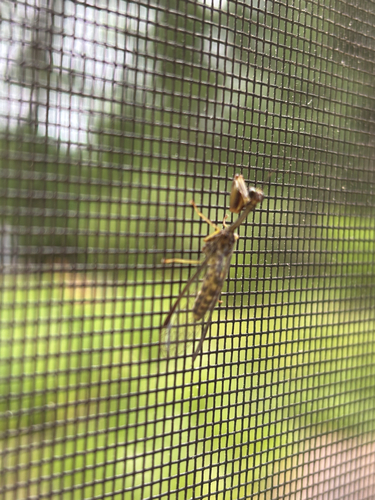
The head is brown to black with pale yellow markings. Wings are clear with brown veins and lack brown spots at the tips.
Source: Wikipedia
Size
Length ranges from 14 to 15 mm.
Source: Wikipedia
What it eats
Adults feed on small flying insects.
Source: Wikipedia
Life cycle
Females lay eggs on any substrate. There is one generation per year.
Source: Wikipedia
When you see it
Adults are on the wing from July 15 to September 4, with a peak in late July.
Source: Wikipedia
Lookalikes
Dicromantispa interrupta is larger and has a dark patch near the wing tip. Leptomantispa pulchella shows paired yellow stripes of equal width on the abdomen, unlike the uneven pattern of D. sayi.
Source: Wikipedia
Where it is found in the US
Recorded in 43 of 51 states and DC. Most records: Texas, Ohio, Massachusetts, Florida, New York, Illinois, Connecticut, Maryland.
Darker = more records. Counts are museum and citizen-science records, not population size.
Source: GBIF
Status: native in North America; native in Canada; native in United States. Source: iNaturalist
Months it is reported in the US
Source: GBIF
More photos
Questions people ask
How can I tell Say's mantidfly apart from similar species?
Look for the 14-15 mm size, a brown-black head with pale yellow marks, clear wings with brown veins and no tip spots; larger D. interrupta has a dark wing-tip patch, while L. pulchella has paired equal yellow stripes on the abdomen.
Source: Wikipedia
When will I see these insects?
Adults are active from mid-July through early September, with most sightings at the end of July.
Source: Wikipedia
What do the larvae eat?
The larvae hunt spider eggs, especially those of wolf spiders and the running crab spider Philodromus vulgaris.
Source: Wikipedia
Same family (Mantispidae)


Sources
- Wikipedia: https://en.wikipedia.org/wiki/Dicromantispa_sayi
Look it up elsewhere: GBIF · iNaturalist · BugGuide · ITIS · Wikipedia
Text written 2026-10-22 from the sources above and checked sentence by sentence against them. Data fetched 2026-10-22.