 Bug FAQ
Brown Wasp Mantidfly
Climaciella brunnea · Order: Neuroptera · Family: Mantispidae
Also called: Wasp Mantidfly, Brown Wasp Mantisfly, Wasp Mantisfly

Brown wasp mantidflies are 2 to 3 cm long and mimic local Polistes wasps with many color forms. Adults sit on flowers in forest clearings, while larvae attach to substrates with a caudal sucker and later feed on spider eggs. They occur from Canada through the United States down to Nicaragua and gather in groups when attracted by male pheromones.
Source: Wikipedia
How to recognize it
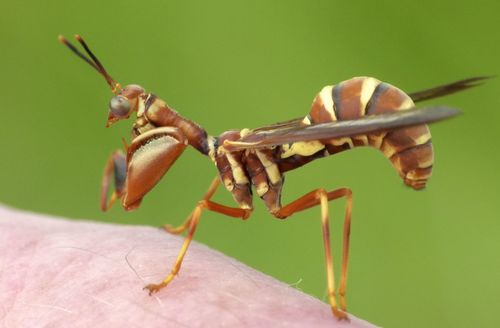
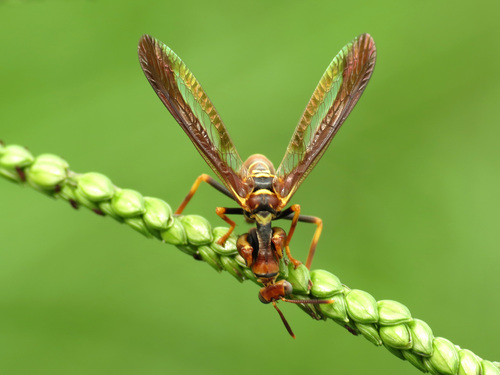
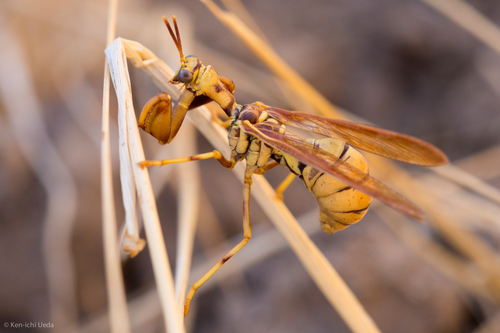
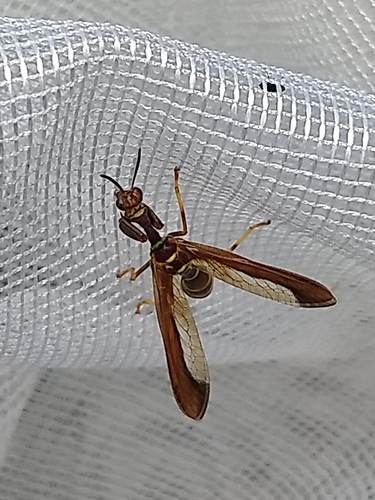
Their markings copy those of Polistes wasps and they show strong color polymorphism to match local wasp species.
Source: Wikipedia
Size
Body length ranges from 2 to 3 cm.
Source: Wikipedia
Where it lives
Adults are found perched on vegetation or flower heads in forest clearings, often waiting for prey or feeding on nectar.
Source: Wikipedia
What it eats
Larvae use a caudal sucker to attach to surfaces, then wave their bodies before feeding on spider eggs inside the sac.
Source: Wikipedia
Life cycle
First-instar larvae are campodeiform and hitch rides on adult spiders to reach spider egg sacs.
Source: Wikipedia
When you see it
Groups gather where male pheromones are present to breed and feed.
Source: Wikipedia
Where it comes from
They are native from Canada and the United States southward to Nicaragua.
Source: Wikipedia
Lookalikes
They have a triangular head, large compound eyes, a broad frons, and straight antennae.
Source: Wikipedia
Where it is found in the US
Recorded in 46 of 51 states and DC. Most records: Texas, Wisconsin, Minnesota, Michigan, Vermont, Massachusetts, Ohio, Illinois.
Darker = more records. Counts are museum and citizen-science records, not population size.
Source: GBIF
Status: native in North America; native in Canada; native in United States. Source: iNaturalist
Months it is reported in the US
Source: GBIF
More photos
Questions people ask
What do Brown wasp mantidflies look like?
They have a triangular head with large compound eyes, a broad frons, straight antennae, and wasp-like coloration that varies by region.
Source: Wikipedia
What do the larvae eat?
Larvae attach to substrates with a caudal sucker, then feed on spider eggs inside the sac using a specialized sucking tube.
Source: Wikipedia
When are they most active?
Adults gather in groups when attracted by male pheromones to breed and feed.
Source: Wikipedia
Same family (Mantispidae)

Sources
- Wikipedia: https://en.wikipedia.org/wiki/Climaciella_brunnea
Look it up elsewhere: GBIF · iNaturalist · BugGuide · ITIS · Wikipedia
Text written 2026-10-22 from the sources above and checked sentence by sentence against them. Data fetched 2026-10-22.