 Bug FAQ
Striped lax beetle
Thelyphassa lineata · Order: Coleoptera · Family: Oedemeridae
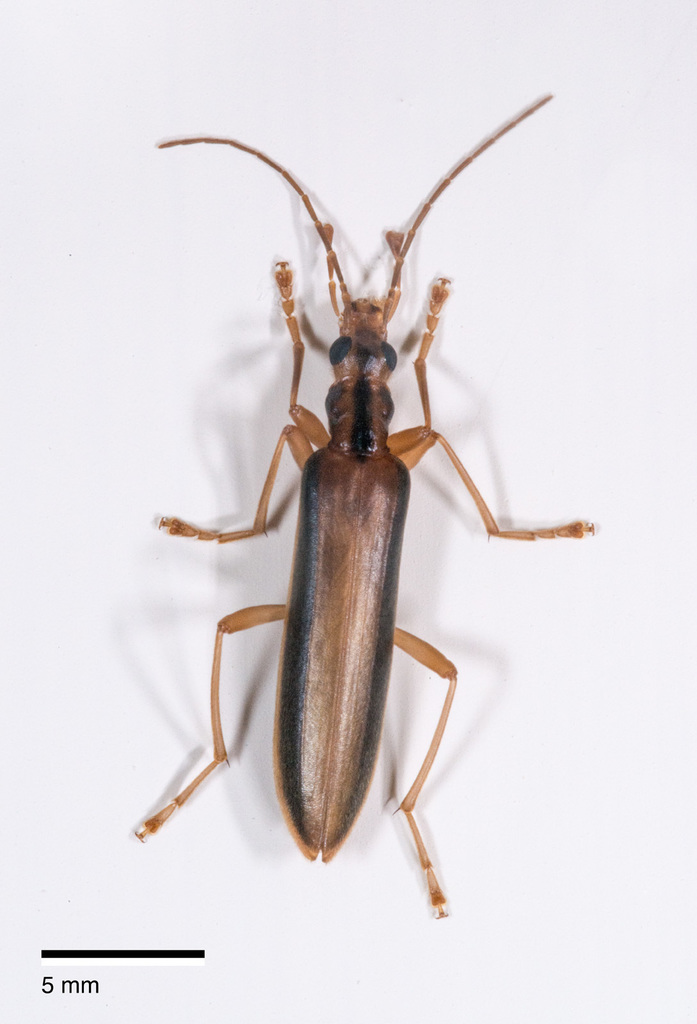
Adults are about 15 mm long. They have a golden-brown body with two black stripes on the abdomen and one on the pronotum. The species lives only in New Zealand and its larvae develop in rotting forest logs, while adults likely feed on pollen and nectar.
Source: Wikipedia
How to recognize it
The beetle’s body is golden-brown with two black side stripes on the abdomen and a single black stripe on the pronotum.
Source: Wikipedia
Size
Adults measure roughly 15 mm in length.
Source: Wikipedia
What it eats
Larvae live in decaying forest logs.
Source: Wikipedia
Where it comes from
It is endemic to New Zealand.
Source: Wikipedia
Where it is found in the US
Recorded in 1 of 51 states and DC. Most records: Hawaii.
Darker = more records. Counts are museum and citizen-science records, not population size.
Source: GBIF
Months it is reported in the US
Source: GBIF
More photos

Questions people ask
What does the striped lax beetle look like?
It has a golden-brown body with two black stripes along the abdomen and one black stripe on the pronotum.
Source: Wikipedia
Same family (Oedemeridae)

Sources
- Wikipedia: https://en.wikipedia.org/wiki/Thelyphassa_lineata
Look it up elsewhere: GBIF · iNaturalist · BugGuide · Wikipedia
Text written 2026-10-23 from the sources above and checked sentence by sentence against them. Data fetched 2026-10-23.