 Bug FAQ
Streaked Ethmia
Ethmia longimaculella · Order: Lepidoptera · Family: Ethmiidae
Also called: Streaked Ethmia Moth
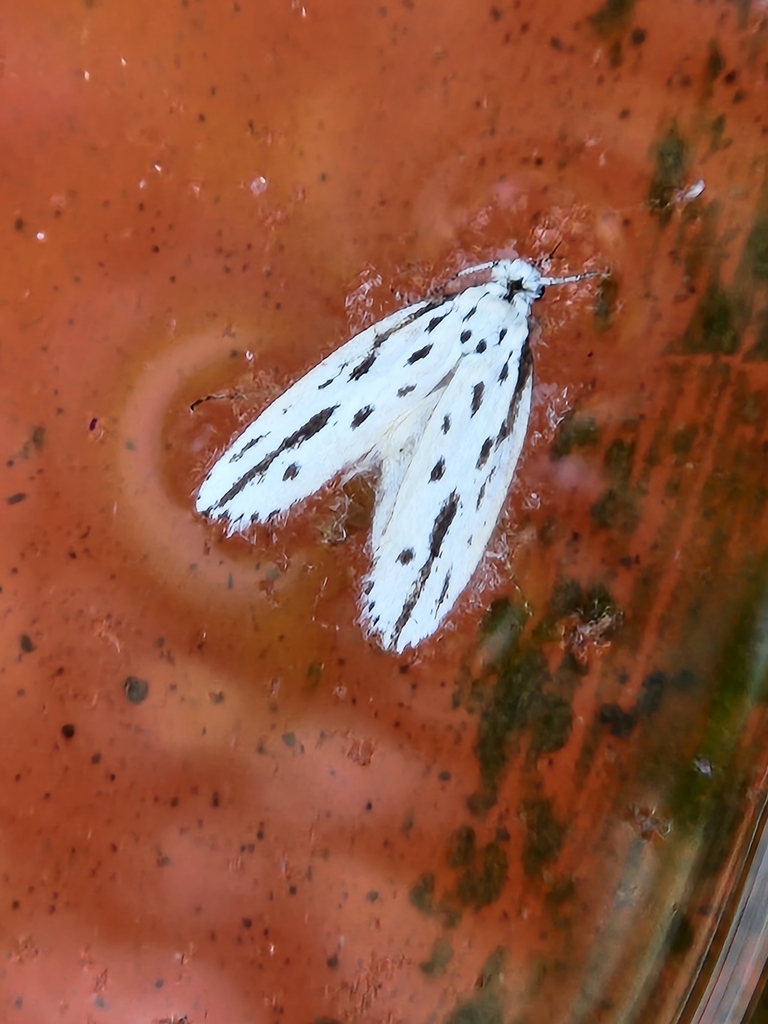
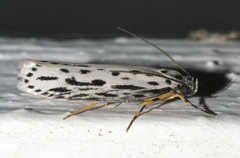
The forewings measure about 9 to 11 mm long. The front wings are white with black, mostly longitudinal streaks, while the hind wings are whitish turning pale brown near the base. It lives east of the Rockies from southern Canada down through the northern United States and into Texas.
Source: Wikipedia
How to recognize it
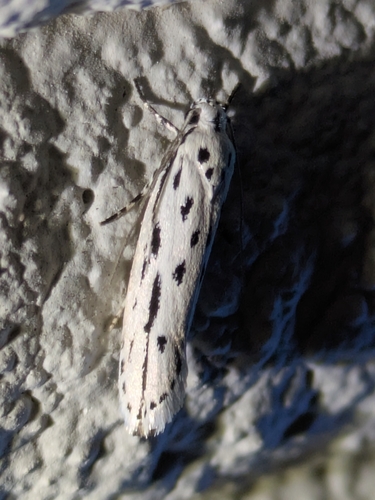
The forewings have a white background crossed by black streaks that run lengthwise. The hindwings are a whitish color that becomes pale brown toward the body.
Source: Wikipedia
Size
Forewing length ranges from 8.8 mm to 11.2 mm.
Source: Wikipedia
Where it lives
It is found east of the Rocky Mountains in southern Canada and the northern United States. In the Midwest its range reaches as far south as Texas.
Source: Wikipedia
What it eats
Larvae feed on plants of the Lithospermum genus, such as L. officinale and L. latifolium. They have also been raised on Onosmodium hispidissimum.
Source: Wikipedia
Life cycle
Adults of the subspecies longimaculella are typically on the wing from late May through early July.
Source: Wikipedia
When you see it
The flight period for longimaculella spans late May to early July, while coranella appears in May, June and August.
Source: Wikipedia
Where it comes from
The distribution extends southward into Texas in the Midwest.
Source: Wikipedia
Where it is found in the US
Recorded in 11 of 51 states and DC. Most records: Tennessee, Texas, Minnesota, Vermont, Virginia, Oklahoma, Kentucky, Ohio.
Darker = more records. Counts are museum and citizen-science records, not population size.
Source: GBIF
Months it is reported in the US
Source: GBIF
More photos
Questions people ask
What plants do the larvae eat?
The caterpillars feed on Lithospermum species like L. officinale and L. latifolium, and they can also develop on Onosmodium hispidissimum.
Source: Wikipedia
When are the adult moths active?
Longimaculella adults fly from late May to early July, and coranella adults have been seen in May, June and August.
Source: Wikipedia
Same family (Ethmiidae)


Sources
- Wikipedia: https://en.wikipedia.org/wiki/Ethmia_longimaculella
Look it up elsewhere: GBIF · iNaturalist · BugGuide · Wikipedia
Text written 2026-10-29 from the sources above and checked sentence by sentence against them. Data fetched 2026-10-29.