 Bug FAQ
Mountain-mahogany Moth
Ethmia discostrigella · Order: Lepidoptera · Family: Ethmiidae
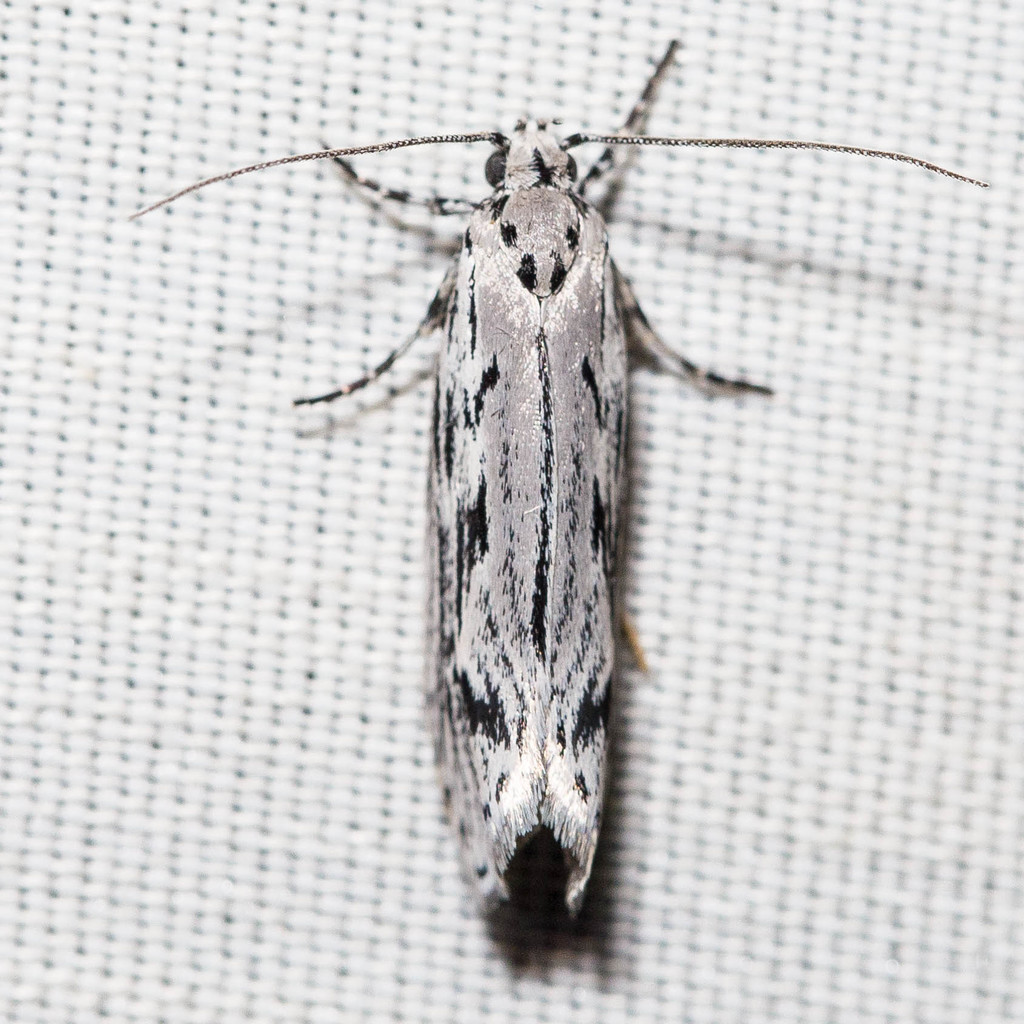
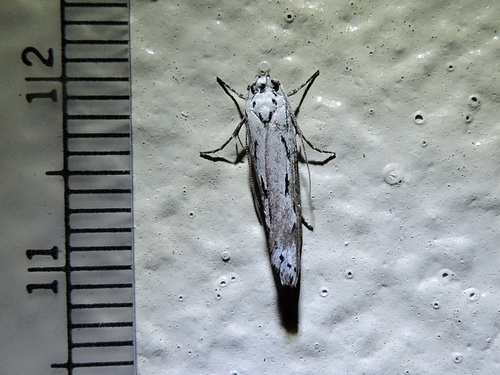
The mountain-mahogany moth has forewings 10.4 to 14.7 mm long and dark gray wings speckled with whitish scales. It lives in the western United States and extends south into Mexico, where its larvae feed on various Cercocarpus shrubs.
Source: Wikipedia
How to recognize it
Forewings are dark gray with scattered whitish scales. Hindwings are pale gray, turning whitish-ochre toward the anal area.
Source: Wikipedia
What it eats
Larvae of the nominate subspecies eat Cercocarpus ledifolius and probably other Cercocarpus species.
Source: Wikipedia
Life cycle
Adults of the nominate subspecies fly from April to September, producing several generations each year in the south.
Source: Wikipedia
When you see it
The nominate subspecies is active April-September; subcaerulea is active March-September.
Source: Wikipedia
Where it comes from
Its native range includes the western United States and extends into Mexico.
Source: Wikipedia
Where it is found in the US
Recorded in 13 of 51 states and DC. Most records: California, Arizona, Colorado, New Mexico, Texas, Nevada, Montana, Utah.
Darker = more records. Counts are museum and citizen-science records, not population size.
Source: GBIF
Status: native in North America; native in United States. Source: iNaturalist
Months it is reported in the US
Source: GBIF
More photos
Questions people ask
When are adult mountain-mahogany moths active?
The nominate form flies from April through September, while subspecies subcaerulea is on wing from March through September, with several generations each year.
Source: Wikipedia
What do the larvae feed on?
Larvae of the main form eat Cercocarpus ledifolius and likely other Cercocarpus species; the subcaerulea subspecies feeds on Cercocarpus betuloides and Cercocarpus minutiflorus.
Source: Wikipedia
Same family (Ethmiidae)
Sources
- Wikipedia: https://en.wikipedia.org/wiki/Ethmia_discostrigella
Look it up elsewhere: GBIF · iNaturalist · BugGuide · Wikipedia
Text written 2026-10-24 from the sources above and checked sentence by sentence against them. Data fetched 2026-10-24.