 Bug FAQ
Spur-throated Locust
Austracris guttulosa · Order: Orthoptera · Family: Acrididae
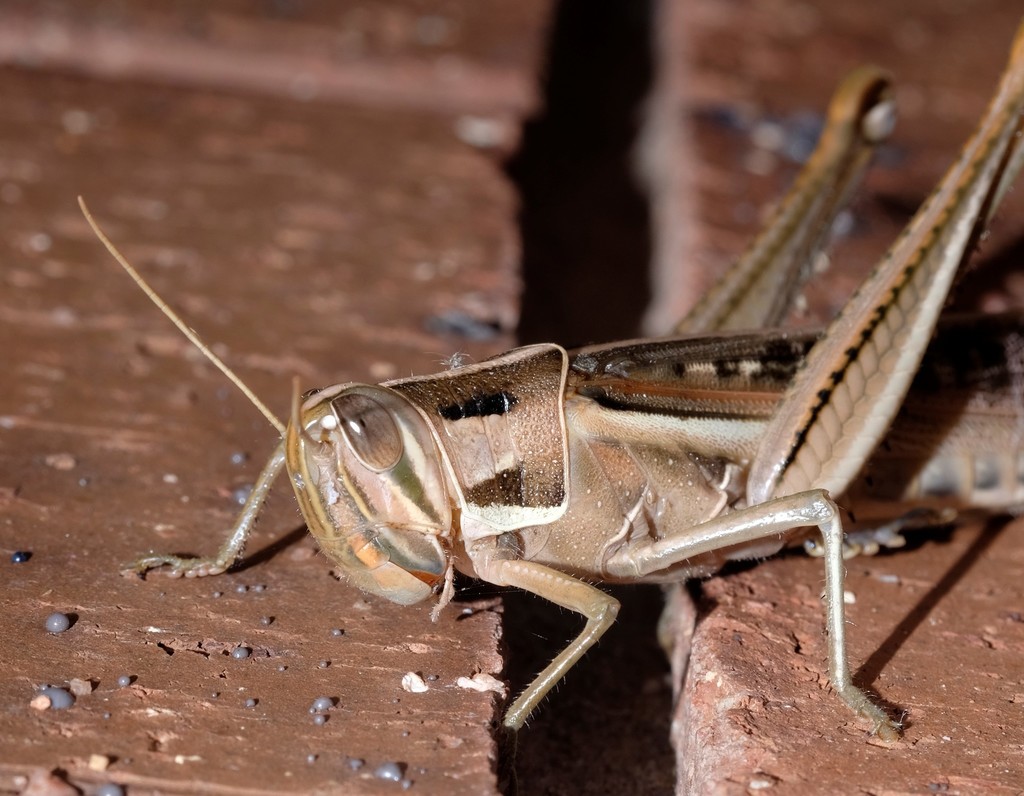
It is a native Australian locust that lives about ten to twelve months, from autumn to summer, and is considered an agricultural pest in several states.
Source: Wikipedia
How to recognize it
Adults are pale brown with colourless wings, white and dark markings on the thorax, and yellow hind legs bearing two rows of white spines; juveniles are green or yellow and may have a dark or pale stripe on the back.
Source: Wikipedia
How to get rid of it
Overpopulation is managed by the Australian Plague Locust Commission.
Source: Wikipedia
Life cycle
Its life span is ten to twelve months, spanning from autumn to summer.
Source: Wikipedia
When you see it
It is present from autumn through summer during its ten-to-12-month life cycle.
Source: Wikipedia
Where it comes from
The spur-throated locust is native to Australia.
Source: Wikipedia
Questions people ask
How can I control a spur-throated locust outbreak?
The Australian Plague Locust Commission handles control measures for overpopulations.
Source: Wikipedia
What do adult spur-throated locusts look like?
Adults are pale brown with colourless wings, white and dark thorax markings, and yellow hind legs with two rows of white spines; they are 35 to 65 mm long depending on sex.
Source: Wikipedia
Same family (Acrididae)
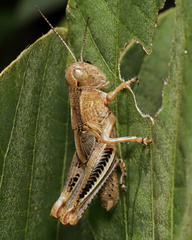 Differential GrasshopperMelanoplus differentialisDamages trees, gardens or crops
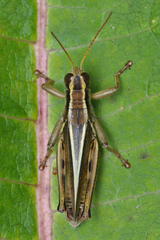 Two-striped GrasshopperMelanoplus bivittatusDamages trees, gardens or crops
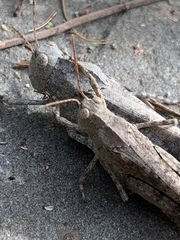 Carolina GrasshopperDissosteira carolinaDamages trees, gardens or crops
 Common Field GrasshopperChorthippus brunneus
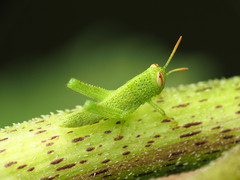 Egyptian Bird GrasshopperAnacridium aegyptium
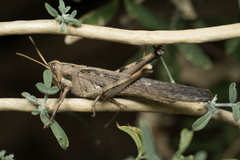 Gray Bird GrasshopperSchistocerca nitensDamages trees, gardens or crops
Sources
- Wikipedia: https://en.wikipedia.org/wiki/Spur-throated_locust
Look it up elsewhere: GBIF · iNaturalist · BugGuide · Wikipedia
Text written 2026-10-23 from the sources above and checked sentence by sentence against them. Data fetched 2026-10-22.