 Bug FAQ
Spotted Willow Leaf Beetle
Chrysomela vigintipunctata · Order: Coleoptera · Family: Chrysomelidae
Source: Wikipedia


They live in forests, near lakes and swamps, and both larvae and adults eat the leaves of willow and poplar, especially other Salicaceae species. The beetle occurs across most of Europe, Mongolia, the Russian Far East and Japan.
Source: Wikipedia
Size
Adults range from about 6.5 mm to 9.2 mm in length.
Source: Wikipedia
Where it lives
They are found mainly in forests, along lakes and swamps, where they feed on willow and poplar.
Source: Wikipedia
What it eats
Both larvae and adults eat the leaves of their host plants, especially species in the Salicaceae family.
Source: Wikipedia
Where it comes from
They are native to most of Europe, Mongolia, the Russian Far East and Japan.
Source: Wikipedia
Where it is found in the US
Recorded in 1 of 51 states and DC. Most records: Indiana.
Darker = more records. Counts are museum and citizen-science records, not population size.
Source: GBIF
Questions people ask
How big are spotted willow leaf beetles?
Adults measure between 6.5 mm and 9.2 mm long.
Source: Wikipedia
Where are they found?
They occur across most of Europe, Mongolia, the Russian Far East and Japan.
Source: Wikipedia
Same family (Chrysomelidae)
 Spotted Cucumber BeetleDiabrotica undecimpunctataDamages trees, gardens or crops
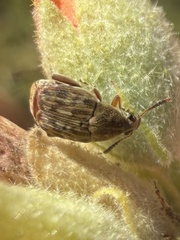 Bean WeevilAcanthoscelides obtectusDamages trees, gardens or crops
 Cowpea WeevilCallosobruchus maculatusDamages trees, gardens or crops
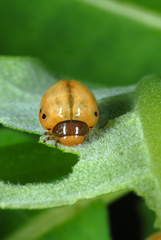 Swamp Milkweed Leaf BeetleLabidomera clivicollisDamages trees, gardens or crops
 Alder Leaf BeetleAgelastica alniDamages trees, gardens or crops
 Dogbane Leaf BeetleChrysochus auratus
Sources
- Wikipedia: https://en.wikipedia.org/wiki/Chrysomela_vigintipunctata
Look it up elsewhere: GBIF · iNaturalist · BugGuide · Wikipedia
Text written 2026-10-23 from the sources above and checked sentence by sentence against them. Data fetched 2026-10-22.