 Bug FAQ
Spotted Cranefly
Nephrotoma appendiculata · Order: Diptera · Family: Tipulidae
Also called: Spotted Crane Fly
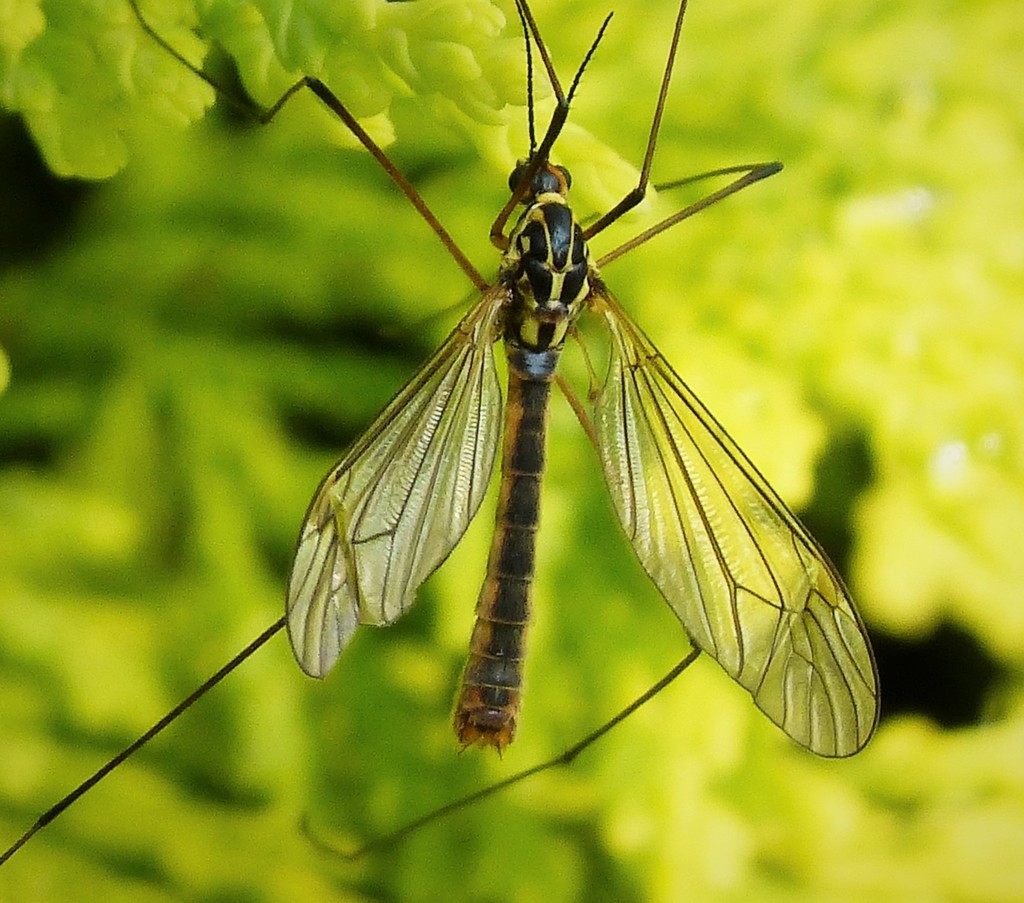
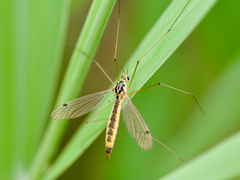
Spotted crane flies are about 13 to 15 mm long with a wingspan near 50 mm and have a yellow body marked with black stripes and a distinctive black horseshoe on the side. They live on woodland edges, gardens, fields and farmland across most of Europe, North Africa, the Near East and parts of southern Alberta, and adults are seen from April to August.
Source: Wikipedia
Where it lives
They are found at the edges of woods, in gardens, fields, rough grassland and farmland.
Source: Wikipedia
What it eats
Larvae, called leatherjackets, feed on grass roots, while adults feed on umbellifer plants such as cow parsley.
Source: Wikipedia
Life cycle
Adults are on the wing from April through August.
Source: Wikipedia
When you see it
You can see adult spotted crane flies between April and August.
Source: Wikipedia
Where it comes from
The species occurs throughout most of Europe, in North Africa, the Near East and also in southern Alberta, Canada.
Source: Wikipedia
Lookalikes
It looks similar to the species Nephrotoma flavescens.
Source: Wikipedia
Where it is found in the US
Recorded in 4 of 51 states and DC. Most records: Connecticut, Massachusetts, New York, Virginia.
Darker = more records. Counts are museum and citizen-science records, not population size.
Source: GBIF
Months it is reported in the US
Source: GBIF
More photos


Questions people ask
What do the larvae of spotted crane flies eat?
The larvae feed on the roots of grasses.
Source: Wikipedia
Same family (Tipulidae)


Sources
- Wikipedia: https://en.wikipedia.org/wiki/Nephrotoma_appendiculata
Look it up elsewhere: GBIF · iNaturalist · BugGuide · Wikipedia
Text written 2026-10-22 from the sources above and checked sentence by sentence against them. Data fetched 2026-10-22.