 Bug FAQ
Speckled Black Cicada
Gaeana maculata · Order: Hemiptera · Family: Cicadidae
Also called: Black Spotted Cicada
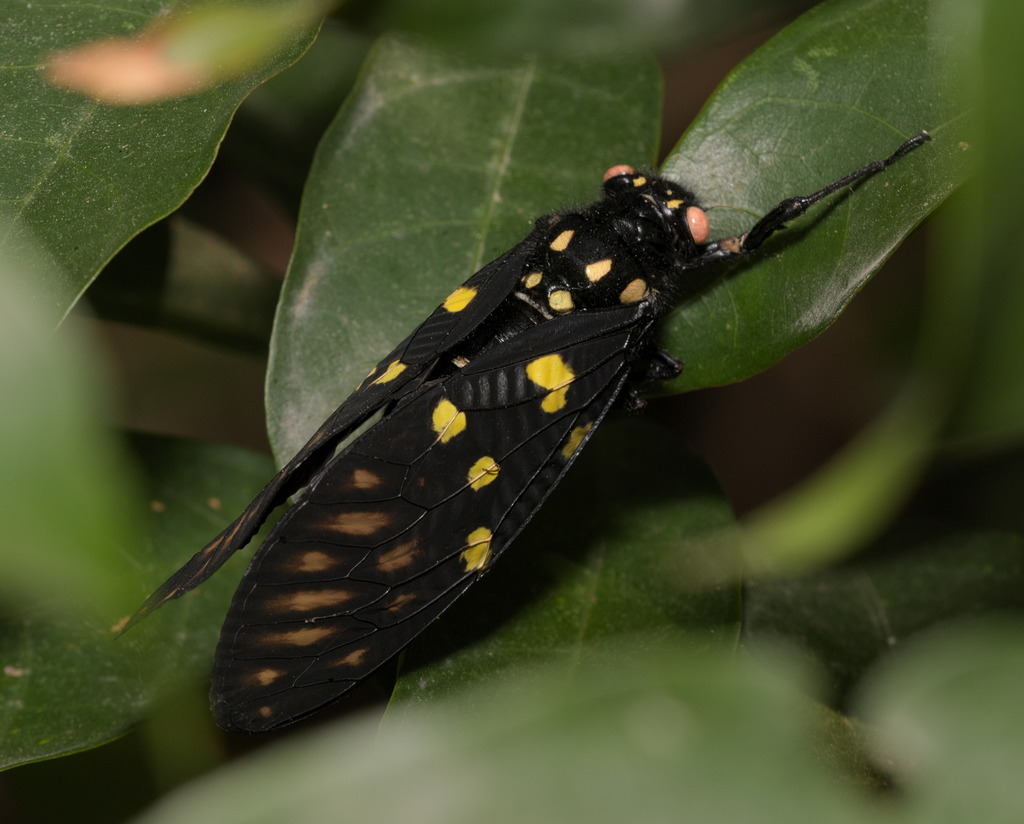
The speckled black cicada has a wingspan of about 3¾ inches (95 mm). Its upper side is black with orange spots on the head, thorax, abdomen and wings, while the underside shows similar black coloring with orange markings on the head, thorax and abdomen.
Source: Wikipedia
How to recognize it
Upper side: black head with yellow-brown eyes, two orange spots between them, black thorax with a row of orange spots, black abdomen with orange-edged rings and an orange anus; wings are black with orange streaks and spots. Underside: black head ending in a long beak, two orange spots below the eyes, orange spots on each side of the thorax, black legs and abdomen with six orange spots, wings match the upper side.
Source: Wikipedia
Size
Wingspan measures about 95 mm (3¾ inches).
Source: Wikipedia
Where it lives
Gaeana maculata is the type species of the cicada genus Gaeana.
Source: Wikipedia
Where it comes from
It was first described from China in 1773 by Dru Drury.
Source: Wikipedia
Lookalikes
Similar taxa include G. maculata barbouri, G. maculata distanti, and the nominal form G. maculata maculata.
Source: Wikipedia
More photos
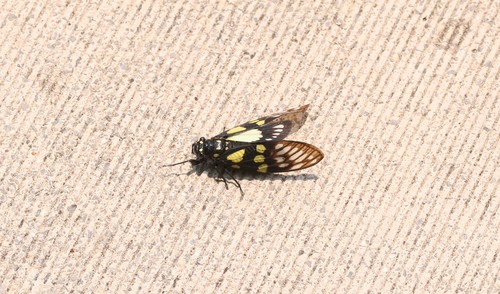
Same family (Cicadidae)
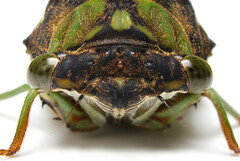
Sources
- Wikipedia: https://en.wikipedia.org/wiki/Gaeana_maculata
Look it up elsewhere: GBIF · iNaturalist · BugGuide · Wikipedia
Text written 2026-10-23 from the sources above and checked sentence by sentence against them. Data fetched 2026-10-22.