 Bug FAQ
South American Locust
Schistocerca cancellata · Order: Orthoptera · Family: Acrididae
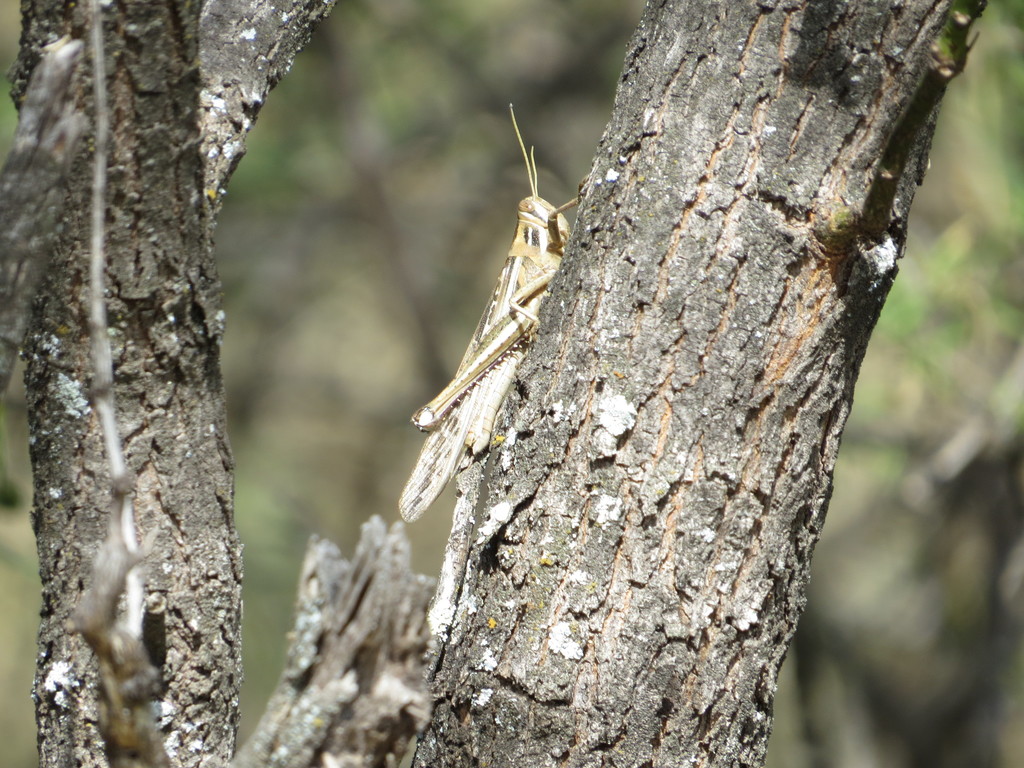
The South American locust shows phase polymorphism, with solitarious and gregarious forms that were once thought to be separate species. It lives in subtropical South America, especially in desert-like areas of northwest Argentina, southeast Bolivia and western Paraguay, and its solitary phase occurs between 18°S and 35°S.
Source: Wikipedia
How to recognize it
Solitary nymphs are green, while gregarious nymphs are yellow with a black pattern, and adults also differ morphologically between the two phases.
Source: Wikipedia
Where it lives
The solitary phase is found between 18°S and 35°S in South America. Plagues start in desert and semi-desert zones of northwest Argentina, southeast Bolivia and western Paraguay.
Source: Wikipedia
What it eats
It is polyphagous and damages many crops and forage plants.
Source: Wikipedia
Life cycle
The species shows typical locust phase polymorphism. For many years the two phases were thought to be different species, with the gregarious form once named S. paranensis.
Source: Wikipedia
Where it comes from
It is the major swarming locust species in subtropical South America.
Source: Wikipedia
More photos

Questions people ask
What do the different phases look like?
Solitary nymphs are green, while gregarious nymphs are yellow with black markings, and the adults also differ in appearance.
Source: Wikipedia
Where do South American locusts occur?
They are found in subtropical South America, especially in desert-like areas of northwest Argentina, southeast Bolivia and western Paraguay, with the solitary phase between 18°S and 35°S.
Source: Wikipedia
What species were they once confused with?
The gregarious form was long mistaken for a separate species called S. paranensis.
Source: Wikipedia
Same family (Acrididae)
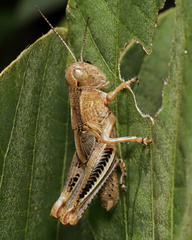 Differential GrasshopperMelanoplus differentialisDamages trees, gardens or crops
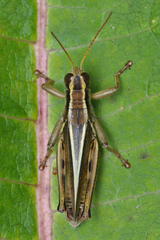 Two-striped GrasshopperMelanoplus bivittatusDamages trees, gardens or crops
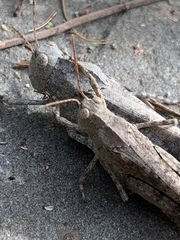 Carolina GrasshopperDissosteira carolinaDamages trees, gardens or crops
 Common Field GrasshopperChorthippus brunneus
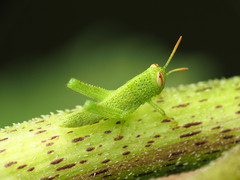 Egyptian Bird GrasshopperAnacridium aegyptium
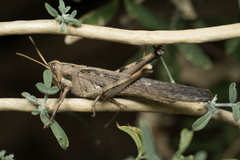 Gray Bird GrasshopperSchistocerca nitensDamages trees, gardens or crops
Sources
- Wikipedia: https://en.wikipedia.org/wiki/Schistocerca_cancellata
Look it up elsewhere: GBIF · iNaturalist · BugGuide · Wikipedia
Text written 2026-10-23 from the sources above and checked sentence by sentence against them. Data fetched 2026-10-23.