 Bug FAQ
Snowy Tree Cricket
Oecanthus fultoni · Order: Orthoptera · Family: Gryllidae
Source: Wikipedia
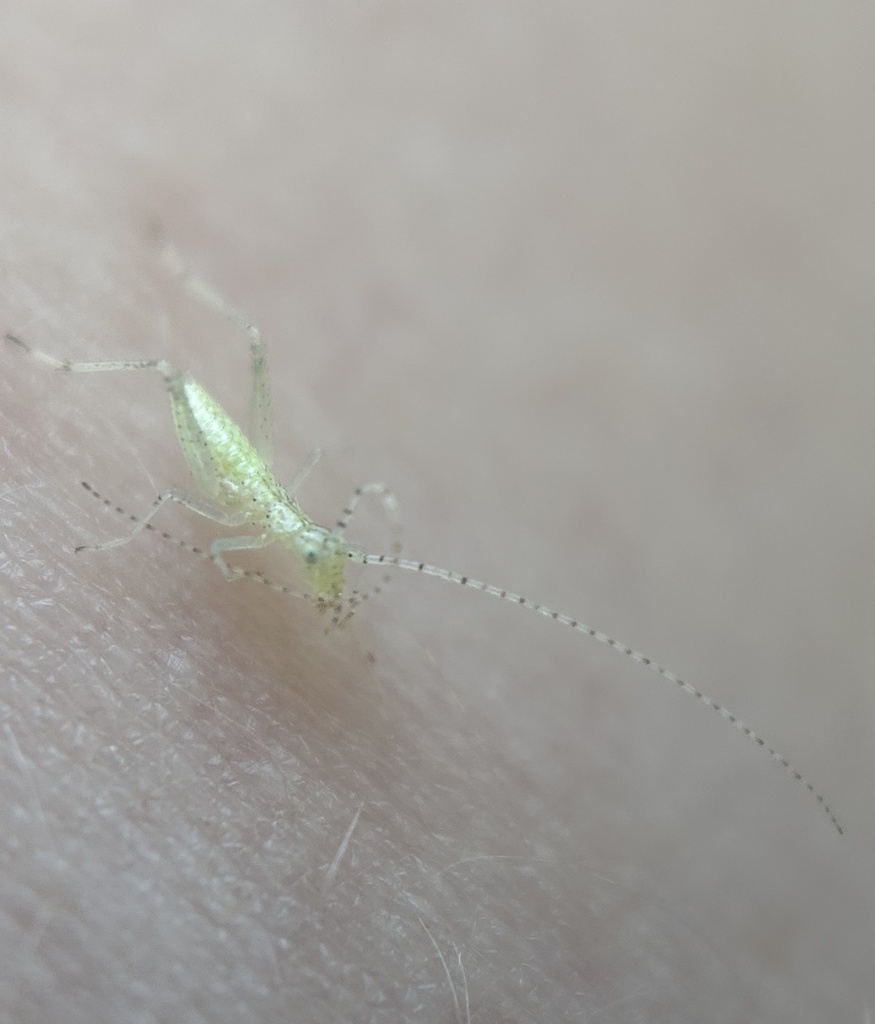
The snowy tree cricket is a light-green insect about 15 to 18 mm long with translucent wings. Adults appear from mid-July to mid-November and can chew holes in ripe fruit, causing it to rot.
Source: Wikipedia
How to recognize it
The first two antennal segments have round or oval black marks about half the segment length.
Source: Wikipedia
Is it a pest in the house?
It feeds on leaves and also damages fruit. Adults make holes in ripe fruit, which then rot.
Source: Wikipedia
Where it lives
It lives across the United States except the southeast, in shrubs, vines, fruit trees, broad-leaved trees and oaks.
Source: Wikipedia
What it eats
Both nymphs and adults feed on leaves, causing only minimal damage. It also feeds on apples, plums, peaches and cherries, damaging those fruits.
Source: Wikipedia
When you see it
Adults are present from mid-July through mid-November.
Source: Wikipedia
Where it comes from
The snowy tree cricket is native to North America.
Source: Wikipedia
Lookalikes
It was long confused with Oecanthus niveus described by Charles De Geer in 1773.
Source: Wikipedia
Where it is found in the US
Recorded in 42 of 51 states and DC. Most records: Texas, Massachusetts, New York, Ohio, California, Vermont, Arizona, Minnesota.
Darker = more records. Counts are museum and citizen-science records, not population size.
Source: GBIF
Status: native in North America; native in Canada. Source: iNaturalist
Months it is reported in the US
Source: GBIF
More photos
Questions people ask
What fruit does the snowy tree cricket damage?
It chews holes in apples, plums, peaches and cherries, causing the fruit to rot.
Source: Wikipedia
Where can I find snowy tree crickets?
They occur throughout the United States except the southeast, in shrubs, vines, fruit trees and other broad-leaved trees.
Source: Wikipedia
How can I tell a snowy tree cricket apart from similar species?
It has distinctive black marks on the first two antennal segments and is often confused with Oecanthus niveus or Oecanthus rileyi in the western range.
Source: Wikipedia
Same family (Gryllidae)


Sources
- Wikipedia: https://en.wikipedia.org/wiki/Oecanthus_fultoni
Look it up elsewhere: GBIF · iNaturalist · BugGuide · ITIS · Wikipedia
Text written 2026-10-24 from the sources above and checked sentence by sentence against them. Data fetched 2026-10-24.