 Bug FAQ
House Cricket
Acheta domesticus · Order: Orthoptera · Family: Gryllidae
Also called: Common House Cricket, European House-Cricket
Source: extension.umd.edu, pestsense.cahnrs.wsu.edu, UF/IFAS

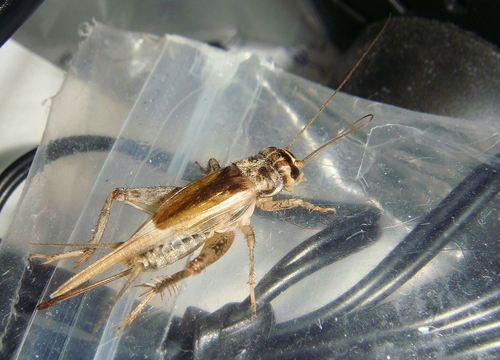
The house cricket is a gray-brown insect about 16 to 21 mm long with three dark head bands and long, slender antennae. It lives indoors where it likes warmth, can survive long periods inside, and may chew fabrics, paper, rubber and pantry items.
Source: Wikipedia, extension.umd.edu, pestsense.cahnrs.wsu.edu, UF/IFAS
How to recognize it
Adults are light yellowish-brown or straw-colored with three dark head bands; females have a needle-like ovipositor at the rear. Antennae are thin and longer than the body.
Source: extension.umd.edu, pestsense.cahnrs.wsu.edu, Wikipedia, UF/IFAS
Size
Adults range from about 19 mm to 25 mm (¾ to 1 in) in length.
Is it a pest in the house?
They are attracted to light and can survive long periods indoors. They may chew fabrics (wool, silk, nylon, cotton, linen), paper, rubber and stored pantry foods.
Source: extension.umd.edu, pestsense.cahnrs.wsu.edu, UF/IFAS
How to get rid of it
Non-chemical methods like glue boards and exclusion are first-line controls. If needed, insecticides should be used only with structural repairs and sanitation. Professional pest management can be contacted for indoor cricket problems.
Source: extension.umd.edu, pestsense.cahnrs.wsu.edu, UF/IFAS
Where it lives
They are attracted to warm indoor areas and can live in buildings year-round. Life cycle from egg to adult takes two to three months at 26 to 32 °C (79 to 90 °F).
Source: extension.umd.edu, Wikipedia
What it eats
House crickets are omnivores that eat plant material, animal matter, fruits, vegetables, grains and commercial cricket foods.
Source: Wikipedia
Life cycle
Juveniles look like smaller, wingless versions of the adults.
Source: Wikipedia
Where it comes from
The species is probably native to southwestern Asia.
Source: Wikipedia
Lookalikes
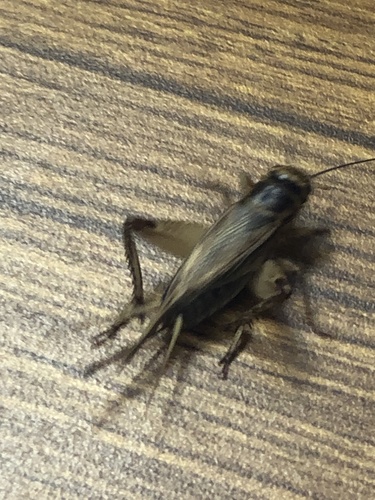
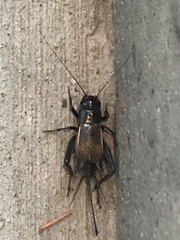
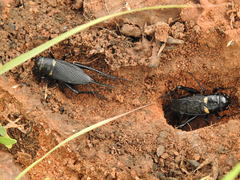
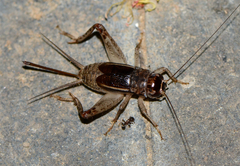
Field crickets are similar but usually black or brown and slightly larger, up to about 1 in long.
Source: extension.umd.edu, pestsense.cahnrs.wsu.edu, UF/IFAS
Where it is found in the US
Recorded in 40 of 51 states and DC. Most records: California, Texas, Illinois, Arizona, South Carolina, Alabama, Hawaii, Mississippi.
Darker = more records. Counts are museum and citizen-science records, not population size.
Source: GBIF
Status: introduced in North America; introduced in Canada; introduced in United States. Source: iNaturalist
Months it is reported in the US
Source: GBIF
More photos


Questions people ask
How can I get rid of house crickets indoors?
Place glue boards in corners, reduce indoor lighting, seal entry cracks and, if necessary, use insecticides together with repairs and sanitation.
Source: pestsense.cahnrs.wsu.edu, UF/IFAS, extension.umd.edu
What do house crickets look like?
They are ¾ to 1 in long, light yellow-brown with three dark head bands, have long slender antennae, and females have a needle-like ovipositor.
Source: extension.umd.edu, pestsense.cahnrs.wsu.edu, Wikipedia
Do house crickets damage anything in the home?
Yes, they can chew fabrics, paper, rubber and stored food items.
Source: extension.umd.edu, pestsense.cahnrs.wsu.edu, UF/IFAS
Same family (Gryllidae)


Sources
- extension.umd.edu: https://extension.umd.edu/resource/crickets
- pestsense.cahnrs.wsu.edu: https://pestsense.cahnrs.wsu.edu/fact-sheet/crickets/
- UF/IFAS: https://edis.ifas.ufl.edu/publication/IG146
- Wikipedia: https://en.wikipedia.org/wiki/House_cricket
Look it up elsewhere: GBIF · iNaturalist · BugGuide · ITIS · Wikipedia
Text written 2026-10-23 from the sources above and checked sentence by sentence against them. Data fetched 2026-10-23.