 Bug FAQ
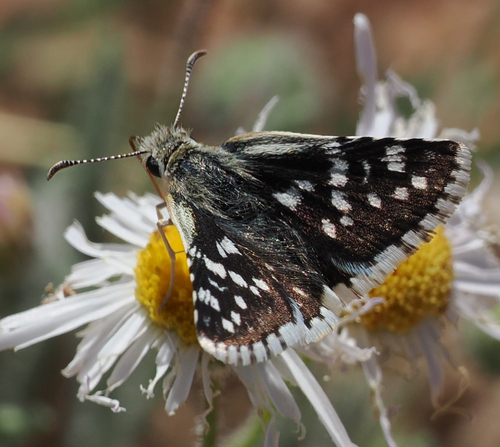
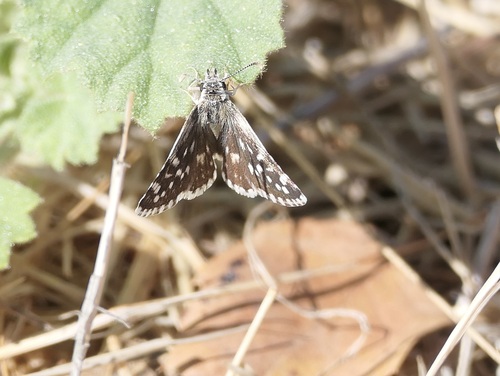
Small Checkered-Skipper
Pyrgus scriptura · Order: Lepidoptera · Family: Hesperiidae

The small checkered-skipper is a butterfly in the skipper family Hesperiidae. Adults have a wingspan of about 16 to 22 mm. It lives from Texas northward to Montana and into parts of Canada, including southeastern Alberta and southwestern Saskatchewan.
Source: Wikipedia
How to recognize it
Pyrgus scriptura, known as the small checkered-skipper, belongs to the skipper family Hesperiidae.
Source: Wikipedia
Size
The wingspan ranges from 16 to 22 mm.
Source: Wikipedia
Where it lives
It is found from Texas to Montana and into southeastern Alberta and southwestern Saskatchewan.
Source: Wikipedia
What it eats
Caterpillars feed on plants in the Malvaceae family and on Sida hederacea.
Source: Wikipedia
Life cycle
There are two generations that appear from May through August.
Source: Wikipedia
When you see it
Adults are on the wing in two broods between May and August.
Source: Wikipedia
Where it comes from
Its range includes Texas, Montana, southeastern Alberta and southwestern Saskatchewan.
Source: Wikipedia
Where it is found in the US
Recorded in 12 of 51 states and DC. Most records: California, Arizona, Colorado, New Mexico, Nevada, Utah, Texas, Montana.
Darker = more records. Counts are museum and citizen-science records, not population size.
Source: GBIF
Status: native in North America; native in Canada; native in United States. Source: iNaturalist
Months it is reported in the US
Source: GBIF
More photos


Same family (Hesperiidae)




Sources
- Wikipedia: https://en.wikipedia.org/wiki/Pyrgus_scriptura
Look it up elsewhere: GBIF · iNaturalist · BugGuide · ITIS · Wikipedia
Text written 2026-10-24 from the sources above and checked sentence by sentence against them. Data fetched 2026-10-24.