 Bug FAQ
Slender Meadow Katydid
Conocephalus fasciatus · Order: Orthoptera · Family: Tettigoniidae
Also called: Slender Meadow Grasshopper

The slender meadow katydid is a small, thin insect about 1.8 to 2.6 cm long with long narrow wings that stick out behind it. It lives year-round in grassy and weedy spots across the United States and southern Canada, such as pastures, open pine woods and roadsides. It mainly eats grasses and grass seedheads but will sometimes take small insects.
Source: Wikipedia
How to recognize it
Males have green cerci with a stout inner tooth and a slightly flattened tip.
Source: Wikipedia
Size
Adults measure roughly 18 to 26 mm in length.
Source: Wikipedia
Where it lives
Found in grassy, weedy areas like pastures, open pine woods and roadsides.
Source: Wikipedia
What it eats
Feeds mainly on grasses and grass seedheads, occasionally on small insects.
Source: Wikipedia
Where it comes from
Native to the United States and Canada.
Source: Wikipedia
Lookalikes
Its song is a soft series of alternating ticks and buzzes lasting 1 to 20 seconds.
Source: Wikipedia
Where it is found in the US
Recorded in 49 of 51 states and DC. Most records: Texas, Florida, New York, Illinois, Utah, Massachusetts, Maryland, Virginia.
Darker = more records. Counts are museum and citizen-science records, not population size.
Source: GBIF
Status: native in North America; native in Canada; native in United States. Source: iNaturalist
Months it is reported in the US
Source: GBIF
More photos
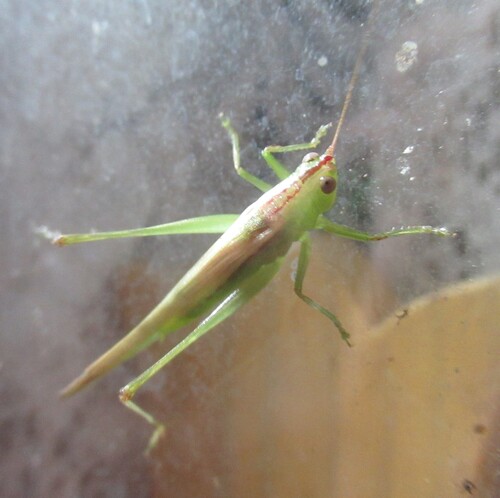
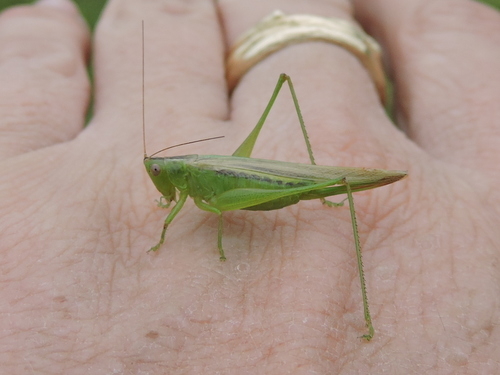
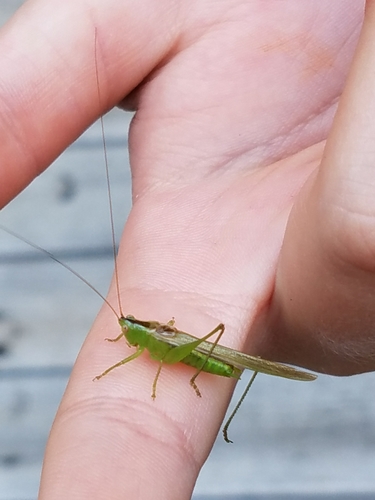
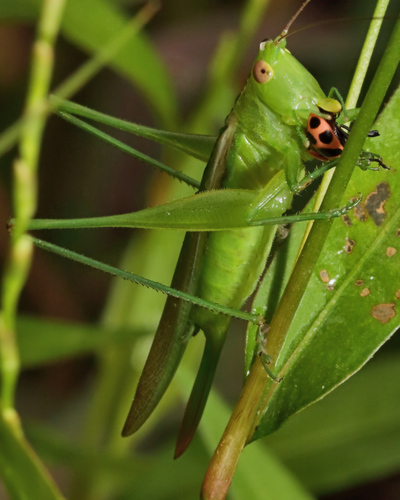
Same family (Tettigoniidae)
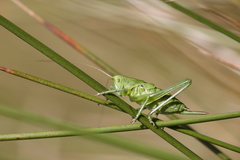 Great Green Bush-cricketTettigonia viridissimaCan bite
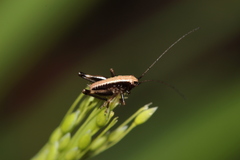 Dark Bush-cricketPholidoptera griseoaptera
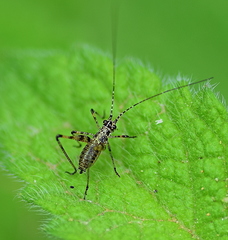 Mediterranean KatydidPhaneroptera nanaDamages trees, gardens or crops
 Fork-tailed Bush KatydidScudderia furcataDamages trees, gardens or crops
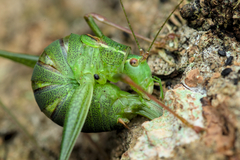 Speckled Bush-cricketLeptophyes punctatissima
 Roesel's Bush-cricketRoeseliana roeselii
Sources
- Wikipedia: https://en.wikipedia.org/wiki/Conocephalus_fasciatus
Look it up elsewhere: GBIF · iNaturalist · BugGuide · ITIS · Wikipedia
Text written 2026-10-22 from the sources above and checked sentence by sentence against them. Data fetched 2026-10-22.