 Bug FAQ
Sequoia Sphinx
Sphinx sequoiae · Order: Lepidoptera · Family: Sphingidae
Also called: Sequoia Sphinx Moth
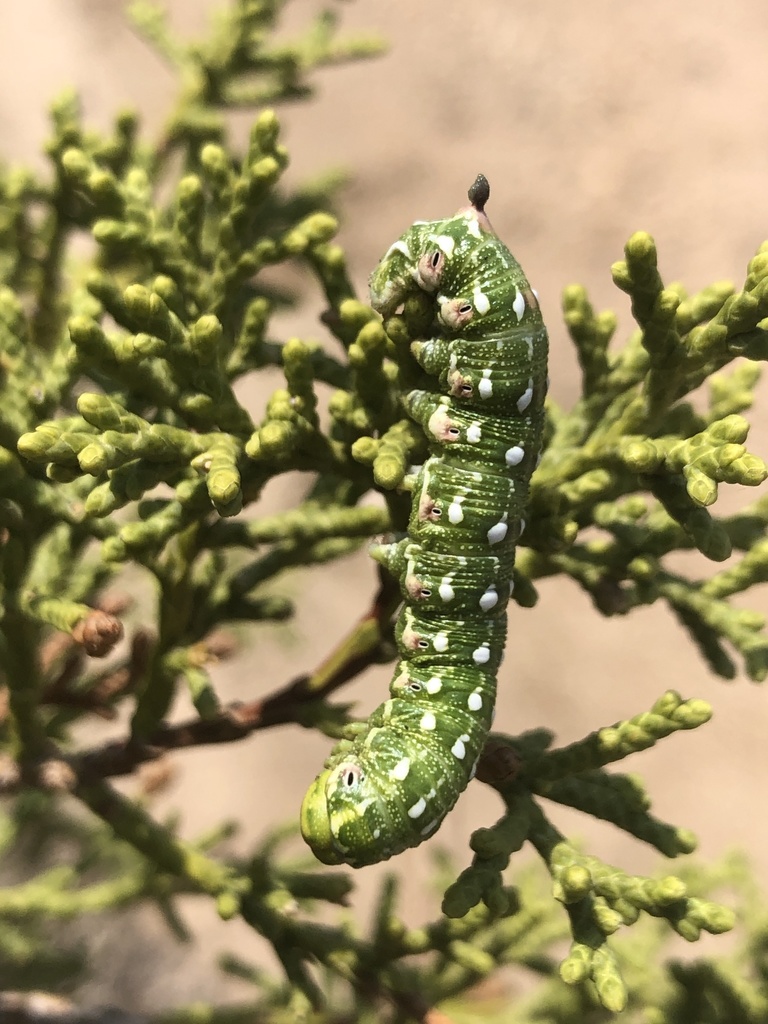
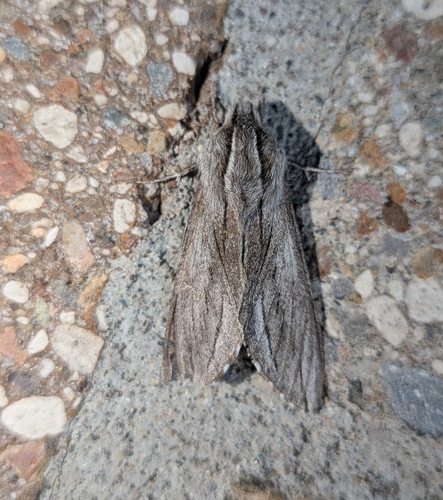
The Sequoia sphinx is a small moth with a wingspan of about 5 to 7 cm and ash-gray forewings marked by several horizontal black dashes; its hindwings and body are also ash-gray with a white-and-brown checkered fringe. It lives in juniper and cedar forests of the Pacific Northwest, especially east of the Cascade Range, and its range extends from Oregon through California, Nevada, southeastern Utah, Arizona, and into northern Baja California, Mexico. Adults appear once a year from May to August, and the green larvae have a short blunt horn with a yellow tip and distinctive spotted pattern.
Source: Wikipedia
How to recognize it
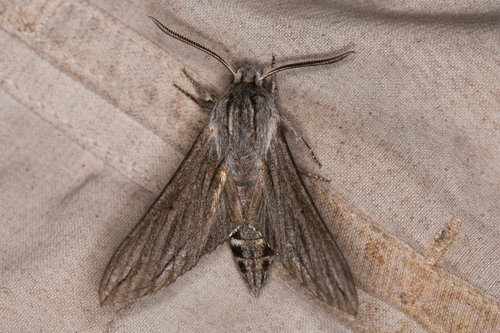
Forewings are ash-gray and pointed with several horizontal black dashes; hindwings are a uniform ash-gray. The thorax and abdomen are also gray and the moth has a white-and-brown checkered fringe.
Source: Wikipedia
Size
Wingspan ranges from 48 to 68 mm and each forewing is 24 to 26 mm long.
Source: Wikipedia
Life cycle
There is one generation of adults each year, flying between May and August.
Source: Wikipedia
When you see it
Adults are on the wing from May through August.
Source: Wikipedia
Where it comes from
Its range continues into northern Baja California, Mexico.
Source: Wikipedia
Where it is found in the US
Recorded in 6 of 51 states and DC. Most records: California, Oregon, Nevada, Utah, Maine, Arizona.
Darker = more records. Counts are museum and citizen-science records, not population size.
Source: GBIF
Status: native in North America; native in United States. Source: iNaturalist
Months it is reported in the US
Source: GBIF
More photos
Questions people ask
How can I tell this moth apart from similar species?
It is the smallest species in its genus except for Sphinx dollii, and it has ash-gray forewings with horizontal black dashes, unlike its lookalikes that occur in other regions.
Source: Wikipedia
Same family (Sphingidae)

Sources
- Wikipedia: https://en.wikipedia.org/wiki/Sphinx_sequoiae
Look it up elsewhere: GBIF · iNaturalist · BugGuide · ITIS · Wikipedia
Text written 2026-10-26 from the sources above and checked sentence by sentence against them. Data fetched 2026-10-26.