 Bug FAQ
Hummingbird Clearwing
Hemaris thysbe · Order: Lepidoptera · Family: Sphingidae
Also called: Common Clear-wing, Hummingbird Clearwing Moth, Hummingbird Moth
Source: Wikipedia
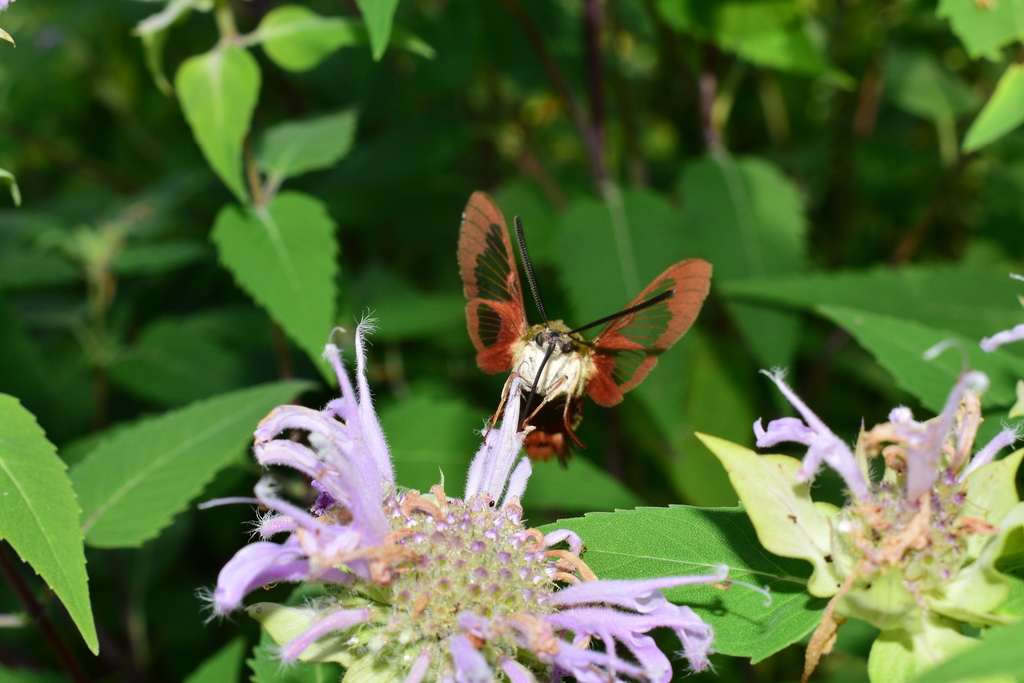
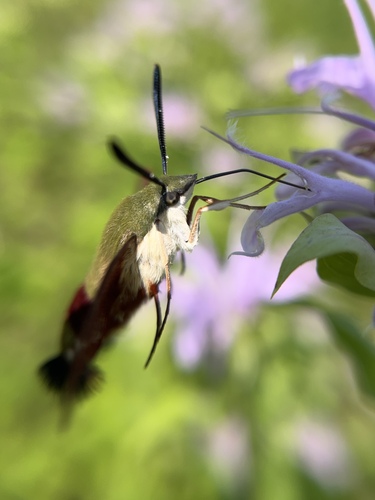
The hummingbird clearwing is a medium-sized moth with a 4 to 5.5 cm wingspan that flies fast and hovers like a hummingbird. It has transparent wings edged in reddish-brown and a green-burgundy back with a yellow-white underside. Adults are seen in gardens and meadows from early spring to fall, most active in the hottest part of the day.
Source: Wikipedia
How to recognize it
The moth’s back is olive green and burgundy, while the underside is white or yellow with burgundy markings. Its wings are clear with a reddish-brown border.
Source: Wikipedia
Size
Wingspan ranges from about 4 to 5.5 cm (1.6 to 2.2 in).
Source: Wikipedia
Where it lives
It lives in second-growth forests, meadows and cultivated suburban gardens.
Source: Wikipedia
What it eats
Caterpillars eat honeysuckle, dogbane and various fruit trees.
Source: Wikipedia
Life cycle
In the south there are two generations per year, only one in the north. It overwinters as a brown, hard-shelled pupa buried in the soil.
Source: Wikipedia
When you see it
Adults appear from March to June and again from August to October in southern areas.
Source: Wikipedia
Where it comes from
Found across much of North America, from Alaska and Oregon in the west to Newfoundland in the east, and south to Texas and Florida.
Source: Wikipedia
Lookalikes
Because of its hovering flight and coloration, it is often mistaken for a hummingbird or bumblebee.
Source: Wikipedia
Where it is found in the US
Recorded in 44 of 51 states and DC. Most records: Ohio, Pennsylvania, New York, Virginia, Maryland, North Carolina, Vermont, Illinois.
Darker = more records. Counts are museum and citizen-science records, not population size.
Source: GBIF
Status: native in North America; native in Canada; native in United States. Source: iNaturalist
Months it is reported in the US
Source: GBIF
More photos
Questions people ask
Are they a problem for my garden?
The caterpillars feed on honeysuckle, dogbane and fruit trees, so they can damage those plants.
Source: Wikipedia
Why do they look like hummingbirds?
Their rapid wing beats and hovering flight, plus their clear wings with colored borders, make them resemble hummingbirds.
Source: Wikipedia
Same family (Sphingidae)
 White-lined SphinxHyles lineataDamages trees, gardens or crops
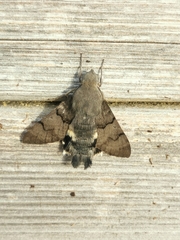 Eurasian Hummingbird HawkmothMacroglossum stellatarum
 Snowberry ClearwingHemaris diffinis
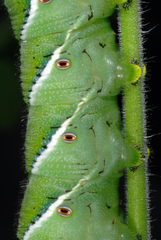 Carolina SphinxManduca sextaDamages trees, gardens or crops
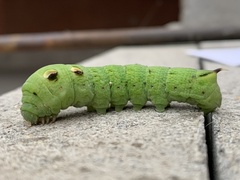 Elephant HawkmothDeilephila elpenor
 Convolvulus HawkmothAgrius convolvuliDamages trees, gardens or crops
Sources
- Wikipedia: https://en.wikipedia.org/wiki/Hemaris_thysbe
Look it up elsewhere: GBIF · iNaturalist · BugGuide · ITIS · Wikipedia
Text written 2026-10-22 from the sources above and checked sentence by sentence against them. Data fetched 2026-10-22.