 Bug FAQ
Russian Thistle Stem Miner Moth
Coleophora parthenica · Order: Lepidoptera · Family: Coleophoridae
Also called: Moth
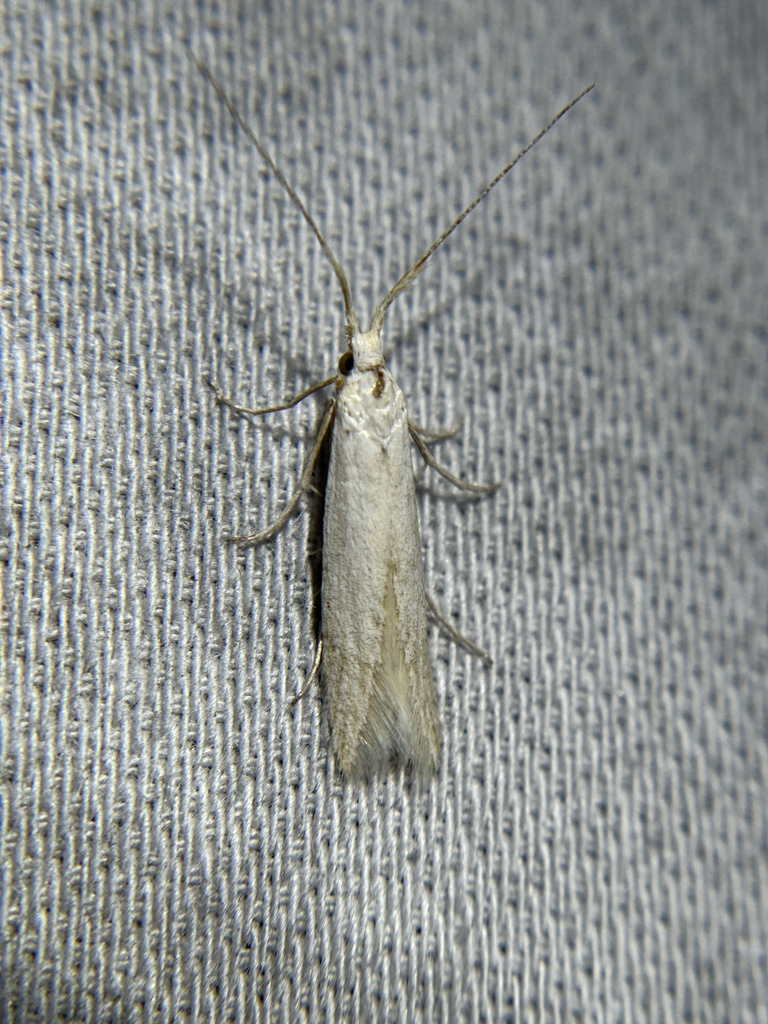
The Russian thistle stem miner moth is a small moth whose adults are creamy-white and whose full-grown larvae are about 17 mm long and orange.
Source: Wikipedia
How to recognize it
Adult moths have a creamy-white coloration.
Source: Wikipedia
Size
Full-grown larvae reach about 17 mm (0.67 in) in length and are orange.
Source: Wikipedia
How to get rid of it
It was deliberately introduced to help control invasive Salsola species.
Source: Wikipedia
What it eats
The larvae feed on plants in the genus Salsola, for example Salsola australis.
Source: Wikipedia
Life cycle
In warm regions the species can have up to three generations each year, while cooler areas support one or two generations.
Source: Wikipedia
Where it is found in the US
Recorded in 7 of 51 states and DC. Most records: California, Arizona, New Mexico, Washington, Minnesota, Texas, Utah.
Darker = more records. Counts are museum and citizen-science records, not population size.
Source: GBIF
Status: introduced in United States. Source: iNaturalist
Months it is reported in the US
Source: GBIF
Questions people ask
What plants do the larvae eat?
The larvae feed on Salsola species, such as Salsola australis.
Source: Wikipedia
How many generations does this moth produce each year?
In warm areas it can produce up to three generations per year, while cooler areas have one or two.
Source: Wikipedia
Why was this moth introduced to the United States?
It was released as a biological control agent against invasive Salsola plants.
Source: Wikipedia
Same family (Coleophoridae)



Sources
- Wikipedia: https://en.wikipedia.org/wiki/Coleophora_parthenica
Look it up elsewhere: GBIF · iNaturalist · BugGuide · Wikipedia
Text written 2026-10-29 from the sources above and checked sentence by sentence against them. Data fetched 2026-10-29.