 Bug FAQ
Large Clover Casebearer Moth
Coleophora trifolii · Order: Lepidoptera · Family: Coleophoridae
Also called: Large Clover Case-Bearer, Large Green Case-bearer, Large clover casebearer
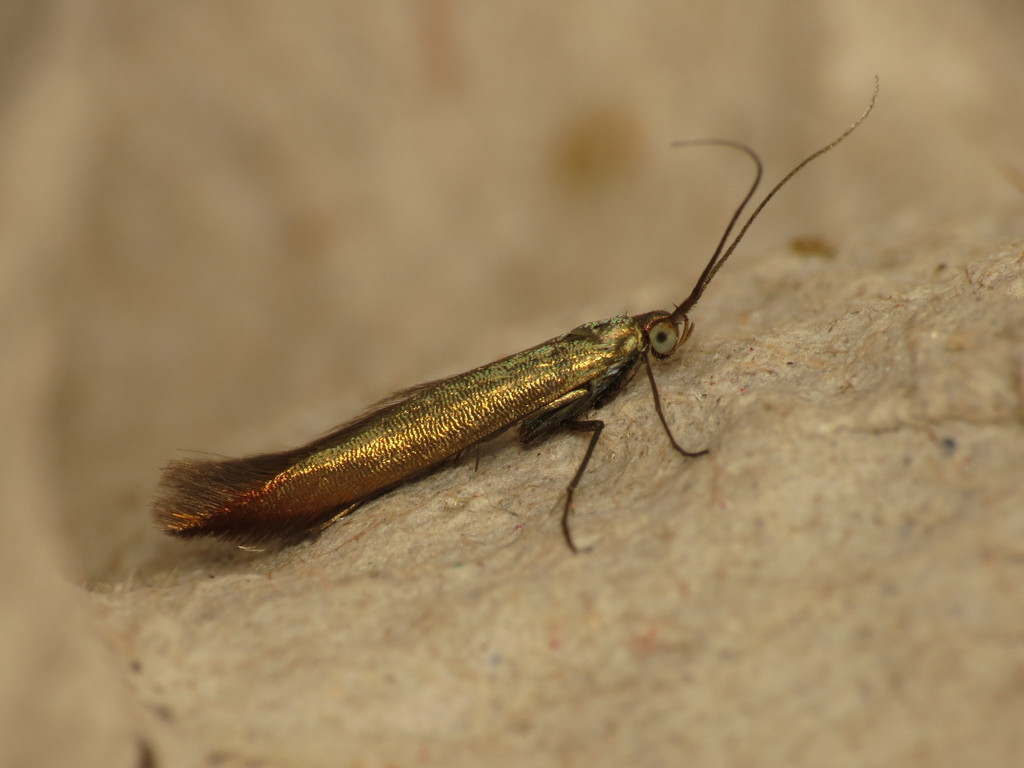
The Large Clover Casebearer Moth is a small bronze-green moth with a wingspan of 15 to 20 mm and pale yellow eye fringe. Adults are on the wing in June and July, flying by day, and can only be reliably distinguished from similar species by microscopic genitalia examination.
Source: Wikipedia
How to recognize it
It shows a metallic bronze-green hue with pale yellow scales bordering its eyes.
Source: Wikipedia
Size
The wingspan measures roughly 15 to 20 mm.
Source: Wikipedia
Where it lives
It is found across Europe, North Africa, parts of Asia Minor, Afghanistan and also in North America.
Source: Wikipedia
What it eats
Larvae feed on the seeds of Melilotus species such as M. albus, M. officinalis and M. altissima from July to September.
Source: Wikipedia
Life cycle
Adults fly during June and July and are active during daylight hours.
Source: Wikipedia
When you see it
Adults are on wing from June through July and are day-time fliers.
Source: Wikipedia
Where it comes from
In its native range it occurs in Europe and North Africa and extends into North America.
Source: Wikipedia
Lookalikes
It may be mistaken for other Coleophora moths, but definitive ID requires microscopic examination of the genitalia.
Source: Wikipedia
Where it is found in the US
Recorded in 27 of 51 states and DC. Most records: Montana, Michigan, New York, Ohio, Minnesota, Illinois, Massachusetts, Alaska.
Darker = more records. Counts are museum and citizen-science records, not population size.
Source: GBIF
Status: introduced in United States; introduced in Canada. Source: iNaturalist
Months it is reported in the US
Source: GBIF
More photos

Questions people ask
When are the adults active?
Adults are seen flying in June and July and are active in the daytime.
Source: Wikipedia
Same family (Coleophoridae)


Sources
- Wikipedia: https://en.wikipedia.org/wiki/Coleophora_trifolii
Look it up elsewhere: GBIF · iNaturalist · BugGuide · Wikipedia
Text written 2026-10-27 from the sources above and checked sentence by sentence against them. Data fetched 2026-10-27.